Longines HydroConquest vs. Tissot Seastar 1000: Is the Price Jump Justified?
This is a classic 'Big Brother vs. Little Brother' matchup within the Swatch Group hierarchy. Comparing the Longines HydroConquest (Ref: L3.782.4.96.6) to…
This is a classic “Big Brother vs. Little Brother” matchup within the Swatch Group hierarchy. Comparing the Longines HydroConquest (Ref: L3.782.4.96.6) to the Tissot Seastar 1000 (Ref: T120.407.11.041.03) is a study in diminishing returns: is the Longines twice as good as the Tissot, given that it costs nearly double?
In the world of Swiss dive watches, $1,000 is a significant psychological barrier. Below it, you find incredible value; above it, you enter the realm of entry-level luxury. The Tissot Seastar 1000 (Ref. T120.407.11.041.03) is arguably the benchmark for a Swiss diver under a grand. However, for a few hundred dollars more, the Longines HydroConquest (Ref. L3.782.4.96.6) beckons with more prestige and a slimmer profile.
Both watches are siblings under the Swatch Group umbrella, meaning they share corporate resources but target different audiences. One is built for the value-conscious enthusiast; the other for the budding luxury collector.
In this comprehensive comparison, we analyze whether the HydroConquest earns its premium or if the Seastar 1000 is all the diver you’ll ever need.
*By clicking on the product links in this article, we may receive a commission fee at no cost to you. Thank you for your support.
Longines HydroConquest vs Tissot Seastar 1000 Comparison
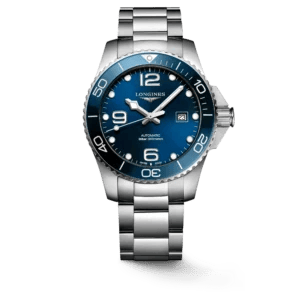
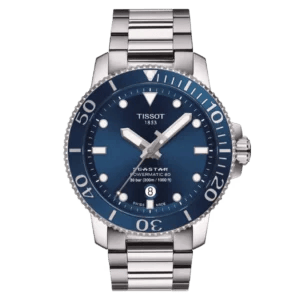
| Feature | Tissot Seastar 1000 (T120.407.11.041.03) | Longines HydroConquest (L3.782.4.96.6) |
|---|---|---|
| Movement | Powermatic 80.111 | Longines L888.5 |
| Power Reserve | 80 Hours | 72 Hours |
| Water Resistance | 300 m | 300 m |
| Bezel | Ceramic (Polished) | Ceramic (Polished) |
| Case Width | 43 mm | 43 mm |
| Lug-to-Lug Distance | 49.6 mm | 52 mm |
| Case Thickness | 12.7 mm | 11.9 mm |
| Balance Spring | Nivachron (Anti-magnetic) | Silicon (Anti-magnetic/Temp-resistant) |
| Price | $795 - $825 | $1,775 |
Quick Verdict: Which One Should You Buy?
Choose the Tissot Seastar 1000 if: You want the best technical “spec-per-dollar” ratio. It offers a 300m depth rating, a ceramic bezel, and a massive 80-hour power reserve for under $850. The exhibition case back makes it a joy for those who want to see the automatic movement at work, and its shorter lug-to-lug makes it wear more compactly than the Longines.
Choose the Longines HydroConquest if: You are looking for a “forever watch.” The HydroConquest is significantly thinner (11.9mm), making it far more versatile for formal occasions. With a more advanced movement featuring a Silicon balance spring and a brand name that carries significant weight in the horological world, it is a true entry-luxury piece that feels more refined on the wrist.
Dial Aesthetics: “Sunray” Luxury vs. “Gradient” Sport
While both watches sport beautiful blue dials, the finishing techniques define their personalities.
The Tissot Seastar’s “Deep Sea” Vibe
Tissot uses a fumé (gradient) dial that transitions from a bright royal blue in the center to an almost black perimeter. This mimics the way light fades as you dive deeper into the ocean. It features circular and rectangular indices that are generously filled with Super-LumiNova. The T-shaped counterweight on the second hand is a nice branding touch, but the overall look is “chunky” and aggressive.
The Longines HydroConquest’s “High-End” Glow
Longines opts for a sunray blue finish. Instead of a color gradient, the dial features fine lines radiating from the center that catch the light, shifting the blue from navy to electric blue as you move your wrist. The hallmark of the HydroConquest is its oversized Arabic numerals at 12, 6, and 9. It also features a unique “snowflake-style” diamond hour hand, which gives it a more distinctive, recognizable silhouette in a sea of dive watches.
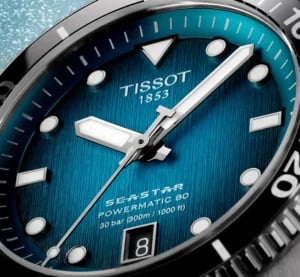
Bezel and Tactile Quality: Where the Money Goes
Both watches feature Ceramic bezel inserts, which is a massive upgrade over the aluminum bezels of the past. They won’t scratch, and they won’t fade.
- The Grip: The Tissot Seastar has a very pronounced, “toothed” bezel edge. It is incredibly easy to grip, even with diving gloves.
- The Finish: The Longines bezel is more refined. The transition between the ceramic insert and the steel edge is seamless. While the Tissot feels like a piece of equipment, the Longines feels like a piece of jewelry. The “click” of the Longines bezel is often described as tighter and more metallic, whereas the Tissot has a slightly softer, dampened sound.
Case Ergonomics: The Battle of the Millimeters
On paper, both are 43mm divers. In reality, they wear very differently.
- The Thickness Factor: The Tissot Seastar is 12.7mm thick. This isn’t “fat” for a diver, but it is noticeable. The Longines HydroConquest, however, manages a remarkable 11.9mm thickness. This sub-12mm profile is the “Goldilocks” zone for luxury divers, allowing it to slide effortlessly under a dress shirt cuff.
- The Lug Distance: Tissot’s lugs are short (49.6mm), making the watch feel “round” on the wrist. Longines has longer, sweeping lugs (52mm) that give the watch a more elongated, elegant profile.
Expert Note: If you have a flat, wide wrist, the Longines will look magnificent. If you have a rounder, smaller wrist, the Tissot’s shorter footprint might actually be more comfortable.
Movement
Both watches are powered by movements based on the ETA 2824 architecture, but they have been heavily modified for their respective brands.
- Tissot Powermatic 80: This movement is a marvel of efficiency. By reducing the beat rate to 21,600 vph, Tissot provides an 80-hour power reserve. It uses a Nivachron hairspring, which is a titanium-based alloy that is excellent at resisting magnetic fields.
- Longines L888.5: This is a higher-tier caliber. It beats at a unique 25,200 vph, which offers a smoother “sweep” of the second hand than the Tissot. Crucially, it features a Silicon balance spring. Silicon is not only anti-magnetic but is also impervious to temperature fluctuations and requires no lubrication, making the Longines te
Bracelet and Clasp: The Weak Point?
In the sub-$2,000 category, bracelets are often where brands cut corners.
- Tissot: The Seastar comes on a solid oyster-style bracelet with polished center links. It’s flashy and comfortable, though the clasp is a standard pressed-steel fold-over. It does, however, include a diver’s extension.
- Longines: The HydroConquest bracelet is significantly more substantial. The tolerances between the links are tighter, resulting in less “rattle.” However, Longines uses a double-security folding clasp that is notoriously stiff to open. While it feels incredibly secure, it lacks the “on-the-fly” micro-adjustments found on some modern competitors.
Brand Heritage: The “Longines” Effect
We cannot ignore the name on the dial. Longines is one of the most storied names in Swiss watchmaking, with a history of aviation and sports timing that rivals Omega and Rolex. Owning a Longines carries a level of social “prestige” that Tissot—marketed as a high-volume value leader—doesn’t quite reach.
If you are attending a board meeting or a wedding, the Longines HydroConquest is a “flex” that signals you’ve graduated to luxury Swiss watches. The Tissot is the “smart” choice for the enthusiast, but the Longines is the “emotional” choice for the collector.
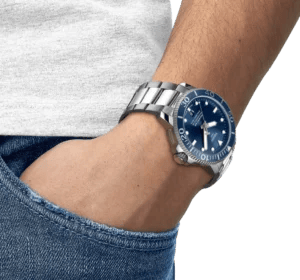
Verdict: Longines HydroConquest vs Tissot Seastar 1000
Based on our honest opinion, you can weigh the two options this way:
Choose the Tissot Seastar 1000 if:
- If you have a bigger wrist. The 43 mm case width is already on the larger side of the scale, but due to the case design, the Tissot will look like a big beautiful dial on top of your wrist, as the case itself becomes somewhat secondary visually.
- If you want the ultimate “daily driver.” It’s rugged, and has a see-through case back.
- If budget is the only factor: the Tissot leaves an extra $900 in your pocket for your next watch.
Choose the Longines HydroConquest if:
- Brand power and heritage are important factors. Longines has high-end, entry-level luxury timepieces, and having a timepiece from a brand like that could be a factor.
- If you have a smaller wrist, or thinner arm. There are smaller versions of the Longines, while the Tissot Seastar is available in only the 43 mm case width.
Longines HydroConquest
Specs:
- Movement: Automatic
- Caliber: L888
- Power Reserve: 72 hours
- Case Width: 43 mm
- Lug Distance: 21 mm
- Water Resistance: 300 m
- Retail Price: $1,775
Tissot Seastar 1000
Specs:
- Movement: Automatic
- Caliber: Powermatic 80.111
- Power Reserve: 80 hours
- Case Width: 43 mm
- Lug Distance: 21 mm
- Water Resistance: 300 m
- Retail Price: Around $750