Hamilton Khaki Navy Scuba vs. Mido Ocean Star 200: Which to Buy?
Compare the 43mm Hamilton Khaki Navy Scuba and 42.5mm Mido Ocean Star 200 on calendar, fit, bezel, and value. Which blue-dial diver suits you?
At similar prices, the Hamilton Khaki Navy Scuba is our pick if you want a ceramic bezel and have no use for a calendar. Choose the Mido Ocean Star 200 if its day-date display and lower case profile matter more to you. Neither has a power-reserve advantage, so this decision is more about how you use a watch than how long it runs.
The Hamilton gives you an uninterrupted dial and a higher water-resistance rating. The Mido gives you the day and date at a glance, in a case that is slightly narrower and thinner. That makes it a genuinely different proposition, not simply a step up or down from the Hamilton.
We are comparing the blue steel-bracelet Hamilton H82505140, at 43mm, with the earlier Mido M026.430.11.041.00, at 42.5mm. Smaller Khaki Navy Scuba models, the newer 41mm Ocean Star 200, and the ceramic-bezel Ocean Star 200C have different specifications.
Product links may earn us a commission at no extra cost to you.
Hamilton Khaki Navy Scuba vs Mido Ocean Star 200 Comparison
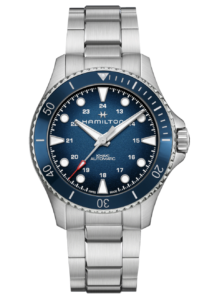
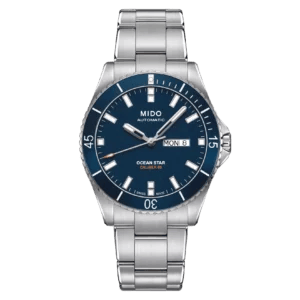
| Feature | Hamilton Khaki Navy Scuba | Mido Ocean Star 200 |
|---|---|---|
| Case diameter | 43 mm | 42.5 mm |
| Case thickness | 12.58 mm | 11.8 mm |
| Movement | H-10 automatic | Caliber 80 automatic |
| Power reserve | Up to 80 hours | Up to 80 hours |
| Calendar | None | Day and date |
| Water resistance | 300 m | 200 m |
| Bezel insert | Ceramic | Aluminum |
| Crystal | Sapphire | Sapphire |
| Main appeal | No-date dial and ceramic bezel | Lower profile and day-date utility |
The Quick Verdict: Which Should You Choose?
Choose the Hamilton if you prefer a sporty, symmetrical dial and do not want a calendar window. Its ceramic bezel makes the stronger case at a similar price, provided the larger case feels right on your wrist.
Choose the Mido if this will be your everyday watch and you regularly check the day or date. Its lower profile is another reason to try it first if you often wear close-fitting shirt cuffs. You do not need to regard the aluminum bezel as a dealbreaker to make a sensible purchase.
If you rotate watches, the Hamilton has a small convenience advantage: after it stops, there is no displayed calendar to reset. If you wear the same watch most days, the Mido’s extra information may be more useful than that simplicity.
The Dial: No Date Does Not Mean Less Character
The Hamilton’s dial has no calendar opening, but it is not minimalist. Large round and triangular markers sit outside an inner 13-to-24 scale, while the blue darkens toward the edge. That combination gives it a busy, purposeful look despite its symmetry.
The inner scale is a reference for reading 24-hour time, not a second time zone. It adds a recognizable Khaki detail without adding another hand or a GMT function.
Mido takes a different approach. Rectangular markers and a more even blue dial make the Ocean Star look restrained beside the Hamilton. The day-date window at three o’clock interrupts the pattern, but provides information you can use throughout the week.
For someone who checks a phone for the date anyway, we would favor the Hamilton’s uninterrupted layout. For someone who wants their watch to answer both questions in one glance, the Mido makes the better argument. This is the difference you will notice far more often than the depth rating.
Bezel: Hamilton Has the Material Advantage
The Hamilton’s ceramic insert is generally more resistant to surface scratching than the older Mido’s aluminum insert. If bezel marks tend to bother you, that is a worthwhile reason to choose the Scuba.
Ceramic is not impact-proof, though. A hard knock can still cause damage, and choosing it does not make the entire watch more resistant to every kind of wear. The Mido’s aluminum insert is a tradeoff, not evidence that it is unsuitable for daily use.
Their markings also create different visual rhythms. Hamilton uses a familiar sequence of ten-minute numerals; Mido emphasizes 15, 30, and 45. We would choose based on material and appearance rather than assuming either layout makes one watch categorically more capable.
If you prefer the Mido but want ceramic, consider the Ocean Star 200C before deciding. It changes this part of the comparison.
Case and Bracelet: Is the Mido Easier to Wear?
The Mido is about 0.8mm thinner than the Hamilton. That gives it a lower profile and may help it clear a shirt cuff, but it is still a large watch. A 42.5mm diameter is only half a millimeter smaller than 43mm; neither number guarantees comfort.
For this pair, we would try the Mido first for desk-and-office use, and the Hamilton first if a more substantial sports-watch appearance is part of the appeal. Those are starting points, not wrist-size rules.
With both watches, check how the lugs and first bracelet links sit when your hand is resting naturally. Then bend your wrist and see whether the crown or clasp presses uncomfortably. A watch that looks well proportioned in a photograph can still feel wrong after a few minutes at a keyboard.
Hamilton supplies a steel bracelet with a folding clasp. On either watch, ask the seller to demonstrate the available sizing and clasp adjustments. A diver extension is not the same as fine everyday adjustment, so do not buy the older Mido on the assumption that every Ocean Star has the same clasp features.
For a used example, make sure the spare links you need are included. A comfortable fit is more useful than a theoretical advantage in bracelet specifications.
Movement: A Tie on Reserve, a Choice on Convenience
Both movements offer up to 80 hours of reserve when fully wound. Either can cover a typical Friday-evening-to-Monday-morning break, which is useful when switching to another watch for the weekend.
That does not mean a briefly worn watch always starts with the full reserve. Nor does the shared figure establish that the two movements are identical or that one will keep better time. For an older example, its condition and service history matter more than an assumed winner based on the caliber name.
Hamilton specifies a Nivachron balance spring for the 43mm Scuba, intended to reduce the effects of magnetism. That is a useful feature, but not a reason to treat the watch as immune to magnetic fields or to expect guaranteed accuracy.
The more practical choice remains the calendar. Mido’s day-date is useful while the watch is running, but adds settings to check when it has stopped. The Hamilton suits a rotation where you want to set the time and move on.
Water Resistance: How Much Does the Extra 100m Matter?
The Hamilton is rated to 300m and the Mido to 200m. Hamilton therefore has the higher stated rating, but that alone does not make it the automatic winner for ordinary swimming or daily wear.
For an older or pre-owned watch, the condition of the seals matters. Follow the manufacturer’s care instructions and have water resistance checked before relying on it in the water. We would not trade away a comfortable fit or a preferred dial solely for the difference between these two ratings.
Price and Value: Does Mido Offer Enough?
The Hamilton H82505140 lists at $1,225 in the US as of September 25, 2026. For the earlier Mido, compare offers for M026.430.11.041.00 specifically, including condition, warranty provider, and returns.
At similar prices, we lean toward the Hamilton if the calendar is unimportant. The ceramic bezel is a useful material advantage, and you keep the same advertised reserve. There is no need to pay more for the Mido simply because you assume it has a better movement.
The Mido can still justify an equal or higher price if its fit and day-date display suit you better. Those are everyday benefits. Buying the Hamilton for its specifications and then wishing it had a date would miss the point of the comparison.
A substantially cheaper Mido changes the equation again. If you like its dial and can accept the aluminum insert, it offers a persuasive alternative without giving up reserve. Compare the actual watches being sold, rather than one brand’s retail price against the other’s best used offer.
For a third option with a date display, read our Hamilton Khaki Navy Scuba vs. Tissot Seastar 1000 comparison.
Smaller Sizes and Ceramic Mido Alternatives
The Ocean Star 200C M042.430.11.041.00 combines a ceramic bezel with a day-date display. Its 42.5mm case is 12.3mm thick, so it gives up some of the older Mido’s profile advantage. Against the Hamilton, it turns the decision more squarely toward dial layout and fit.
The newer 41mm Ocean Star 200 M026.930.11.041.00 is a more relevant alternative if both watches here feel too broad. It measures 11.7mm thick and retains the day-date display and 80-hour reserve. It is a separate reference, not a different size specification for the watch in our table.
Be careful when shopping for a smaller Hamilton, too. The older 40mm H82345141 has a 100m rating and a date display, and Hamilton lists it as a past-collection model. Do not assume a smaller Khaki Navy Scuba is simply the 43mm watch scaled down.
Final Thoughts
The Hamilton is our choice for the buyer who wants a no-date diver with a ceramic bezel. The Mido is our choice for the buyer who will use the calendar and prefers a lower case profile.
The Mido does offer enough to choose it over the Hamilton, but its strongest argument is everyday usefulness, not an assumed movement or bracelet upgrade. Equally, the Hamilton does not need a day-date display to be the better watch for someone who values a symmetrical dial.
Try both, compare the actual prices, and decide which compromise you would notice less: an aluminum bezel or no calendar. For this pairing, that is more revealing than trying to rank the brands.
For a higher-budget alternative, our Longines HydroConquest vs. Mido Ocean Star 200 comparison examines what spending more buys.
Frequently Asked Questions
Does the Hamilton Khaki Navy Scuba have a date?
The 43mm H82505140 compared here does not. Other Khaki Navy Scuba references do, including the older 40mm H82345141, so check the full reference number.
Which is better for smaller wrists?
The older Mido is slightly narrower and thinner, but it is still 42.5mm across. Neither watch is a guaranteed small-wrist fit. Try them on or consider a smaller reference rather than relying on diameter alone.
Does the Mido have a better movement?
It offers day and date displays, while this Hamilton shows only the time. Both advertise up to 80 hours of reserve. Those differences do not establish an accuracy winner or justify choosing one purely by brand.
Which has a ceramic bezel?
The Hamilton H82505140 has a ceramic insert. The older Mido M026.430.11.041.00 has aluminum; the Ocean Star 200C is the ceramic alternative.