Oris Watches Review: The Seven Collections And My Picks
Oris gives me two very different reasons to pay attention: an Aquis that takes its dive-watch job seriously, and a bright green Kermit that puts a smile in the date window. Between them sits a surprisingly broad collection of mechanical watches, from a compact vintage-style Star to elaborate hand-wound models.
My first recommendations would be the Big Crown Pointer Date for character, the Aquis Date 41.5mm for a modern diver, and the Divers Date 39mm for a softer, vintage-inspired alternative. I would consider Calibre 400 if its five-day reserve would make a real difference to how I use the watch. It is a worthwhile choice to understand, rather than an automatic upgrade everyone needs.
This review covers all seven families in Oris’s current U.S. catalog: Aquis, Divers, Big Crown, ProPilot, ProPilot X, Artelier, and Heritage. Related sizes, movements, and special editions are grouped into galleries. My recommendations are based on official specifications and photographs, not a hands-on test of these watches. I have linked my existing Aquis comparisons where they can help with the next decision.
Prices and availability were checked on November 25, 2026. Prices are official U.S. list prices in USD, before any applicable checkout tax. Each card describes its featured reference only; gallery alternatives can have different movements, dimensions, prices, and availability. Purchase links go directly to Oris. “Notify me” means the reference was listed in the current catalog but unavailable to order from the U.S. online store when checked.
Jump to my verdict, movements, Aquis, Big Crown, Divers, ProPilot, ProPilot X, Artelier, Heritage, or buying advice.
Oris At A Glance
| What I Would Want To Know | The Short Answer |
|---|---|
| Home | Hölstein, Switzerland; founded in 1904 |
| Ownership | Independent; a management buyout restored independence in 1982 |
| Current focus | Mechanical watches, including automatic and hand-wound models |
| My everyday starting point | Big Crown Pointer Date 40mm, $2,400 on a bracelet |
| My modern dive-watch pick | Aquis Date 41.5mm, $2,800 on a bracelet |
| My compact retro pick | Oris Star Edition, 35mm and $2,300 |
| Main movement decision | Standard automatics versus the five-day Calibre 400 family or ten-day hand-wound calibers |
| Main caution | Similar names can hide different generations, movements, and water-resistance ratings |
My Verdict: Are Oris Watches Worth Buying?
Yes, particularly if you want a mechanical Swiss watch with a recognizable design and room to choose your own level of technical ambition. The Big Crown’s pointer date, the Aquis’s substantial case and bracelet, and the ProPilot X’s angular titanium construction give me specific reasons to consider Oris beyond the name on the dial.
I think the strongest starting point is around $2,200–$2,800, where the Artelier Date, Big Crown, ProPilot Date, Aquis Date, and Divers Date offer quite different personalities. Spending more can buy a longer-running movement, an unusual complication, titanium, or a special dial. I would decide which of those I actually wanted before moving up the range.
There are compromises. A five-day movement adds a meaningful premium, some specialist watches are very large, and the lighter water-resistance ratings on the Artelier and Big Crown deserve attention. Nor would I assume that a high list price guarantees the bracelet fit, finishing, or legibility I prefer. Those are things I would still check in person.
A Brief History: Hölstein, Big Crowns, And Independence
Oris was founded in 1904 by Paul Cattin and Georges Christian in Hölstein. The official history dates the original Big Crown pilot’s watch to 1938, already combining an oversized crown with a pointer-style calendar. That makes the modern Pointer Date a continuation of a longstanding idea, even though today’s cases and movements are different.
The independence story needs a little context. Oris became part of the ASUAG group in 1970, then regained independence through a 1982 management buyout led by Rolf Portmann and Ulrich W. Herzog. The company subsequently committed to mechanical watches. I would describe Oris as independent today, rather than suggest its ownership never changed.
More recently, the hand-wound Calibre 110 arrived in 2014, followed by the automatic Calibre 400 in 2020. Those developments explain why the current catalog contains both relatively straightforward automatics and much more ambitious movement projects. The playful collaborations are another part of its present identity; they sit alongside, rather than replace, the traditional designs.
Oris Movements: When I Would Pay For Calibre 400
The movement name matters more than a broad claim that an Oris is “in-house.” The current range mixes standard automatic calibers with movements Oris designed and developed itself. I would check the exact reference: even 733 and 733-1 do not have the same quoted reserve in the examples below.
| Movement Choice | What It Adds | My Buying View |
|---|---|---|
| 733-1 / 754-1 automatics | 41-hour reserve in the featured Date and Pointer Date models | My starting point when design and price matter most |
| Calibre 400 / 401 / 403 | Five-day reserve; different date and seconds layouts; extended warranty with registration | Worth considering for a watch rotated with others |
| Calibre 473 | Hand winding, five-day reserve, pointer date, and a reserve display on the back | For someone who enjoys winding a watch themselves |
| Calibre 111 / 113 / 115 | Hand winding and ten-day reserve; date, business calendar, or skeletonized construction depending on caliber | A specialist purchase, with larger cases and higher prices |
Calibre 400 uses two barrels for its 120-hour reserve. Oris also specifies increased resistance to magnetism and a −3/+5 seconds per day accuracy target. Those are manufacturer claims, not measurements I have made, and I would not describe that target as proof of COSC certification.
For me, the practical benefit is being able to put a fully wound watch aside for several days and return to it before it stops. That matters more if I rotate watches than if I wear the same one every day. The Calibre 403 adds small seconds and a pointer date; the 473 brings hand winding and a rear reserve indicator. They are related choices, but not interchangeable features.
The price step is substantial. The featured standard Aquis is $2,800, while the current blue Calibre 400 Aquis on a bracelet is $4,300 and has a larger 43.5mm case. I would evaluate the whole watch, including size, rather than treat that as a movement-only surcharge between otherwise identical references.
Aquis: My Starting Point For A Modern Oris Diver
The Aquis Date 41.5mm would be my first stop for someone who wants a contemporary dive watch. The blue dial, ceramic timing bezel, and broad bracelet create a coherent design, and the 300m rating gives it a different emphasis from the dressier Oris families. At $2,800, the standard automatic is where I would start before deciding whether a five-day movement is worth more to me.
The main Date range includes 36.5mm, 41.5mm, and 43.5mm cases. The gallery shows blue and green 41.5mm watches, a pink Taste of Summer and an Upcycle in 36.5mm, the raised-scale Date Relief, and two 43.5mm Calibre 400 choices. Upcycle dials vary in pattern, so the photograph illustrates the idea rather than promising an identical dial.
Featured: Aquis Date 41.5mm, blue dial on a steel bracelet.
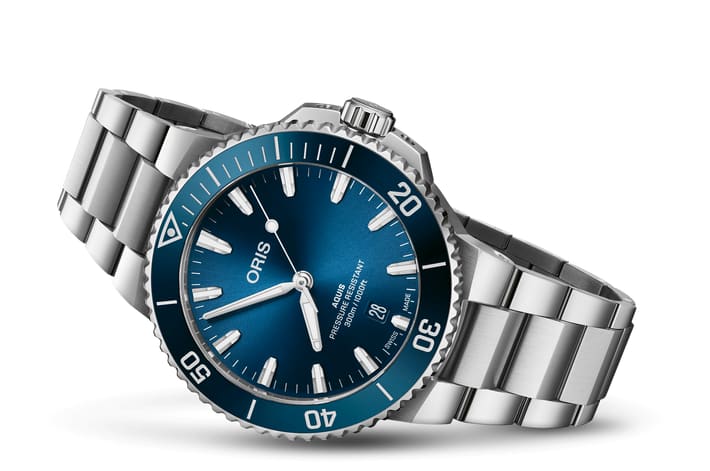
- Reference: 01 733 7787 4135-07 8 22 04PEB
- Case: 41.5mm stainless steel; ceramic timing bezel
- Movement: Oris 733-1 automatic; 41-hour reserve
- Crystal: Domed sapphire with internal antireflective coating
- Water Resistance: 300m / 30 bar
- Dial: Blue; date at 6
- Bracelet: Stainless steel
- U.S. List Price: $2,800; accepting online orders
I would choose the case size before the dial color. The shaped bracelet connection is also something I would check before buying third-party straps; an advertised width alone does not establish compatibility. The 36.5mm Upcycle shown was on “Notify me”, while the other pictured references in this card were accepting online orders.
The broader Date family includes diamond-set versions and editions such as Kelp Forest, Yangtze Jiangtun, New York Harbor II, Oris Social Club II, and Bracenet. The current Calibre 400 group also includes Great Barrier Reef IV. These offer different materials, colors, and project connections; I would read the individual edition’s terms rather than assume every environmental collaboration makes the same donation or supports the same cause. Bracenet was unavailable online when checked.
My Aquis versus Mido Ocean Star comparison is the most direct next read for the featured 41.5mm standard automatic. I would also use my Longines HydroConquest versus Aquis comparison to explore the design choice, checking the exact generation and today’s price before buying.
The Aquis Specialists: Chronograph, Pro, And Depth Gauge
The rest of the Aquis catalog deserves a separate look because these are not simply more dial colors. The Chronograph adds a stopwatch and a 62-hour reserve. The Aquis Pro 1000m and Pro 4000m use substantial 49.5mm titanium-based cases; the latter also has Calibre 400. I would consider either a specialist choice, not a natural upgrade for someone whose main concern is everyday fit.
The Depth Gauge has a 45.8mm case and a 500m rating, while Dat Watt II, under Small Second, Date, uses a smaller seconds display and a different movement. The Sun Wukong Artist Edition is another current catalog branch, with a listed $30,400 price that places it in a very different buying conversation.
Featured: Aquis Chronograph 43.5mm.

- Reference: 01 771 7793 4155-07 8 23 01PEB
- Case: 43.5mm stainless steel; ceramic timing bezel
- Movement: Oris 771-1 automatic chronograph; 62-hour reserve
- Crystal: Domed sapphire
- Water Resistance: 300m / 30 bar
- Functions: Chronograph, running seconds, and date
- Bracelet: Stainless steel
- U.S. List Price: $5,000; unavailable online — “Notify me”
The Chronograph, both Pro models, Depth Gauge, and Sun Wukong Artist Edition were listed with “Notify me” in the U.S. shop. Dat Watt II was accepting orders. I have kept them in the guide because they are current catalog offerings, without presenting them as immediately available purchases.
Big Crown: My Pick For Oris Character
If I wanted an Oris that felt especially tied to the brand, I would start with the Big Crown Pointer Date. Its extra central hand points to a date scale around the dial, leaving the face free of a conventional date window. That is a small difference in function, but a substantial part of its character.
The current 40mm bracelet model in oxblood red would be my choice here. At $2,400, it combines a distinctive color with the familiar pointer-date layout. I also like the more overtly retro 38mm Bullseye, while the bronze models offer a warmer case material that will change appearance over time.
Featured: Big Crown Pointer Date 40mm, oxblood dial on a steel bracelet.
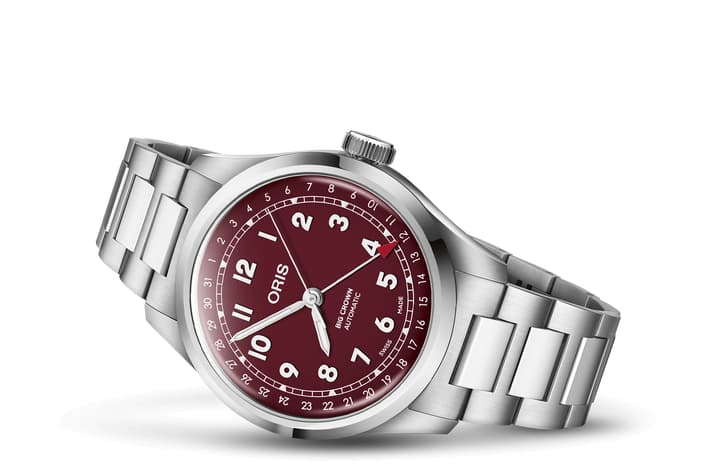
- Reference: 01 754 7798 4038-07 8 20 06
- Case: 40mm stainless steel
- Movement: Oris 754-1 automatic; 41-hour reserve
- Crystal: Domed sapphire
- Water Resistance: 50m / 5 bar
- Dial: Oxblood red; central pointer-date hand
- Bracelet: Stainless steel
- U.S. List Price: $2,400; accepting online orders
The gallery puts the principal alternatives together: a second 40mm color, Bullseye, Calibre 403, the hand-wound Calibre 473, the ten-day Calibre 113, a bronze 80th Anniversary Edition, a 34mm no-date Big Crown, and a 29mm Pointer Date. All pictured references were accepting orders when checked. There are also diamond-set 34mm models, Cervo Volante strap editions, and collaborations including Doraemon, Lou Gehrig, Hank Aaron, and Father Time in the current collection. Doraemon was labeled as a preorder.
I would be careful with the family name: the 34mm watch does not have the pointer date, and the 43mm Calibre 113 displays a business calendar including week and month. The featured standard automatic’s 50m rating and 41-hour reserve are also different from an Aquis’s priorities. My choice would be the regular Pointer Date for its design; I would pay more for a 403 or 473 only if I specifically wanted its reserve, seconds layout, or winding experience.
Divers Date: My Vintage-Inspired Everyday Diver
The Divers Date 39mm is my starting recommendation in the vintage-inspired Divers family. It keeps a softer case shape and domed-crystal look, while adding a ceramic bezel insert, 200m water resistance, and a quick-change bracelet with an additional rubber strap.
At $2,800, it costs the same as the featured Aquis. I would choose between them on appearance and fit before worrying about the difference between 200m and 300m on paper. The Divers Date’s brown-dial version appeals to me for its subdued palette, although the black and green options are equally easy to understand as everyday watches.
Featured: Divers Date 39mm, brown dial, bracelet and additional rubber strap.

- Reference: 01 733 7795 4051-Set
- Case: 39mm stainless steel; ceramic timing bezel
- Movement: Oris 733-1 automatic; 41-hour reserve
- Crystal: Domed sapphire
- Water Resistance: 200m / 20 bar
- Dial: Brown; date at 6
- Straps: Quick-change steel bracelet plus black rubber strap
- U.S. List Price: $2,800; accepting online orders
The gallery shows all four regular dial colors currently listed: brown, black, green, and blue. Blue was on “Notify me”; the other three were accepting orders. The collection also contains the RedBar II edition. I would keep this 39mm model distinct from older Sixty-Five references when comparing prices: the movement version, bezel, water resistance, and supplied straps can all change the value proposition.
Divers Sixty-Five: More Retro, More Variety
I would turn to the 60th Anniversary Edition for a stronger 1960s look. Its oversized numerals and retro logo give it a different mood from the Divers Date, and the no-date layout helps the dial remain focused. It is 40mm, $2,600, and rated to 100m, with a bracelet and an extra leather strap.
Featured: Divers Sixty-Five 60th Anniversary Edition.

- Reference: 01 733 7772 4034-Set
- Case: 40mm stainless steel
- Movement: Oris 733-1 automatic, no date; 41-hour reserve
- Crystal: Domed sapphire
- Water Resistance: 100m / 10 bar
- Dial: Black; retro numerals and Oris logo
- Straps: Steel bracelet plus leather strap
- U.S. List Price: $2,600; accepting online orders
The gallery also shows the 12H Calibre 400, the 38mm no-date Calibre 400, the Chronograph, and Cotton Candy in bronze and steel. The 12H bezel can help track another time zone, but it does not add an independently adjustable GMT hand. Cotton Candy is where I would look for color; I would choose steel if I did not want bronze patina.
The remaining Divers lineup includes Sixty-Five Date, the LFP edition, and city-specific Oris Social Club models. Those chapter editions account for much of the catalog’s apparent size. I would not mistake dozens of city versions for dozens of unrelated watch designs.
The 38mm no-date Calibre 400 was unavailable online; the other pictured references were accepting orders. One detail needs checking on the Anniversary watch: Oris specifies a bidirectional bezel on models through 2025 and a unidirectional bezel from 2026. I would confirm the production version with the seller if bezel operation mattered to my purchase.
ProPilot: The Straightforward Aviation Choice
For a clear Arabic-numeral dial and a contemporary aviation look, I would start with the ProPilot Date. The current 41mm steel bracelet model is $2,550, with the 41-hour automatic and a 100m rating. It is a sensible alternative to the Big Crown if I prefer a conventional date window and a more restrained dial.
Featured: ProPilot Date 41mm, black dial on a steel bracelet.
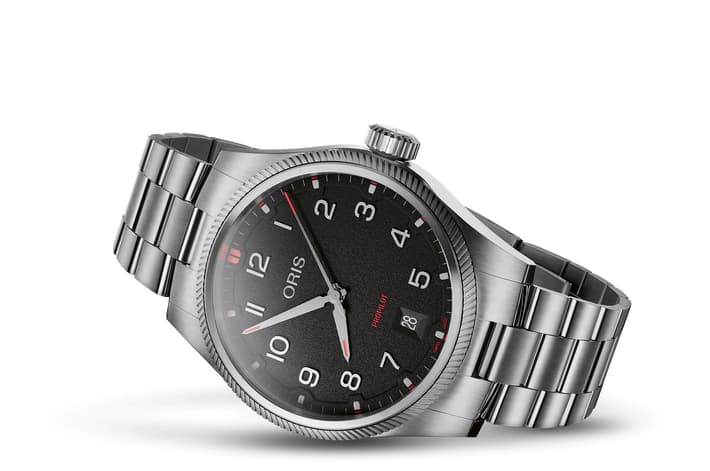
- Reference: 01 733 7805 4164-07 8 20 04LC
- Case: 41mm stainless steel
- Movement: Oris 733-1 automatic; 41-hour reserve
- Crystal: Domed sapphire
- Water Resistance: 100m / 10 bar
- Dial: Black; date window
- Bracelet: Stainless steel
- U.S. List Price: $2,550; accepting online orders
The gallery groups the steel Date with Bronze, Desert Edition, Calibre 111, and Altimeter. The basic Date also comes in other dial colors and on straps. The Desert Edition brings carbon-fiber construction into the case, while the 43mm Calibre 111 is a hand-wound, ten-day watch with a reserve display. Those are meaningful changes rather than cosmetic trim levels.
The 47mm Altimeter is the most specialized option, available with feet or meter scales, plus the Oris × BWD edition. I would read the operating instructions and check its size carefully before choosing it; the altimeter is a function to understand, not just an extra dial decoration. The pictured feet-scale reference was unavailable online, while the other four pictured ProPilots were accepting orders. The official ProPilot collection is the place to compare those branches.
ProPilot X: Titanium, Architecture, And A Little Fun
The ProPilot X is the Oris family I would explore for a more angular, contemporary design. Its 39mm Calibre 400 models pair titanium cases and bracelets with the five-day automatic. The Kermit Edition, at $5,100, is my personal favorite for the cheerful green dial and Kermit’s appearance in the date window on the first of each month.
That extra character is the reason to choose Kermit. The regular gray, blue, and salmon-dial Calibre 400 models list at $4,800; they were on “Notify me” when checked, while Kermit was accepting orders.
Featured: ProPilot X Kermit Edition, 39mm titanium.

- Reference: 01 400 7778 7157-Set
- Case: 39mm titanium
- Movement: Oris Calibre 400 automatic; 120-hour reserve
- Crystal: Domed sapphire
- Water Resistance: 100m / 10 bar
- Dial: Green; Kermit appears on the first of each month
- Bracelet: Titanium
- U.S. List Price: $5,100; accepting online orders
The gallery shows how far the ProPilot X collection stretches. Laser uses a no-date Calibre 400 and a dial whose color comes from its treated surface. Miss Piggy is a smaller 34mm steel watch with a different, 42-hour automatic; I would not buy it expecting the titanium construction or five-day reserve of Kermit.
At the other end, the 44mm Calibre 115 exposes its hand-wound mechanism and offers a ten-day reserve. Gonzo and Year of the Snake are further expressions of that larger platform. Laser and the regular skeletonized Calibre 115 were accepting orders; Miss Piggy, Gonzo, and Year of the Snake were unavailable online. I would choose the 115 for its visible mechanism, while keeping the simpler 39mm models on my shortlist for everyday use.
Artelier: The Dressier Side Of Oris
The current Artelier Date is where I would start for a cleaner, dressier Oris. Its 38mm case, simple markers, and restrained dial give it a quieter presence than the Big Crown. At $2,200 on leather, it is also one of the more approachable entry points among the watches featured here.
Featured: Artelier Date 38mm, blue dial on leather.
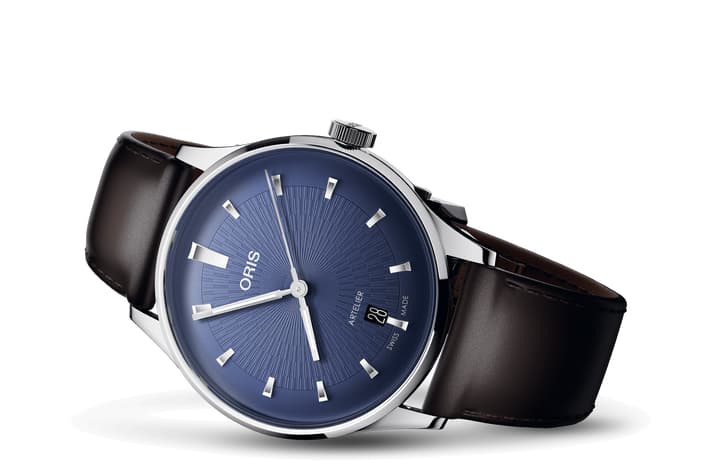
- Reference: 01 733 7810 4055-07 6 20 17FC
- Case: 38mm stainless steel
- Movement: Oris 733-1 automatic; 41-hour reserve
- Crystal: Domed sapphire
- Water Resistance: 30m / 3 bar
- Dial: Blue; date window
- Strap: Leather
- U.S. List Price: $2,200; accepting online orders
The gallery covers the three regular Date colors, the 39.5mm Artelier Complication, the 43mm Calibre 113, and Hölstein Edition 2026. All pictured references were accepting orders. The Complication combines a moonphase and second time zone, while the hand-wound 113 adds a ten-day reserve and a business calendar. I would choose the Date for visual simplicity and the Complication if I wanted a more interesting dial without moving to the larger 113.
Hölstein Edition 2026 uses the five-day Calibre 401. The Artelier catalog also includes the Calibre 113-based Year of the Horse, which was unavailable online. These editions belong in the overview, but I would not let their special status distract from whether I liked the watch itself.
The main practical limitation of the featured Date is its 30m rating. I would treat it as a dress-oriented choice and choose another family for regular swimming. I would also compare its $2,200 price with the dressier options in my Tissot review and Longines review before deciding how much the Oris design appealed to me.
Heritage: The Compact Oris Star Edition
The Heritage collection currently contains the Oris Star Edition. This is more specific than a general label for every vintage-inspired Oris: the Big Crown and Divers remain their own families.
The Star’s 35mm barrel-shaped case makes it a particularly interesting option for someone who prefers compact watches. It references the 1966 Oris Star and uses domed plexiglass, rather than sapphire, to maintain that period character. I like the idea, but I would accept the greater susceptibility to surface scratches as part of the choice.
Featured: Oris Star Edition, 35mm, gray dial on leather.
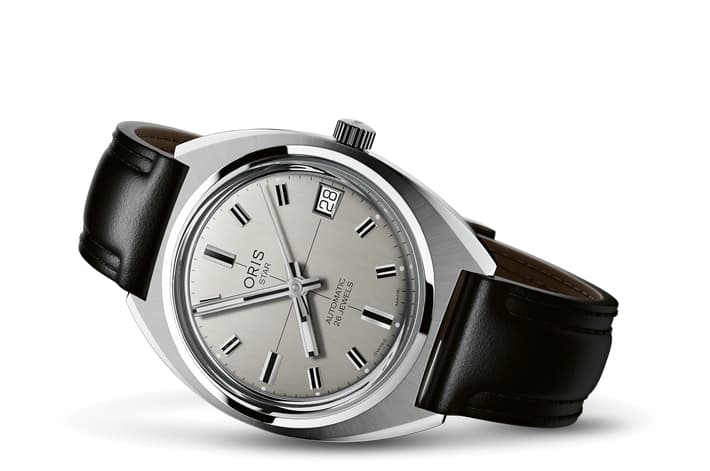
- Reference: 01 733 7813 4151-Set
- Case: 35mm stainless steel, barrel-shaped
- Movement: Oris 733-1 automatic; 41-hour reserve
- Crystal: Domed plexiglass
- Water Resistance: 50m / 5 bar
- Dial: Gray; date window
- Strap: Leather
- U.S. List Price: $2,300; accepting online orders
At $2,300, the Star was accepting orders when checked. I would shortlist it for its shape and proportions, not because it offers more technical specification than the similarly priced Artelier or Big Crown. The second gallery photograph is an official wrist image, useful for seeing the design in context; it is not a photograph from my own testing.
Which Oris Would I Choose?
| If You Want… | I Would Start With… | Why |
|---|---|---|
| The clearest Oris identity | Big Crown Pointer Date 40mm | The pointer calendar and distinctive dial, at $2,400 |
| A modern everyday diver | Aquis Date 41.5mm | 300m, ceramic bezel, and a substantial bracelet design |
| A vintage-inspired diver | Divers Date 39mm | 200m, ceramic bezel, and bracelet plus rubber strap |
| A dressier watch | Artelier Date 38mm | The simplest, quietest design here, from $2,200 |
| A small vintage-style watch | Star Edition 35mm | Compact barrel case and period-style plexiglass |
| A clear aviation dial | ProPilot Date 41mm | Straightforward date display and 100m rating |
| Titanium with personality | ProPilot X Kermit | Five-day movement and a playful dial idea |
My own shortlist would be Big Crown Pointer Date, Aquis Date 41.5mm, and Star Edition. They offer three distinct reasons to buy an Oris. I would try those shapes on first, then decide whether a movement upgrade mattered enough to widen the budget.
What I Would Check Before Buying
Match the complete reference. Older retail listings can look very close to the current watch while using another movement generation, case size, or bracelet. My TAG Heuer Aquaracer versus Oris Aquis comparison discusses an earlier 41.5mm Calibre 400 Aquis; I would not transfer its reference or retailer price to the current 43.5mm model shown here.
Understand the warranty route. The featured standard automatics list a two-year warranty, extendable to three years through MyOris. The featured Calibre 400 model extends to ten years, while the ten-day Calibre 111/113/115 examples extend to five years. Registration and eligibility matter. If buying outside Oris’s authorized network, I would confirm in writing whether the watch comes with manufacturer coverage or the retailer’s own warranty.
Allow for maintenance. Oris’s current service guidance recommends 10–12 years for its five-day in-house movements, 5–7 years for ten-day movements, and 3–5 years for other models. Its Calibre 400 pages separately describe ten-year intervals. These are service recommendations, not a promise that no attention will be needed in between; damage, timekeeping changes, and water-resistance checks remain separate concerns.
Try the case and bracelet together. I would compare the 35mm Star, 39mm Divers Date, and 41.5mm Aquis on the wrist rather than rank them by diameter alone. The official technical entries checked here do not consistently provide thickness or lug-to-lug, so I have not filled those gaps with estimates. For an Aquis or ProPilot X, I would pay particular attention to bracelet articulation, clasp fit, and available adjustment.
Compare alternatives that solve the same problem. My Mido brand review is useful for another approach to Swiss everyday and dive watches. Longines is worth comparing across sport and dress models. I would choose the individual watch on design, movement, fit, warranty, and the actual selling price—not assume one brand wins every comparison.
Frequently Asked Questions
Are Oris watches Swiss-made?
Oris is a Swiss watch company based in Hölstein, founded in 1904. Its current collection consists of mechanical watches, including automatic and hand-wound models.
Is Oris part of Swatch Group?
Oris is independent today. It joined ASUAG in 1970, but a management buyout in 1982 restored its independence.
Does every Oris have an in-house movement?
No. Oris offers standard automatic calibers alongside its own developed movements. Calibre 400, 403, and 473 provide five-day reserves, while the hand-wound 111, 113, and 115 offer ten days. Check the exact reference rather than assuming the whole range shares one movement.
Is Oris Calibre 400 worth the extra money?
I would consider it if the five-day reserve, increased magnetic resistance, and ten-year warranty available through MyOris registration matter to my use. A standard automatic can be the better starting point when design, fit, and price matter more. The case and bracelet can also differ between versions.
What is the difference between the Aquis and Divers Date?
The featured Aquis Date 41.5mm has a contemporary case and bracelet design with 300m water resistance. The Divers Date 39mm takes a vintage-inspired approach, has a 200m rating, and includes a bracelet and additional rubber strap. Both featured references use the 41-hour Calibre 733-1. Older Divers Sixty-Five models can have different specifications.
Which Oris would I recommend as a first purchase?
I would start with the Big Crown Pointer Date for its distinctive calendar, the Aquis Date 41.5mm for a modern diver, or the Divers Date 39mm for a vintage-inspired alternative. For a smaller watch, I would also consider the 35mm Star Edition.
How long is the Oris warranty?
Oris specifies a two-year warranty for watches purchased from an authorized dealer, with eligible MyOris registration extending coverage to three, five, or ten years depending on the movement. The featured standard automatics extend to three years, the ten-day 111/113/115 models to five, and the featured Calibre 400 model to ten. Confirm eligibility and registration with the seller.
My Final Take
Oris is most convincing to me when I can point to a specific reason to choose it: the Big Crown’s calendar, the Aquis’s shape, the Star’s compact case, or the ProPilot X’s titanium design. The current collection leaves room for both straightforward mechanical watches and more ambitious movements.
I would begin with the design and fit, then choose the movement. For many readers, a standard Big Crown, Aquis, or Divers Date will already deliver the attraction. If the five-day reserve would make ownership more convenient, Calibre 400 deserves a closer look—but I would make that decision after finding the Oris I actually want to wear.