Oris Aquis Date vs. Mido Ocean Star 200C: Design or Everyday Value?
Compare the 41.5mm Oris Aquis Date and Mido Ocean Star 200C on power reserve, price, dial design, bracelet fit, and the differences that matter in daily wear.
The Mido Ocean Star 200C is our pick for practical value. The Oris Aquis Date is the more compelling choice when its distinctive case, dial, and bracelet are what drew you to the comparison. The surprise is that spending more on this Oris means accepting a shorter power reserve, not gaining a longer one.
That does not make the Aquis a poor purchase. It means the decision depends on how you wear a watch and what you enjoy about it. A diver worn every day asks different things of its movement than one sharing wrist time with three other watches.
We are comparing the blue steel-bracelet Oris Aquis Date 41.5mm, reference 01 733 7787 4135-07 8 22 04PEB, with the Mido Ocean Star 200C M042.430.11.041.00. This is the standard Aquis Date, not the more expensive Calibre 400 model.
Compare these exact watches side by side
Oris Aquis Date vs. Mido Ocean Star 200C at a Glance
| Feature | Oris Aquis Date | Mido Ocean Star 200C |
|---|---|---|
| Case diameter | 41.5 mm | 42.5 mm |
| Movement | Oris 733-1 automatic | Mido Caliber 80 automatic |
| Power reserve | 41 hours | Up to 80 hours |
| Calendar | Date at six o’clock | Day and date at three o’clock |
| Bezel insert | Ceramic | Ceramic |
| Front crystal | Sapphire | Sapphire |
| Water resistance | 300 m | 200 m |
| Case back | Exhibition, mineral glass | Closed steel |
| Bracelet | Stainless steel | Stainless steel |
| Warranty | 2 years; 3 with MyOris registration | 2 years |
| US list price, September 26, 2026 | $2,800 | $1,360 |
The Weekend Test: When the Mido’s Reserve Matters
Imagine taking your diver off on Friday evening and putting it back on Monday morning. That is longer than the Aquis’s 41-hour reserve, but comfortably within the Ocean Star’s maximum 80 hours. Starting fully wound, the Mido can cover that gap; the Oris will need restarting and setting.
For someone who switches to a different watch at weekends, this is a useful advantage. It avoids a small but recurring task. For someone who wears the same watch every day with enough activity to keep it wound, the difference may barely enter the ownership experience.
Neither habit is more enthusiast-minded than the other. The useful question is whether resetting a watch bothers you. Some owners enjoy it as part of the ritual; others just want to pick up the watch and leave.
The Mido also supplies the weekday. That is a modest convenience, but one you can use throughout a working week. The Oris keeps the calendar simpler. We would choose based on whether you actually read the extra information, rather than treating every additional function as an automatic win.
Why the Aquis Still Has a Strong Case
The Aquis’s appeal is easier to understand by looking at the whole watch than by comparing individual specifications. Its broad bracelet joins closely to the case, while the crown guards and shaped hour markers reinforce the same substantial, modern look. To our eyes, the bracelet feels central to the design rather than an accessory added afterward.
Oris’s current Aquis redesign includes a more tapered bracelet, reworked crown guards, and reshaped hands and markers. These are the kinds of details to look at when trying the watch on: the transitions between surfaces, the width of the bracelet below the case, and how the whole silhouette sits on your wrist.
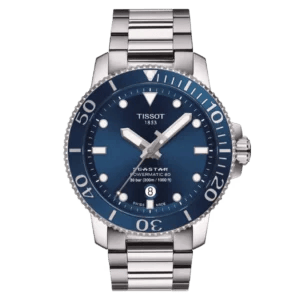
The blue dial is comparatively restrained beside the Mido’s wave pattern. Its date window sits low on the central axis, leaving the right-hand side uninterrupted. We prefer that arrangement for a cleaner-looking dial, though someone who enjoys visible texture may find the Ocean Star more engaging.
The Oris also lets you see the movement through the back. That does not improve timekeeping, but it can add enjoyment for an owner who likes the mechanical aspect of a watch. It is a reason to prefer the Aquis, not evidence that it must outperform the Mido.
Fit: Judge the Bracelet as Well as the Diameter
The Oris is a millimeter narrower, but we would not buy either watch from diameter alone. Try them with the bracelets properly adjusted, then turn your wrist and see where the first links begin to bend. A watch that looks balanced from above can still feel awkward if its bracelet holds the case away from your wrist.
The Mido measures 12.3mm thick. If you expect to wear it with shirts, test it under your own cuff rather than relying on a description such as “office-friendly.” Apply the same test to the Aquis. Comfort at a desk is a better guide to daily suitability than a wrist-size chart.
For the Aquis, think of the case and bracelet as a package. If you love that connected appearance, changing to a strap may not be a priority. If you enjoy frequent strap changes, check compatibility and cost before buying. Oris lists reference-compatible rubber options; do not assume that any generic 22mm strap will reproduce the same fit.
The Mido has a 22mm lug width and a safety folding clasp with a diver extension. Ask to see the clasp adjustments on both watches. Being able to find a comfortable setting matters more than deciding which bracelet looks more expensive in a photograph.
What Is the Oris Premium Worth to You?
The list-price gap is $1,440. That makes the Aquis a little more than twice the price of the Ocean Star, while both already offer ceramic bezels and sapphire crystals.
We would not stretch the budget for the depth rating alone. The Oris has the higher rating, but swimming and everyday ownership also depend on the watch’s condition and proper care. A larger number on the dial is not a substitute for maintaining water resistance.
Instead, ask whether the Mido would feel like a satisfying choice or a watch bought while still wanting the Oris. If its dial, fit, and calendar already suit you, the saving is persuasive. There is no need to spend more just because the budget allows it.
If you keep returning to the Aquis’s appearance, that preference is worth taking seriously. Watches are objects you look at repeatedly, often when you do not particularly need the time. Paying for a design you enjoy can be reasonable, provided you are comfortable with what you are giving up elsewhere.
Warranty adds a smaller distinction: MyOris registration extends this Aquis’s coverage to three years. It is not the ten-year arrangement associated with Calibre 400. Check that a seller’s offer includes the manufacturer coverage you expect.
For a different kind of upgrade, our Mido Ocean Star 200C vs. TAG Heuer Aquaracer 300 comparison looks at a chronometer-certified alternative with the same headline reserve as the Mido.
Other Aquis and Ocean Star Versions
The Aquis Calibre 400 changes the movement argument. The blue 43.5mm bracelet reference 01 400 7790 4135-07 8 23 02PEB offers 120 hours and a ten-year warranty with MyOris registration. At $4,300 US list, it also moves the budget considerably further from the Mido. Its five-day reserve and quick-adjust clasp should not be treated as features of the standard Aquis compared above.
The smaller Ocean Star 200 is another option if fit is the sticking point. Reference M026.930.11.041.00 measures 41mm by 11.7mm. Try it before deciding that the 42.5mm 200C represents how every Ocean Star will wear.
The earlier Ocean Star 200 is different again. Our Tissot Seastar 1000 vs. Mido Ocean Star 200 comparison covers the older 42.5mm M026.430.11.041.00 with an aluminum bezel. A listing for that reference is not an offer for this ceramic 200C.
Final Verdict
Choose the Mido Ocean Star 200C for a practical diver that leaves more room in the budget. It is particularly well suited to someone who rotates watches but dislikes setting them repeatedly. Its day-date display gives it a useful everyday identity of its own.
Choose the Oris Aquis Date because you prefer the Aquis, not because you expect a more expensive movement to win every specification. Its cohesive case-and-bracelet design is the strongest reason to spend more. If it fits you better and is the watch you keep wanting to wear, the shorter reserve need not be a dealbreaker.
Frequently Asked Questions
Is the Oris Aquis worth more than the Mido Ocean Star?
It can be worth the premium if you strongly prefer its design or find it more comfortable after trying both. If you like them equally, we would choose the Mido. The standard Aquis does not offer the movement advantages of the Calibre 400 version.
Will either watch keep running over a weekend?
From a full wind, the Mido can cover a typical Friday-evening-to-Monday-morning break. The standard Aquis compared here cannot. Actual reserve depends on how fully the watch was wound when you took it off.
Does this Oris Aquis have a five-day power reserve?
No. That feature belongs to Calibre 400 models, not this 733-1-powered reference. Check the movement as well as the Aquis name when comparing offers.
Which should I try first for a smaller wrist?
Start with the 41.5mm Aquis, but compare the way its bracelet bends around your wrist with the Mido’s. If neither feels right, the smaller Ocean Star 200 is worth considering. Diameter alone does not settle the fit question.