Traska Watches Review: All Collections And My Picks
Traska makes the kind of watches I find easy to put on a shortlist: restrained designs, sensible proportions, and practical details that matter once the novelty wears off. The hardened steel is the headline feature, but the choice of sizes and the attention paid to bracelets are just as interesting to me.
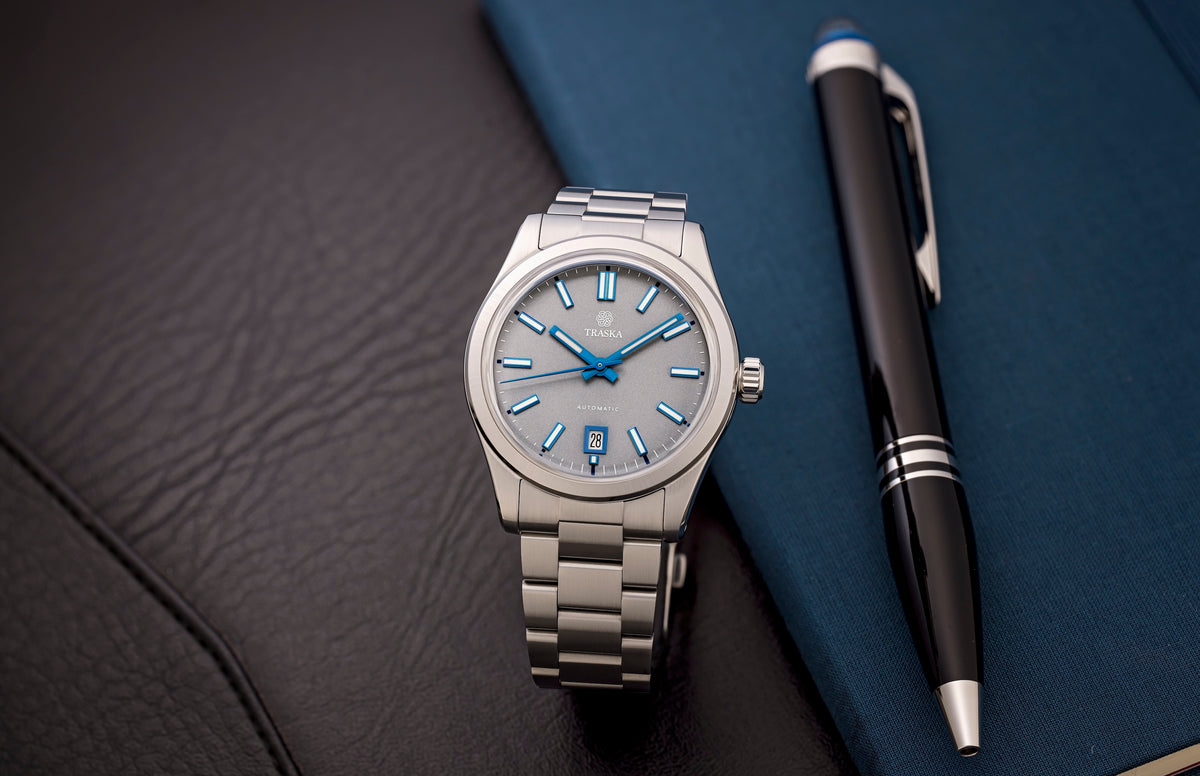
My starting point would be the Commuter 36 in Highland Gray. I like the blue accents against the quiet gray dial, and its straightforward layout would suit a watch worn throughout the week. For travel, I would move to the Venturer GMT; for a more colorful, casual choice, I would look at the Summiteer in Pine Green.
This guide covers all five current families, including the Freediver and mechanical Chronograph, with representative watch cards and galleries for colors and sizes. My recommendations are based on Traska’s published specifications and official photography. I have not published a dedicated Traska hands-on review.
Jump to my verdict, Commuter, Summiteer, Freediver, Venturer GMT, Chronograph, or my recommendations.
Traska At A Glance
| What I Would Want To Know | The Short Answer |
|---|---|
| Brand background | Independent brand founded by Jon Mack, with roots in Jacksonville Beach, Florida |
| First watch | Freediver; Traska dates its watchmaking story to 2018 |
| Everyday watches | Commuter in three size families; Summiteer in two |
| Diver | Freediver with a ceramic timing bezel and 200m rating |
| Travel watch | Venturer with a Miyota 9075 traveler GMT movement |
| Chronograph | TMI NE86 automatic with rotating-disc subdials |
| Current listed prices | $630–$1,650 USD across the catalog |
| Shared appeal | Hardened steel, sapphire crystals, and mechanical Japanese movements |
| Main buying consideration | Release schedules, exact generation, and size-specific bracelet details |
Prices and availability were checked on November 13, 2026. Prices below are official USD listings, before any applicable taxes or import charges. At that check, the watches were unavailable to order: the 36/38 Commuter, Summiteer, Freediver, and Venturer pages announced a return on November 15 at 11 AM Eastern Time; the Chronograph said late November. The Commuter 34 was sold out without that dated return notice. Those are Traska’s plans, so I would check the linked page again before buying.
My Verdict: Are Traska Watches Worth Considering?
Yes, particularly if you want an understated mechanical watch with useful everyday features. The Commuter and Summiteer would be my easiest recommendations within the range. Their appeal is straightforward: a relatively slim case, a clear dial, and several sizes, without requiring you to move to a completely different design to get a smaller watch.
The Venturer adds a more compelling functional reason to choose Traska. Its independently adjustable local hour hand makes sense for someone who crosses time zones. The Freediver offers a more familiar sports-watch layout, while the Chronograph is the choice I would consider for its unusual display rather than as an inexpensive entry to the brand.
The tradeoffs are worth weighing. Stock comes and goes, the three-hand watches and GMT have roughly 42-hour reserves, and the Chronograph costs substantially more than the rest. Specifications also cannot establish how the finishing, clasp, or lume will feel in person. I like the proposition, but I would choose the particular watch for its design and fit rather than treat hardened steel as the whole argument.
The Florida Story And A Habit Of Refinement
Traska’s about page identifies Jon Mack as its founder and traces the business to Jacksonville Beach, Florida. The brand dates its beginnings to 2018, with the Freediver as its first watch. Today, it describes a team and operations spread across North America, Europe, and beyond.
What interests me most in the official history is the emphasis on revising existing designs. The Freediver has reached its seventh generation, the Summiteer its sixth, and the Commuter its fifth. Those changes include movements, case shapes, lume, crystals, bracelets, and clasps, rather than simply another dial color.
That history matters when shopping pre-owned. An early Freediver or Venturer can differ significantly from the current version. I would check the reference and generation before applying today’s specifications to an older watch. Traska’s Florida origins also describe the brand’s background; they do not establish that the watches are manufactured entirely in the USA. The movements covered here are Japanese-made.
What I Like About Traska’s Approach
Hardened steel is a practical attraction. Traska says its treatment brings the case and bracelet steel to around 1,200 HV on the Vickers hardness scale. I would regard that as the manufacturer’s surface-hardness claim, not a promise that a watch cannot scratch, dent, or suffer impact damage. Sapphire crystals complement that approach, but neither feature makes a watch indestructible.
The bracelets deserve attention too. The current Commuter 36/38, Summiteer, Freediver, Venturer, and Chronograph pages describe tool-free clasp adjustment. That is a useful feature when a wrist changes size through the day. The smaller Commuter 34 has a narrower bracelet and a different, conventional micro-adjustable clasp, so I would not assume every Traska has identical hardware.
Japanese mechanical movements underpin the range. The no-date three-hand watches use the Miyota 9039, and the Venturer uses the 9075 GMT. These are automatic movements that can also be wound by hand and stopped for time-setting. The Chronograph uses the TMI NE86. Traska describes regulation in four positions and typical performance of −10 to +20 seconds per day; that is its stated expectation, not a result from my own testing or a chronometer certification.
For the date-equipped Commuter and Freediver, I would confirm the exact caliber before ordering: the product descriptions name the Miyota 9015, while some attached specification graphics say 9019. Both are presented as Miyota 9-series automatics, but the official pages do not currently agree on that detail. The no-date examples featured below consistently specify the 9039.
How To Read The Collection Cards
The galleries show every current dial color across the five families, with examples of each Commuter and Summiteer size family. I have grouped repeated colors rather than adding every size-and-date combination. Clicking the large image opens the pictured product or variant; the specifications remain those of the named featured watch. All photographs are supplied by Traska, and the gallery images are not shown to a common physical scale.
For dimensions, I use the drawings published on the product pages. These show 34.5/36.5/38.5mm diameters for the Commuter’s nominal 34/36/38 sizes, 36.5/38.5mm for the Summiteer, and 40.5mm for the Freediver. That small difference is worth keeping in mind when comparing listings. Where an overall thickness is given below, it includes the raised crystal.
Commuter: My First Choice For Everyday Wear
The Commuter 36 Highland Gray without a date would be my first stop. Its blue hands and marker surrounds add some personality without taking over the dial. I also like the balance of a simple fixed bezel and a bracelet that gives the watch enough presence for casual clothes or a shirt.
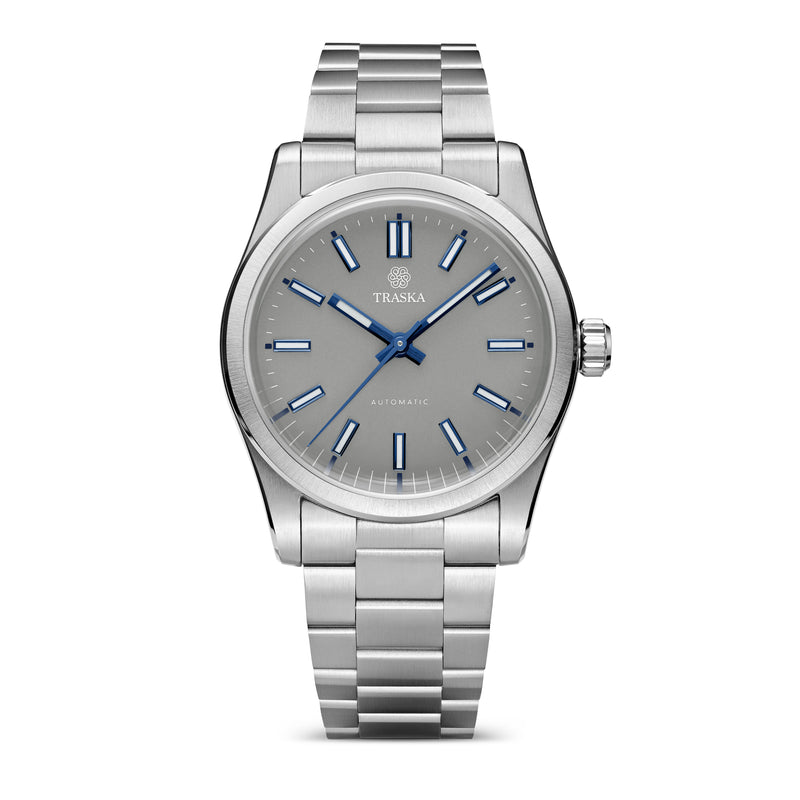
- Featured Watch: Commuter 36 Highland Gray, no date (Ref. 3205)
- Movement: Automatic Miyota 9039; 42-hour reserve
- Case Drawing: 36.5mm × 10.5mm; 44mm lug-to-lug
- Material / Crystal: Hardened 316L steel / boxed sapphire
- Water Resistance: 100m; screw-down crown
- Bracelet: 20mm tapering to 16mm; tool-free clasp adjustment
- Price: $740 USD; date version also offered
- Availability When Checked: Return announced for November 15
The Commuter collection splits into three sizes. Commuter 34 is listed at $630, uses the no-date Miyota 9039, and comes in Carbon Black, Arctic White, Adriatic Blue, and Faded Copper. Its drawing shows a 41.5mm lug-to-lug length and a 19mm bracelet tapering to 15mm.
Commuter 36 and 38 are $740 and $750, respectively, with date and no-date choices. Both offer Carbon Black, Arctic White, Adriatic Blue, Highland Gray, Seafoam Green, and Florida Coral. Their bracelets measure 20mm at the lugs and taper to 16mm; the larger case extends the lug-to-lug measurement from 44mm to 46mm.
I would choose the 34 for the smallest footprint, the 36 as my starting point, and the 38 if I wanted more dial presence. Faded Copper is the warmest alternative to my gray pick, but it belongs to the smaller size’s current selection. I would choose the size first and then work through the available colors.
Summiteer: The More Casual Everyday Choice
The Summiteer 36 in Pine Green appeals to me for its recessed dial, prominent numerals, and warm-colored hands. It feels visually more relaxed than the Commuter, while retaining a relatively compact case and a bracelet. I would put it near the top of the list for someone who likes field watches but wants to move beyond a conventional black dial.
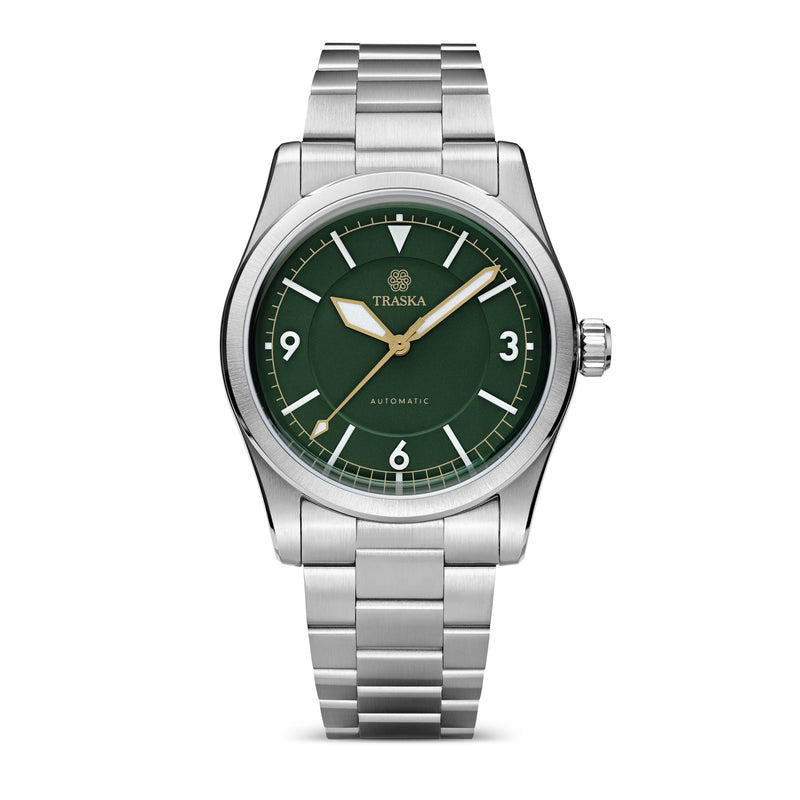
- Featured Watch: Summiteer 36 Pine Green (Ref. 6224)
- Movement: Automatic Miyota 9039; no date
- Power Reserve: 42 hours
- Case Drawing: 36.5mm × 10.5mm; 44mm lug-to-lug
- Material / Crystal: Hardened 316L steel / boxed sapphire
- Water Resistance: 100m; screw-down crown
- Bracelet: 20mm tapering to 16mm; tool-free clasp adjustment
- Price: $740 USD; larger 38 model $750
- Availability When Checked: Return announced for November 15
The Summiteer range currently offers Charcoal Black, Pine Green, Honeycomb Yellow, and Oxblood Red in both sizes. All use a no-date Miyota 9039. The nominal 36 costs $740; the 38 costs $750 and uses the larger 38.5mm × 46mm footprint shown in Traska’s drawing. Both drawings give 10.5mm overall thickness.
Charcoal Black is the easiest neutral choice, while Honeycomb Yellow would be my pick for someone who wants the dial to stand out. The 100m rating and fixed bezel keep this in the everyday/field-watch part of the range. I would move to the Freediver if a rotating timing bezel were part of the brief.
Freediver: My Pick For A Traditional Sports Watch
The Freediver in Chaouen Blue is the version I would choose. The blue dial and bezel give the familiar diver layout some color without making it difficult to pair with everyday clothes. It is also the largest watch here by lug-to-lug measurement, so I would pay more attention to fit than the collection page’s rounded 40mm description might suggest.
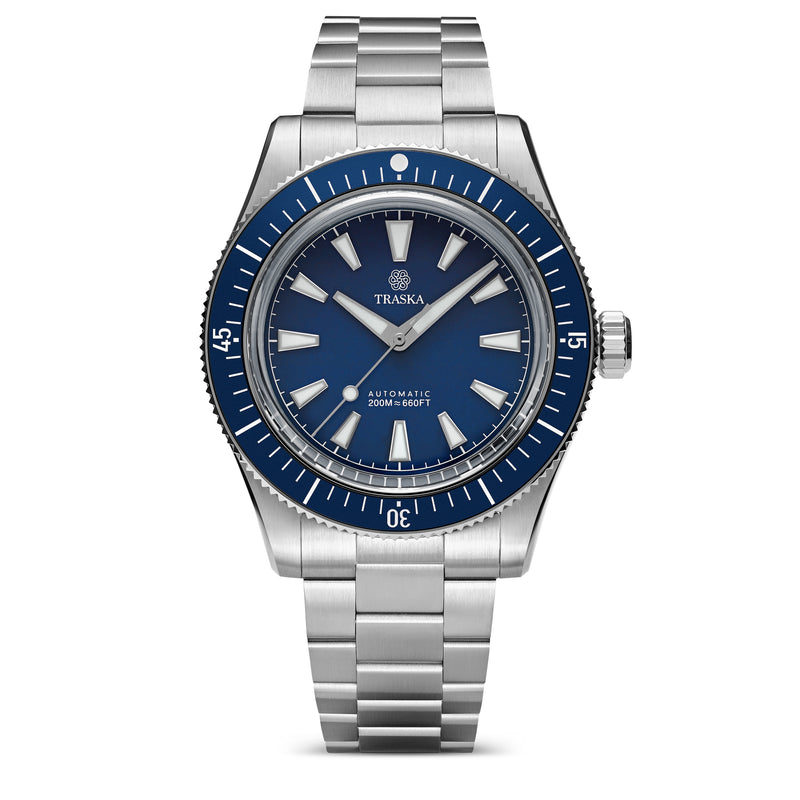
- Featured Watch: Freediver Chaouen Blue, no date (Ref. 1187)
- Movement: Automatic Miyota 9039; 42-hour reserve
- Case Drawing: 40.5mm × 11.9mm; 48mm lug-to-lug
- Material / Crystal: Hardened 316L steel / boxed sapphire
- Water Resistance: 200m; screw-down crown
- Bezel: Ceramic insert; 120-click unidirectional rotation
- Bracelet: 20mm tapering to 16mm; tool-free clasp adjustment
- Price: $795 USD; date version also offered
- Availability When Checked: Return announced for November 15
The current Freediver is Ref. 1187, with Carbon Black, Arctic White, Chaouen Blue, and Seafoam Green all listed at $795. Each product page offers date and no-date configurations. I prefer the symmetry of the no-date dial; the date version adds a useful calendar at six o’clock.
Its 120-click, unidirectional ceramic bezel is the main functional difference from the Commuter and Summiteer. I would find a minute timer useful for plenty of ordinary tasks, regardless of whether the watch ever goes diving. The seventh-generation update also includes revised lume, additional underside anti-reflective coating, and quick-release bracelet spring bars, as described in Traska’s Freediver history.
Venturer GMT: My Choice For Travel
The Venturer GMT in Arctic White is the Traska I would choose if time zones were the priority. The pale dial keeps the additional information visually light, while the extra crown operates an internal 24-hour bezel. I also include this model in my white-dial watch guide.
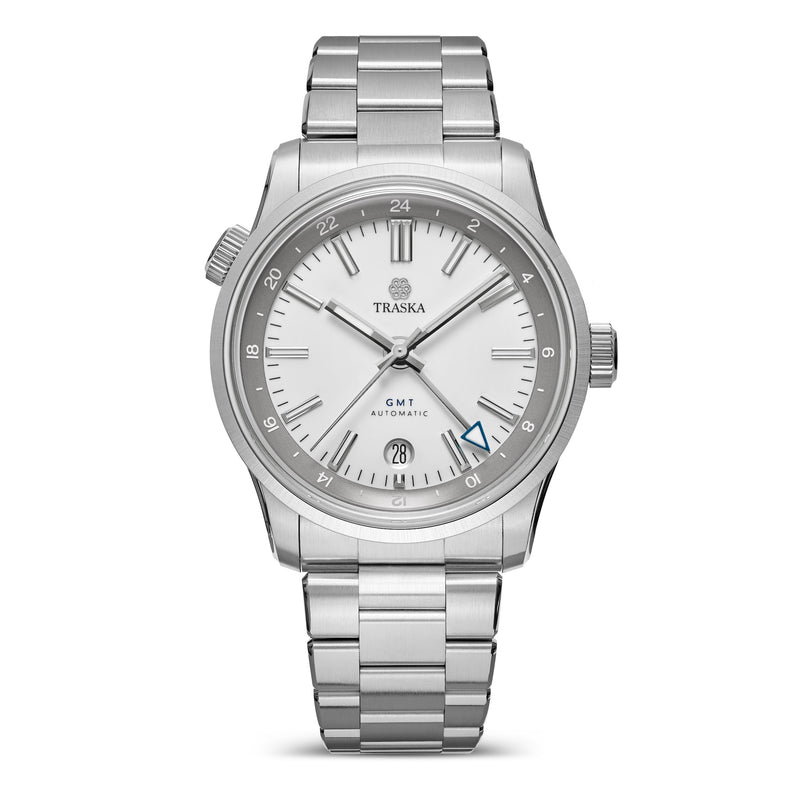
- Featured Watch: Venturer GMT Arctic White (Ref. 4217)
- Movement: Automatic Miyota 9075; 42-hour reserve
- GMT: Independently adjustable local hour hand
- Case Drawing: 38.5mm × 12.1mm; 46.1mm lug-to-lug
- Material / Crystal: Hardened 316L steel / boxed sapphire
- Water Resistance: 150m; screw-down crowns
- Bracelet: 21mm tapering to 16mm; tool-free clasp adjustment
- Price: $950 USD
- Availability When Checked: Return announced for November 15
The important feature is the Miyota 9075’s independently adjustable local hour hand. After arriving in a different time zone, you can move that hand in one-hour steps while leaving the reference time running. That is the traveler-style GMT arrangement I would want for frequent flights. The extra hand and rotating internal scale also make the watch useful for keeping track of someone elsewhere.
The current Venturer collection is Ref. 4217, listed at $950 in Carbon Black, Arctic White, Steel Blue, and Bottle Green. Traska’s generation history describes revised bracelet links, concave case detailing, an applied logo, a circular date aperture, and further crystal changes. Older prices and bracelet specifications do not necessarily describe this version.
The 21mm lug width is worth checking if you intend to replace the bracelet, and the 12.1mm overall thickness makes it taller than the Commuter or Summiteer. For me, those are reasonable tradeoffs if the GMT function will get regular use.
Chronograph: The Most Unusual Traska
The Chronograph in Arctic White is the one I would consider for a more playful collection addition. At first glance, it has a familiar two-register layout. Look again and the subdials use rotating transparent discs read against fixed red markers: elapsed minutes on the left and running seconds on the right. I like that the unusual display is integrated into an otherwise recognizable sports watch.
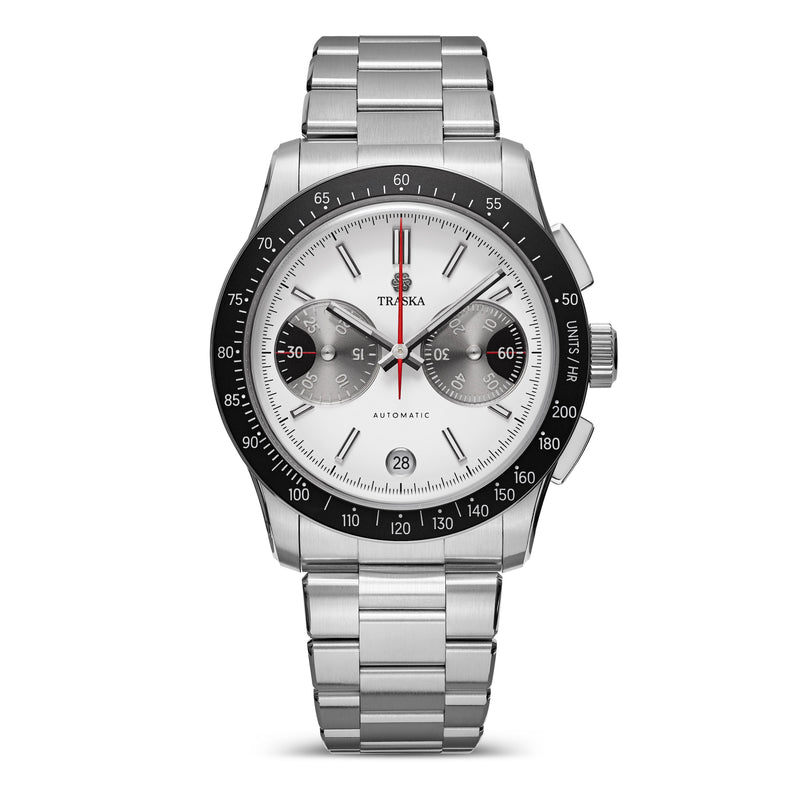
- Featured Watch: Chronograph Arctic White (Ref. 10251)
- Movement: Automatic TMI NE86; 45-hour reserve
- Chronograph: Column wheel, vertical clutch, 30-minute counter
- Case Drawing: 39mm × 13.75mm; 46.5mm lug-to-lug
- Material / Crystal: Hardened 316L steel / boxed sapphire
- Water Resistance: 75m; screw-down crown
- Bezel: Ceramic tachymeter on the white version
- Bracelet: 21mm tapering to 16mm; tool-free clasp adjustment
- Price / Availability When Checked: $1,650 USD / returning late November
Both Arctic White and Tungsten Gray are listed at $1,650. The bezel material differs: the white model has ceramic, while the gray model specifies tungsten. The shared TMI NE86 is an automatic chronograph movement with a column wheel and vertical clutch; the left disc records up to 30 elapsed minutes.
This is a meaningful step up in price and thickness. The drawing gives 13.75mm overall, and the 75m water-resistance rating is the lowest in this guide. I would choose it because I wanted its display and mechanical chronograph, rather than expecting it to wear like the slimmer three-hand models. Both colors were marked for a late-November return when checked.
Which Traska Would I Choose?
| What You Want | My Starting Point | Why I Would Choose It |
|---|---|---|
| One everyday watch | Commuter 36 Highland Gray | Simple layout, restrained color, and a useful middle size |
| The smallest case | Commuter 34 | Shorter 41.5mm lug-to-lug; check the different clasp |
| A casual field watch | Summiteer 36 Pine Green | Numerals, a recessed dial, and a warm color combination |
| A dive-style sports watch | Freediver Chaouen Blue | Ceramic minute bezel and 200m rating |
| A watch for changing time zones | Venturer GMT Arctic White | Independently adjustable local hour hand |
| Something more unusual | Chronograph Arctic White | Rotating-disc registers and a mechanical chronograph |
What I Would Check Before Ordering
Start with availability and the exact generation. The November return notices are plans, not confirmation that a particular color will remain in stock. I would revisit the product page when ready to order. For a used watch, I would compare its reference, movement, and clasp with Traska’s generation notes.
Compare measurements with a watch that fits well. The 34/36/38 names are useful categories, but the published drawings provide the more precise dimensions. Bracelet fit matters too, especially on the smaller Commuter. A gallery photograph alone cannot settle either question.
Read the return conditions before removing any wrapping. Traska’s shipping and warranty policy gives a two-week inspection period, but requires the watch to remain in its original plastic wrapping and original condition. Returns are at the buyer’s expense; international returns carry a $45 processing fee, including a prepaid FedEx label.
The same policy lists a transferable three-year limited international warranty for material or manufacturing defects. Normal wear, impact damage, and specified water-damage situations are excluded. If buying pre-owned, I would obtain the original order number; Traska says warranty shipping costs fall to buyers who did not purchase directly. Free outbound shipping also does not mean free importation: international taxes, duties, and related charges remain the buyer’s responsibility.
Where Traska Fits Among My Other Brand Guides
I would compare Traska with Baltic if vintage styling were the main attraction, Serica for a different interpretation of compact field and dive watches, and UNIMATIC for a more graphic, minimal design direction.
The Seafarer still appears in Traska’s historical reference notes, but it is absent from the five-family current shopping menu checked for this guide. I would treat it as an earlier range to research separately, rather than suggest it is available alongside today’s selections.
Frequently Asked Questions
Is Traska an American watch brand?
Traska is an independent brand founded by Jon Mack with roots in Jacksonville Beach, Florida. Its current about page describes operations across several regions. The watches in this guide use Japanese movements; the brand’s Florida origin does not establish that the complete watches are made in the USA.
Are Traska watches scratch-proof?
No. Traska says its treatment raises the surface hardness of its steel to around 1,200 HV. I would view that as a scratch-resistance feature, not a guarantee against scratches, dents, broken crystals, or impact damage.
Which movements does Traska use?
The no-date three-hand watches use the automatic Miyota 9039 with a stated 42-hour reserve. The Venturer GMT uses the Miyota 9075 with 42 hours, and the Chronograph uses the TMI NE86 with 45 hours. For date-equipped Commuter and Freediver models, the official text names 9015 while some specification graphics say 9019; I would confirm the exact caliber with Traska.
Is the Traska Venturer a traveler GMT?
The current Venturer GMT uses a Miyota 9075 with an independently adjustable local hour hand. I would consider that useful for changing time zones while keeping reference time running. Earlier Venturer generations should be checked individually.
Which Traska would I recommend for a smaller wrist?
I would start with the Commuter 34, whose published drawing shows a 34.5mm diameter and 41.5mm lug-to-lug length. The Commuter 36 and Summiteer 36 provide a larger alternative, with drawings showing 36.5mm diameter and 44mm lug-to-lug. I would compare bracelet fit as well as case measurements.
Can I buy every current Traska immediately?
No. On November 13, 2026, the checked listings were unavailable to order. The Commuter 36/38, Summiteer, Freediver, and Venturer announced a November 15 return at 11 AM Eastern Time; the Chronograph said late November. The Commuter 34 was sold out without that dated notice. I would verify availability on the official page before ordering.
What warranty and return period does Traska offer?
Traska lists a transferable three-year limited international warranty for material or manufacturing defects. Its two-week return inspection period requires the watch to remain in its original plastic wrapping and condition. Return costs and international processing fees apply, so I would read the current policy before removing the wrapping.