Mido Watches Review: Collections, Quality, and My Recommendations
Mido is a brand I would put on a shortlist before deciding that a familiar name is the better purchase. The Ocean Star offers a straightforward way into Swiss dive watches, but it is the less predictable designs that keep me interested: the television-shaped Multifort, a slim Baroncelli, or a Commander with a simple day-date dial.
Those watches suit different people. My starting point is the collection and the exact reference, because one Mido’s movement, dimensions, or water resistance tells me surprisingly little about another.
This guide covers all six families listed on Mido’s US collection page: Ocean Star, Multifort, Commander, Baroncelli, Belluna, and Rainflower. My recommendations include two contrasting Multiforts. My Multifort 8 Two Crowns review goes into more detail on that specific watch; the other recommendations here reflect my assessment of the designs, official specifications, and prices.
Jump to Ocean Star, Multifort, Commander, Baroncelli, Belluna, Rainflower, or my recommendations.
Mido At A Glance
| What I Would Want To Know | The Short Answer |
|---|---|
| Background | Founded in 1918; based in Le Locle, Switzerland; part of Swatch Group |
| Collections | Ocean Star, Multifort, Commander, Baroncelli, Belluna, and Rainflower |
| My sports-watch starting point | Ocean Star 39 |
| My more distinctive alternative | Multifort TV Big Date or the reviewed Multifort 8 Two Crowns |
| My dress-watch starting point | Baroncelli Heritage |
| Main strengths | Useful movement reserves, distinctive designs, and a broad choice of sizes and styles |
| Main reservations | Similar names can hide substantial specification differences; shaped cases and bracelets deserve a try-on |
Prices below are official US list prices in USD, checked October 12, 2026. Taxes, regional prices, and stock can differ. Product buttons link directly to Mido.
My Verdict: Are Mido Watches Worth Considering?
Yes, particularly if you want a Swiss watch you can rotate through the week without constantly resetting it. Many of the models I would consider offer 72 or 80 hours of reserve. That is useful when a watch spends a couple of days off the wrist, although reserve alone is not a measure of accuracy or overall quality.
The designs give me a stronger reason to choose between them. The Ocean Star 39 would be my practical starting point; the TV Big Date is the one I would investigate for personality. For someone who rarely needs a rotating bezel, the Commander or Baroncelli could be a better everyday purchase.
I would still compare the actual selling price with the alternatives. A long specification list will not compensate for a bracelet that fits poorly or a dial I do not enjoy looking at. Mido becomes compelling when the design and practical details both suit the buyer.
A Little History And Context
Mido’s official history begins with Georges Schaeren in 1918. The name comes from the Spanish yo mido, meaning “I measure.” The Multifort arrived in 1934, establishing the durable, practical side of the brand long before today’s angular sports watches.
That history also includes the Aquadura crown-sealing system and the 1959 Ocean Star’s single-shell case. I see those as useful background to Mido’s interest in water resistance, rather than specifications to transfer to a current watch.
Today, Mido is based in Le Locle and belongs to Swatch Group. Its range includes ETA-based movement technology; Mido’s own caliber documentation identifies ETA bases for Caliber 80. I would judge the movement fitted to the reference I am buying, including its reserve and any certification, rather than assume a branded caliber name means an exclusive in-house design.
Ocean Star: My Starting Point For A Sports Watch
Ocean Star is Mido’s dive-watch family. It stretches from the smaller 36.5 and 39 to the 200, ceramic-bezel 200C, and 600 Chronometer, with GMT, Tribute, and Worldtimer branches for travel or a more nostalgic look. Those names represent different choices in size, function, and styling; I would not shop them as interchangeable versions of one watch.
My pick: Ocean Star 39 in blue. The textured gradient dial gives a familiar diver layout some character. More practically, the 39mm diameter and 10.5mm thickness make it the model I would try first if larger dive watches usually feel cumbersome.
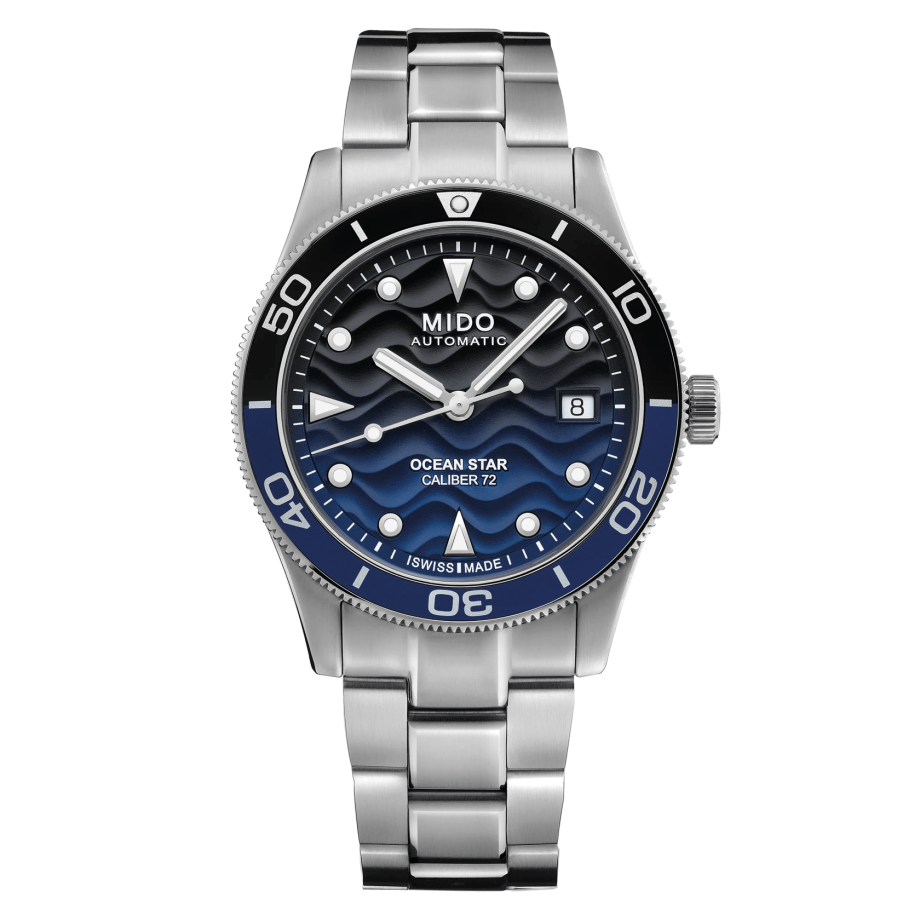
- Reference: M026.907.11.041.00
- Movement: Automatic; up to 72 hours
- Case: 39 mm; 10.5 mm thick
- Water Resistance: 200 m
- Dial / Bracelet: Blue gradient; stainless steel
- US List Price: $1,250
The 200m rating, steel bracelet, and up-to-72-hour reserve make an appealing everyday combination. My reservation would be fit: the case diameter is only part of the story, so I would check how the bracelet sits and how much adjustment the clasp provides on my wrist.
For a ceramic-bezel alternative, the 200C deserves a look. My comparisons with the Oris Aquis and TAG Heuer Aquaracer cover the larger 42.5mm 200C. They are useful next reads, but their conclusions concern that reference, rather than this slimmer 39.
Multifort: Where I Would Look For More Personality
Multifort has the widest spread of ideas. The 8 One Crown and Two Crowns emphasize an angular bezel, while the TV watches make the case silhouette the main attraction. Round M, Chronometer 1, Patrimony, and Powerwind models offer other takes on the everyday watch; GMT, skeleton, and chronograph versions add more specialized displays or functions.
I would narrow this collection by what I want to see on my wrist before comparing movements. A skeleton dial invites a closer look; a clean round dial is easier to take in at a glance.
My Reviewed Pick: Multifort 8 Two Crowns
The blue M047.507.17.041.00 is the watch covered in my dedicated review. Its internal rotating bezel, controlled by the upper crown, makes it an interesting alternative to a conventional sports watch. I find the 9.5mm case thickness especially persuasive alongside the geometric bezel and fitted rubber strap.
- Reference: M047.507.17.041.00
- Movement: Caliber 72 automatic; up to 72 hours
- Case: 40 mm wide; 9.5 mm thick
- Water Resistance: 100 m
- Bezel / Strap: Internal rotating bezel; blue rubber
- US List Price: $1,440
The Caliber 72 includes a Nivachron balance spring, and Mido lists a 100m rating. I would choose it for the combination of design and proportions, while looking to the Ocean Star for a more conventional dive-watch layout. The twin crowns alone do not make it a traditional pressure-operated super-compressor.
Read my full Multifort 8 Two Crowns review for the dial, case, movement, and comparison discussion.
My Other Pick: Multifort TV Big Date
The TV Big Date is the one I would choose if I wanted the watch’s shape to do more of the talking. I like the blue dial and large date at 12: the date feels integrated into the design instead of squeezed into a spare corner.
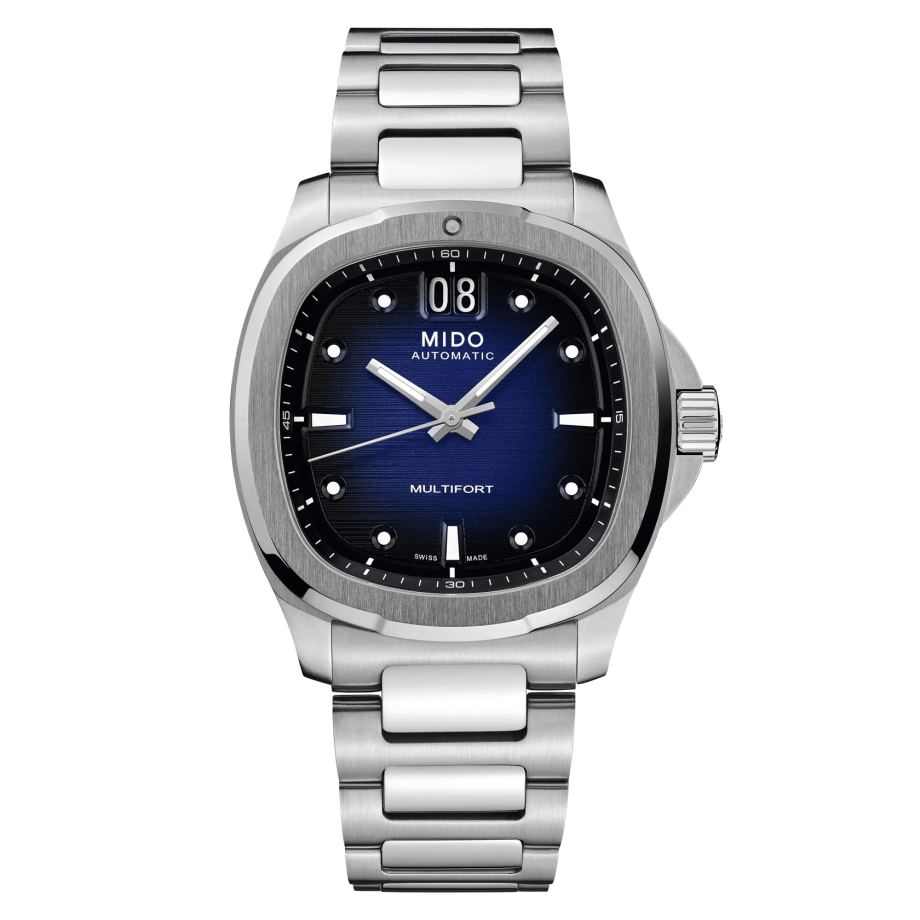
- Reference: M049.526.11.041.00
- Movement: Caliber 80 automatic; up to 80 hours
- Case: 40 mm wide; 11.5 mm thick
- Water Resistance: 100 m
- Dial / Bracelet: Blue with big date; stainless steel
- US List Price: $1,440
It is 2mm thicker than the Two Crowns, and the broad rectangular outline will feel different from a round 40mm watch. I would try both rather than pick from the headline width. The butterfly clasp also deserves a fit check if on-the-fly adjustment is a priority.
The wider TV range includes Big Date Chronometer, TV Chronograph, TV 35, and TV 28 Quartz. Those are worthwhile alternatives if certification, timing functions, a smaller case, or quartz convenience matters more than the standard Big Date. They do not all share this card’s specifications.
Commander: My Understated Everyday Choice
Commander is where I would look for a watch that works with a shirt as easily as casual clothes. The family includes the retro 1959 and Shade, contemporary Datoday and Big Date, translucent-dial Gradient, and the Chronometer and Icône options.
My pick: Commander Datoday. The blue dial, straightforward day-date display, and three-link bracelet make a quieter proposition than either featured Multifort. I like that the useful calendar display does not need a large sports-watch bezel around it.
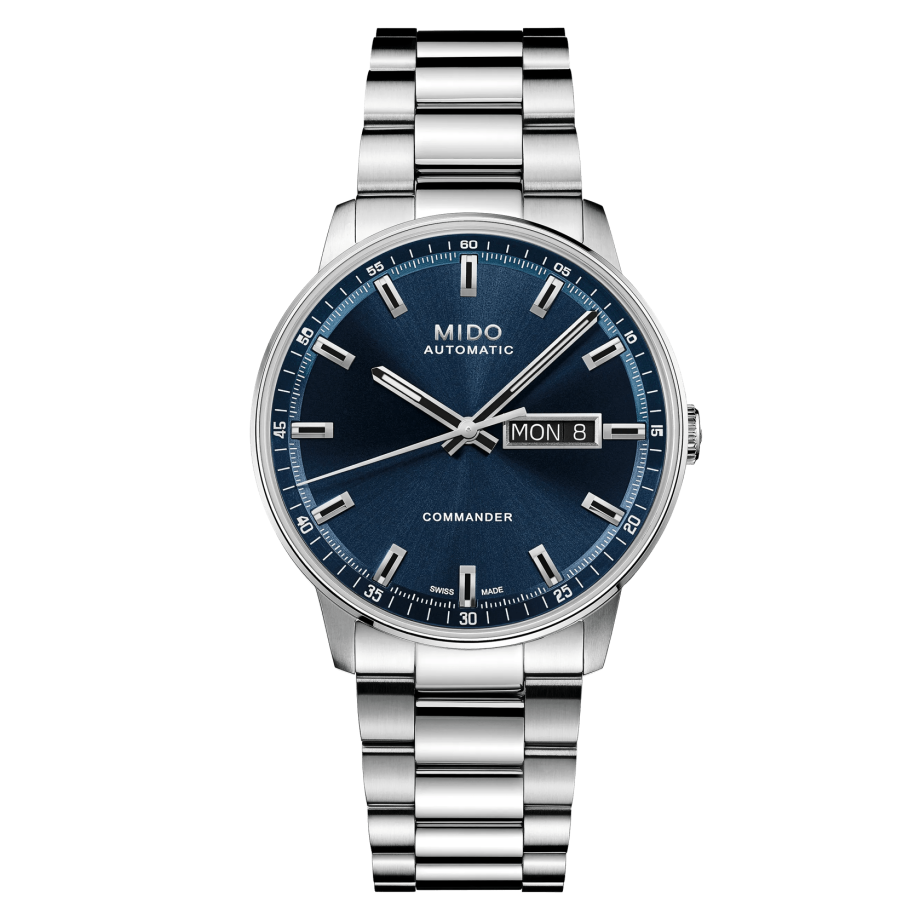
- Reference: M021.430.11.041.00
- Movement: Caliber 80.621 automatic; up to 80 hours
- Case: 40 mm; 10.7 mm thick
- Water Resistance: 50 m
- Dial / Bracelet: Blue day-date; stainless steel
- US List Price: $1,090
The Caliber 80.621, Nivachron spring, and up-to-80-hour reserve give it a practical foundation. Its 50m rating is lower than the sports models above; I would buy it because I wanted this simpler design, rather than treat it as an Ocean Star substitute.
If accuracy certification is a priority, I would compare a Commander explicitly labeled Chronometer or Icône. The Datoday’s Caliber 80 name does not, by itself, establish COSC certification.
Baroncelli: My Choice For A Slim Dress Watch
Baroncelli covers Mido’s more classical side, from Heritage, Tradition, and Signature to Chronometer, Big Date, and Chronograph Moonphase models. Smaller Lady models, decorative dials, and quartz options broaden the range considerably. I would begin with the simplest version and add a complication only if I wanted to use or admire it.
My pick: Baroncelli Heritage on a steel bracelet. The white dial, slender markers, and blued seconds hand appeal to me because they let the proportions carry the design. Its 7.3mm thickness is the most compelling number in this selection.
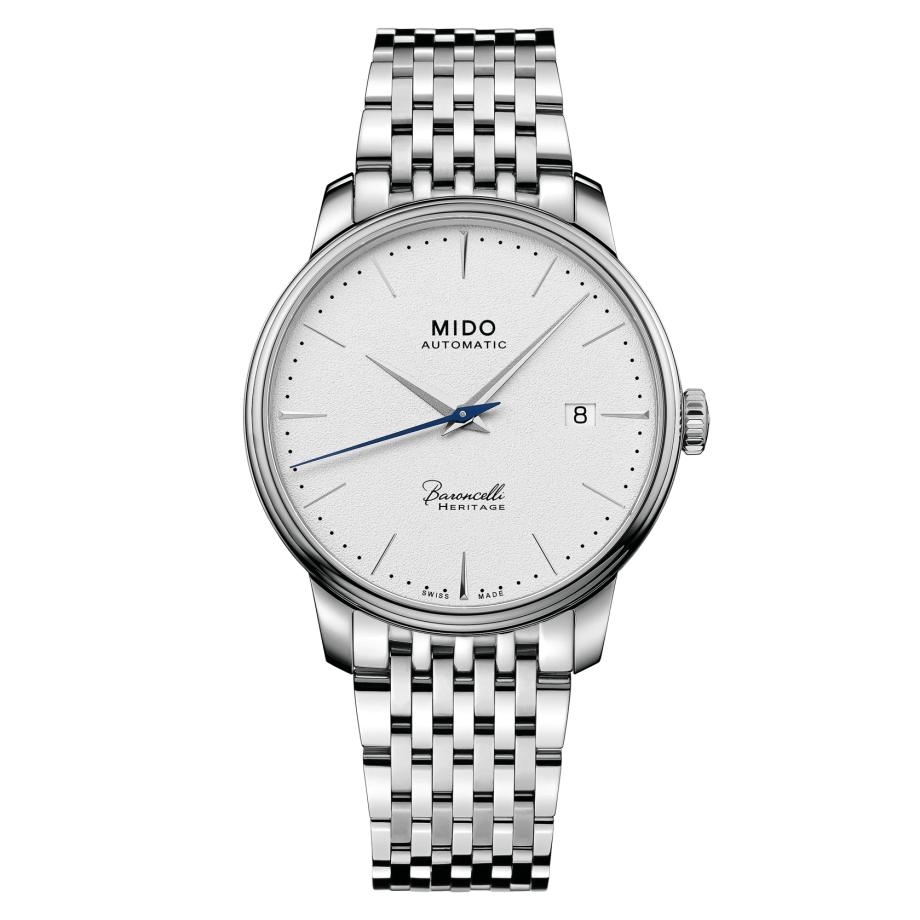
- Reference: M027.407.11.011.00
- Movement: Automatic; up to 72 hours
- Case: 39 mm; 7.3 mm thick
- Water Resistance: 30 m
- Dial / Bracelet: White; stainless steel
- US List Price: $1,250
That thin case makes it a promising candidate for someone who dislikes a watch catching on a cuff. I would still check the bracelet’s drape and the watch’s reach across the wrist in person.
The compromise is a 30m water-resistance rating. I would give this watch a dressier role and use the Ocean Star for swimming. The current page lists up to 72 hours of reserve for this exact reference; I would check older stock carefully before assuming every historical Heritage listing describes the same movement specification.
Belluna: A Softer, More Decorative Design
Belluna remains listed in the US catalog, although the selection is much narrower than Multifort or Baroncelli. The current offerings are Belluna Royal Lady models, with a rounded cushion case rather than a conventional circular silhouette.
My pick: the steel and rose-gold-colored Royal Lady. I would consider it for someone who likes a smaller, dressier watch with jewelry-like details. The diamond markers and two-tone bracelet are central to its appeal; the colored metal is PVD-coated steel, not solid gold.
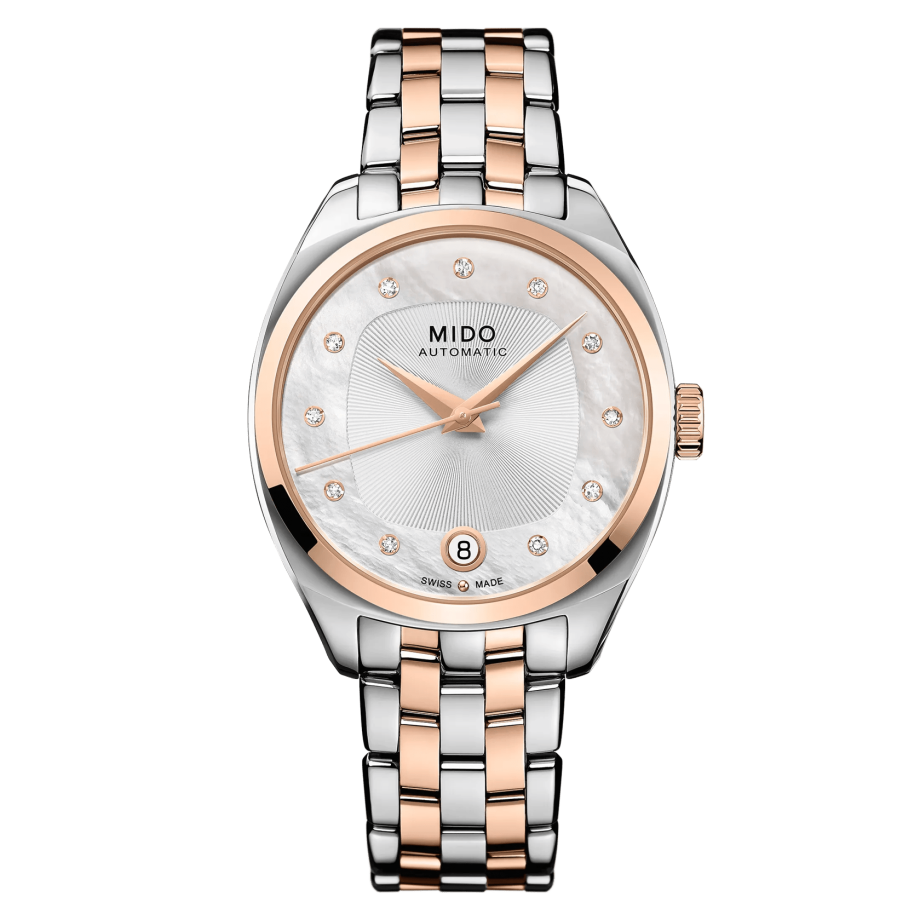
- Reference: M024.307.22.116.00
- Movement: Caliber 80 automatic; up to 80 hours
- Case: 33.4 mm wide; 9.8 mm thick
- Water Resistance: 50 m
- Case / Bracelet: Steel with rose-gold-colored PVD accents
- US List Price: $1,300
I like that a decorative design still gets an automatic movement with an up-to-80-hour reserve. Its 33.4mm width should be assessed as part of a cushion-shaped case, rather than directly equated with the same diameter in a round watch. This is the collection I would explore when softness of shape matters more than a sporty dial.
Rainflower: Floral Design With Mechanical Interest
Rainflower is Mido’s dedicated women’s collection, with Origin and Blossom branches. Its floral shapes draw on Singapore’s ArtScience Museum. I would consider it for someone who wants the dial to be expressive rather than purely functional.
My pick: Rainflower Blossom. The openwork flower reveals part of the skeletonized Caliber 80, with mother-of-pearl and a rose-gold-colored case making the presentation quite different from Mido’s sports watches.
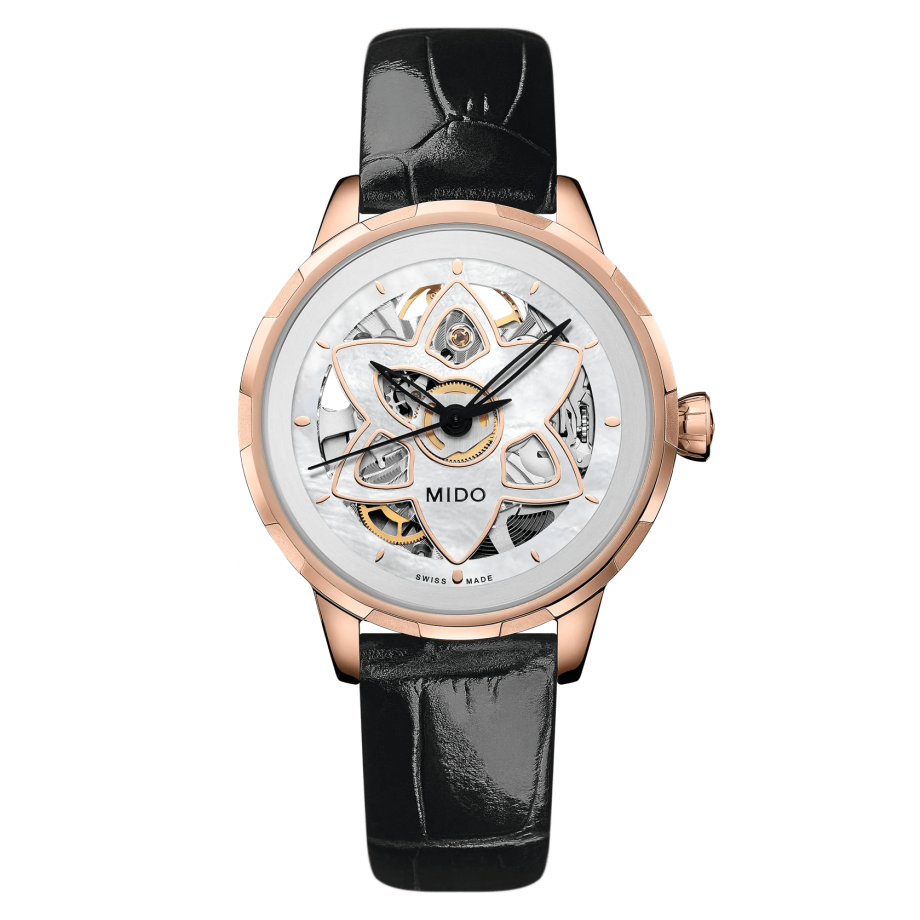
- Reference: M043.236.36.101.00
- Movement: Skeleton Caliber 80 automatic; up to 80 hours
- Case: 34 mm; 9.9 mm thick
- Water Resistance: 30 m
- Case / Strap: Rose-gold-colored PVD steel; black leather
- US List Price: $1,540
The black strap is alligator-style cowhide, rather than alligator leather. I find the contrast with the light dial attractive, although the openwork necessarily competes with the hands for attention. At 34mm and 30m water resistance, this is a decorative everyday or occasion watch I would choose for its design, with the 80-hour reserve as a useful extra.
Quality And Ownership: What I Would Check
Movement names need a little care. Caliber 80 is not a promise that every Mido runs for 80 hours, and a longer reserve does not automatically mean better accuracy. The selected Ocean Star 39, Two Crowns, and Heritage list 72 hours; the other featured watches list 80. Quartz and other mechanical options exist elsewhere in the range.
I would also separate COSC certification from ordinary automatic specifications. Mido sells certified models, but the certification belongs to particular references. It is something I would pay extra for if independently tested timekeeping were a priority, rather than assume from the brand name.
For ownership, Mido states a two-year international warranty, extended to five years for COSC-certified chronometers, subject to its terms and valid official-dealer activation or documentation. A retailer’s own warranty can be different. I would compare the coverage and service arrangements alongside any discount.
Finally, I would try the clasp, check replacement-strap options, and look at the dial in ordinary light. Those are the details most likely to decide whether a technically appealing watch becomes one I actually want to wear.
Which Mido Would I Choose?
For a first Mido, I would start with the Ocean Star 39 for sportier use or the Commander Datoday for a more understated everyday watch. The TV Big Date would be my choice for a distinctive case, and the Two Crowns for its slim profile and internal bezel. For a dressier role, I would begin with the Baroncelli Heritage.
For a smaller, more decorative watch, I would start with Belluna for its soft cushion case or Rainflower Blossom for its openwork flower dial.
If the angular Multiforts are what brought you here, my Alpina brand review is a useful next stop. I would compare the individual designs and fit before deciding which brand offers the watch I prefer.
Mido Watches FAQ
Is Mido a Swiss watch brand?
Yes. Mido was founded by Swiss watchmaker Georges Schaeren in 1918 and is based in Le Locle. It is part of Swatch Group.
Do all Mido watches have an 80-hour power reserve?
No. The selected TV Big Date, Commander, Belluna, and Rainflower list up to 80 hours, while the featured Ocean Star 39, Multifort 8 Two Crowns, and Baroncelli Heritage list up to 72. Mido also sells quartz and other mechanical models, so I check the exact reference.
Are all Mido watches COSC-certified chronometers?
No. COSC certification applies to selected models, not the whole brand. An automatic movement or a Caliber 80 label alone does not establish certification.
Which Mido would I choose as a first watch?
I would start with the Ocean Star 39 for a compact sports watch or the Commander Datoday for a more understated everyday design. The Multifort TV Big Date would be my alternative if the case shape and large date display were the main attraction.
How long is the Mido warranty?
Mido states a two-year international warranty, extended to five years for COSC-certified chronometers, subject to its terms and valid official-dealer activation or documentation. A retailer warranty may offer different coverage.