DOXA Watches Review: Quality, Collections, and Best Models
DOXA is one of those watch brands you can recognize before you can explain why. The orange dial helps, of course. So do the broad bezel, small dial opening, and cushion-shaped case of its best-known divers. Put one next to a row of more conventional dive watches and it tends to hold your attention.
Shopping for one takes a little more patience. A SUB 200, SUB 200 II, and SUB 200T are three different watches. The SUB 300 costs more than the SUB 300T despite having a lower water-resistance rating. And the 40mm SUB 600T can feel more substantial than a larger watch with a softer case shape.
That is where this review starts: which DOXA makes sense for you, and what changes as you move through the range? I have dedicated reviews of the SUB 200 Professional, the SUB 600T Caribbean on a NATO strap, and the SUB 600T Caribbean with a steel bezel and bracelet. All three are included below, with the two 600T configurations kept separate.
My short answer: DOXA is worth considering if you want a distinctive dive watch and enjoy its particular design. I would start with the SUB 200T for a compact everyday choice, the SUB 300 for the traditional cushion-case experience, or the SUB 200 for a lower-cost entry. The SUB 600T is the more angular alternative, and its character is a substantial part of the appeal.
By clicking on the product links in this article, I may receive a commission fee at no cost to you. Thank you for your support.
DOXA Watches At A Glance
| Category | TWR Take |
|---|---|
| Founded | 1889 in Le Locle, Switzerland, by Georges Ducommun |
| Production | Swiss Made; DOXA describes its watches as hand-assembled in Switzerland |
| Coverage | All core families in the current DOXA Watches US catalog, plus selected editions and retail exclusives |
| Movements | Swiss automatic movements; chronometer certification and power reserve vary by model |
| Representative prices | SUB 200 Professional from $1,250; SUB 200T Professional from $1,750; SUB 300T Professional from $2,150 |
| Warranty | Two years, according to DOXA’s published customer FAQ |
| Main strengths | Recognizable designs, color choices, useful size alternatives, and a substantial dive-watch history |
| Main tradeoffs | Similar model names, short reserves on many models, and cases or clasps that deserve a careful fitting |
| TWR reviews | SUB 200 Professional and two SUB 600T Caribbean configurations |
Prices are displayed US-dollar prices from DOXA’s US storefront, checked on September 30, 2026. They exclude applicable local taxes. Where a price is described as “from,” it refers to the named model’s least expensive listed configuration; other colors, materials, and editions may differ. Availability was checked by variant. Older reviews retain their original observations and pricing context.
Quick Verdict: Are DOXA Watches Good?
Yes, particularly when you want a watch with a clear identity. DOXA offers more variety than the orange-dial reputation suggests: traditional skin-diver shapes, compact cushion cases, GMTs, chronographs, titanium, carbon, and some very substantial steel divers.
My SUB 600T bracelet review captures both sides of the appeal. The blue dial, steel bezel, and sharply defined case made a strong impression. The raised caseback and initially difficult clasp were real qualifications. That is more useful buying information than assuming a 600m rating makes the watch an automatic winner.
I would be less enthusiastic about buying a DOXA solely to maximize specifications per dollar. Many models still have a 38-hour power reserve. The larger cases will not suit every wrist, and the colorful configurations can be conspicuously sporty. The reason to buy is the combination of design, fit, construction, and history that you actually enjoy wearing.
DOXA Brand History And Where The Watches Are Made
Georges Ducommun founded DOXA in Le Locle in 1889. The company made watches long before it became associated primarily with diving. Its official history includes pocket watches, automotive clocks, and dress watches, followed by the development of the SUB in the 1960s.
The important turning point for today’s buyer is 1967, when the SUB 300 arrived with the orange dial and distinctive bezel that remain central to the brand’s appearance. DOXA’s relationship with Jacques-Yves Cousteau and U.S. Divers helped establish its diving reputation. The Jenny family acquired DOXA in 1997, and the company moved its headquarters to Biel/Bienne.
DOXA’s Swiss Made statement describes hand assembly in Switzerland. That does not mean every component is made in-house. My dedicated SUB 200 and SUB 600T reviews identify Sellita SW200-1 movements, while current official listings generally describe the movement as a Swiss automatic without naming the supplier.
I would give that history its proper weight, then return to the watch in front of me. A compact SUB 200T and a 45mm SUB 1500T share a brand name, but they answer very different questions about everyday wear.
DOXA Quality, Movements, And Ownership
The Movement Depends On The Model
A useful starting point is the reserve. The current SUB 200, 200 II, 200T, SUB 300 family, and SUB 600T listings generally specify 38 hours. If you take one off on Friday evening, expect to reset it before wearing it on Monday.
Other models offer longer reserves: the SUB 250T GMT lists 50 hours, while the SUB 750T and current chronographs discussed below list 56 hours. Check the exact reference instead of assuming every DOXA uses the same movement because the dial and bezel look familiar.
Certification also varies. The standard SUB 300, SUB 300 Carbon, and SUB 300 Ti5 are listed as COSC-certified chronometers. The standard SUB 300T is not advertised with that certification. Paying more can therefore buy a different movement specification, material, or execution without buying a higher depth rating.
Case Shape And Strap Choice Matter
The SUB 200T is 39mm across and 10.7mm thick. The SUB 600T is only 1mm wider, yet measures 14.15mm thick and has a much longer case footprint. Those two watches are unlikely to feel interchangeable on the wrist.
In my steel-bracelet SUB 600T review, the raised center of the caseback contributed to its substantial feel. The bracelet also changed the overall presentation compared with the NATO version. That is why I would compare the actual configuration rather than make the whole decision from a diameter figure.
Pay attention to lug width as well. The SUB 200 uses 19mm, while the SUB 200T and SUB 250T GMT use 18mm. Some larger models use 21mm. Replacement straps are available, but it helps to know whether the straps already in your drawer will fit.
What The Warranty Tells You
DOXA’s customer FAQ states a two-year warranty. Keep the purchase documentation and check the applicable warranty terms with the seller, especially when comparing a new watch with a used one. I am describing published support here, rather than reporting a warranty claim I have personally tested.
For normal ownership, the official care instructions advise securing the screw-down crown and rinsing the watch with fresh water after seawater exposure. The familiar depth-and-time markings on some bezels are part of DOXA’s diving heritage; they should not be treated as a substitute for current dive planning or a dive computer.
Understanding DOXA Model And Color Names
The model numbers are a useful label, but they are not a complete specification. The current SUB 300T, for example, is rated to 1,200m. The SUB 200 and SUB 200T both have 200m ratings, yet use different cases and bezel layouts.
Color names are easier once you know the pattern:
| DOXA Name | Usual Dial Color |
|---|---|
| Professional | Orange |
| Sharkhunter | Black |
| Searambler | Silver |
| Caribbean | Blue |
| Divingstar | Yellow |
| Aquamarine | Turquoise |
| Whitepearl | White |
| Sea Emerald | Green |
| Redcoral | Red |
Availability and finishes vary by family. “Professional” is the orange colorway name; it is not a separate movement grade. Some collections offer both the familiar flat-color dial and a sunray treatment, so check the photographs and reference number as well as the name.
SUB 200 Vs 200T, And SUB 300 Vs 300T
These four are the most useful starting comparison. The dimensions below are from DOXA’s current standard product listings.
| Watch | Width / Thickness | Main Appeal |
|---|---|---|
| SUB 200 | 42 / 13.8 mm | Traditional skin-diver shape at a lower price |
| SUB 200T | 39 / 10.7 mm | Compact cushion case and signature dual-scale bezel |
| SUB 300 | 42.5 / 13.4 mm | Domed crystal and COSC-certified movement |
| SUB 300T | 42.5 / 13.65 mm | Different crystal profile, 1,200m rating, and lower price than SUB 300 |
SUB 200 vs 200T: choose the 200 for its case design and lower entry price. Choose the 200T if you want the recognizable cushion-case DOXA appearance in a smaller, thinner package. The “T” does not simply turn the 200 into a more water-resistant watch.
SUB 300 vs 300T: the 300 is the more direct choice if the domed crystal and chronometer movement appeal to you. The 300T brings a helium-release valve and a much higher water-resistance rating at a lower price. That makes it an alternative with different priorities, rather than an upgrade that everyone should automatically choose.
DOXA Collections And Watches To Consider
The following sections cover the core families shown in the current catalog, grouping closely related versions together. The three linked TWR reviews provide my existing watch-specific coverage. Comments on the remaining models are based on official specifications and design, rather than additional hands-on testing.
SUB 200: The Familiar Entry Point
SUB 200 Professional On Rubber
- Reference: 799.10.351.21
- Movement: Swiss automatic
- Power Reserve: 38 hours
- Case Width: 42 mm
- Lug-to-Lug Distance: 46 mm
- Case Thickness: 13.8 mm
- Water Resistance: 200 m
- Current Price: $1,250
The SUB 200 is the DOXA I would show someone who likes the brand’s colors but prefers a more conventional dive-watch silhouette. The curved lugs, applied markers, and domed sapphire crystal give it a different feel from the broad cushion case of the SUB 300.
My SUB 200 Professional hands-on review covers the orange-dial watch on rubber. The relatively short 46mm lug-to-lug span is a useful part of its appeal, while the 19mm lug width and 38-hour reserve are worth considering. A 42mm diameter still deserves a fitting; short lugs do not make any watch universally comfortable.
The pictured reference uses a sapphire bezel insert. DOXA also lists steel-insert variants, standard and shorter rubber straps, and a bracelet. The Professional on bracelet is currently $1,290, compared with $1,250 on rubber. I would make that choice before buying, especially if the bracelet is something you expect to want later.
SUB 200 II: A Larger, Dressier Direction
The SUB 200 II is a separate current family, and my SUB 200 review should not be mistaken for a review of it. It has a 44mm case, a 48mm lug-to-lug span, and a 12.8mm thickness, with gradient dials and a choice of mesh bracelet or Dive Flex rubber strap.
The Sharkhunter starts at $1,690 on rubber, or $1,750 on mesh. Its 200m rating and 38-hour reserve are familiar, but the larger case and dial treatment create a different reason to buy. The Redcoral version adds a black DLC-coated case and different pricing.
I would investigate this one if the smoked dial and mesh bracelet were the attraction. If smaller dimensions are your priority, move to the 200T instead.
SUB 200T: My Starting Point For A Smaller DOXA
The SUB 200T Professional starts at $1,750 on rubber, or $1,790 on bracelet. Its 39mm width, 41.5mm lug-to-lug span, and 10.7mm thickness make it one of the most approachable places to start in the current range.
You still get the broad bezel, cushion shape, offset dial text, and 200m water resistance. That combination is the attraction: the recognizable DOXA appearance with less bulk. The movement is a Swiss automatic with a listed 38-hour reserve.
I would compare the Iconic and Sunray dials in person if possible. The surface treatment changes how the same color behaves in the light. I also include the 200T in my small dive-watch guide, though I have not published a dedicated hands-on review of this model.
SUB 300 And SUB 300T: Two Different Priorities
The SUB 300 Professional is $2,850 on rubber or $2,890 on bracelet. Its domed sapphire crystal and COSC-certified movement are the important distinctions to weigh against the 300T. The case measures 42.5mm across with a 45mm lug-to-lug span, and water resistance is 300m.
I would start here if the vintage appearance of the classic DOXA is what brought me to the brand. The compact length of the case is useful, but the broad bezel and small dial opening are still a particular look. Try to see one at normal viewing distance rather than judging it only from enlarged product photographs.
SUB 300T Searambler On Bracelet
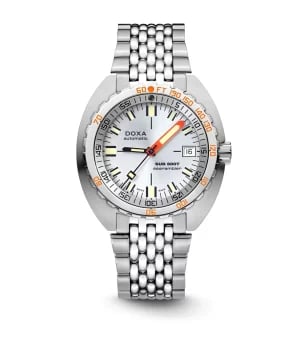
- Reference: 840.10.021.10
- Movement: Swiss automatic
- Power Reserve: 38 hours
- Case Width: 42.5 mm
- Lug-to-Lug Distance: 44.5 mm
- Case Thickness: 13.65 mm
- Water Resistance: 1,200 m
- Current Price: $2,190
The SUB 300T is a compelling alternative if its case and crystal presentation appeal more to you. It has a helium-release valve and a higher depth rating, while the standard movement is not advertised as COSC-certified. Searambler on rubber is $2,150; the pictured bracelet configuration is $2,190.
I like the silver dial as an option for someone who enjoys the shape but wants a quieter color. The difference in price from a SUB 300 is substantial enough that I would compare the two carefully. Choose the execution you prefer, rather than reading the depth rating as an overall quality score.
SUB 300 Ti5, Carbon, And Beta: Materials And Proportions
The SUB 300 Ti5 Professional, at $3,190, uses Grade 5 titanium for the case, crown, and caseback. It keeps the 42.5mm width, 45mm length, 13.4mm thickness, 300m rating, and COSC-certified automatic movement, and comes on a Dive Flex rubber strap. This is the version I would investigate if I liked the SUB 300 but wanted the titanium construction.
The SUB 300 Carbon Professional, at $4,390, takes a more conspicuous material direction. Its forged-carbon case surrounds a titanium movement chamber. It also has COSC certification and 300m water resistance. The dark, patterned case is a strong aesthetic choice; I would want to love that appearance before paying the premium.
The steel SUB 300 Beta Professional starts at $2,450 on rubber, or $2,490 on bracelet. It is thinner at 11.95mm, with a ceramic bezel and a sunray dial. That makes it worth investigating for everyday wear, although the standard steel model is not listed as a COSC-certified chronometer.
The separately listed SUB 300 Beta Sharkhunter is a different proposition again: black ceramic, a titanium chamber, 18-karat gold details, COSC certification, and a $7,850 price. Do not confuse it with a black-dial version of the ordinary steel Beta. This is a material and design purchase at a very different budget.
SUB 250T GMT: For Keeping Another Time Zone In View
The SUB 250T GMT Professional starts at $2,750 on rubber, or $2,790 on bracelet. It combines a 40mm case, 42.9mm lug-to-lug span, 10.85mm thickness, and 250m water resistance with an additional 24-hour hand.
Those proportions make it an interesting option on paper for someone who wants a colorful everyday watch with a second time zone. The listed 50-hour reserve is also longer than that of many three-hand DOXAs. The skeletonized GMT hand helps distinguish the additional display without losing the familiar overall layout.
I would compare it directly with a SUB 200T. If you will use the second time zone, the GMT earns its place. If you will not, the simpler watch costs less and already offers much of the appearance. My GMT watches under $5,000 guide includes the 250T for broader comparison.
SUB 600T: The Angular Alternative I Have Reviewed Twice
Caribbean With Steel Bezel And Bracelet
- Reference: 862.10.201.10
- Movement: Swiss automatic; my review identifies Sellita SW200-1
- Power Reserve: 38 hours
- Case Width: 40 mm
- Lug-to-Lug Distance: 47.6 mm
- Case Thickness: 14.15 mm
- Water Resistance: 600 m
- Current Price: $1,690
The 600T is the DOXA I would show someone who finds the traditional cushion case a little too rounded. Its sharp geometry, four-o’clock crown, and blue-and-orange dial create a very different character. The steel bezel complements that solid, utilitarian appearance.
My SUB 600T Caribbean steel-bracelet hands-on review is particularly useful here. It describes the raised caseback, the strong wrist presence, and a clasp that was difficult to open initially. I liked the watch enough to keep it in my rotation, but those details explain why the 40mm diameter tells only part of the story.
Caribbean With Steel Bezel And NATO Strap
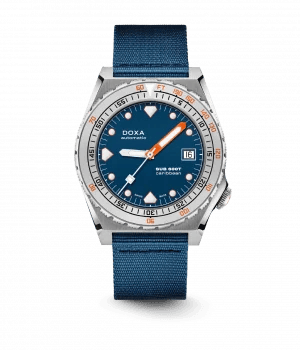
- Reference: 862.10.201.32-N
- Movement: Swiss automatic
- Power Reserve: 38 hours
- Case Width: 40 mm
- Case Thickness: 14.15 mm
- Water Resistance: 600 m
- Configuration: Steel bezel and NATO strap
- Current Price: $1,550
My earlier SUB 600T Caribbean NATO review covers this separate reference. The blue strap gives the watch a more casual appearance, but a pass-through strap also adds material beneath an already tall case.
The current price difference between these two configurations is $140. If you think you will want the bracelet, I would price that choice before ordering the NATO version. DOXA also offers ceramic-bezel configurations at different prices; the two watches pictured and reviewed here both have the sandblasted steel insert.
SUB 750T And SUB 1500T: For Buyers Who Want A Larger Watch
The SUB 750T Professional starts at $2,750 on rubber, or $2,790 on bracelet. Its 45mm width is substantial, but the case is listed at 11.95mm thick with a 47mm lug-to-lug span. The 750m rating and 56-hour reserve give it a different specification from the similarly wide 1500T.
I would investigate the 750T if I wanted a larger dial and case without choosing the thickest watch in the range. I have not reviewed it in depth, so its favorable dimensions on paper should be followed by a fitting.
SUB 1500T Caribbean On Bracelet
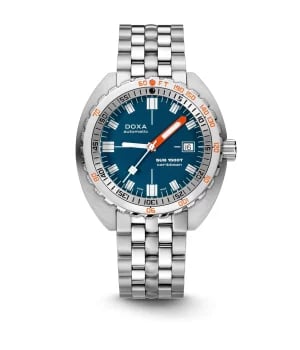
- Reference: 883.10.201.10
- Movement: Swiss automatic
- Power Reserve: 50 hours
- Case Width: 45 mm
- Lug-to-Lug Distance: 47 mm
- Case Thickness: 16.25 mm
- Water Resistance: 1,500 m
- Current Price: $2,690
The 1500T is the deliberate choice for someone who enjoys a very substantial diver. Its helium-release valve and depth rating are part of that identity, but the 16.25mm thickness is likely to matter more during an ordinary working day.
I would compare it with the 750T before assuming that two 45mm DOXAs will feel similar. Buy the 1500T because you want this much watch, with its particular case and bracelet, rather than treating it as the inevitable next step above a 300T.
DOXA Army: A Different Dial And Bezel
The DOXA Army changes the visual balance with a sand-beige dial, bold geometric markings, and a more conventional elapsed-time bezel. The case is 42.5mm wide and 11.95mm thick, with 300m water resistance and a listed 38-hour reserve.
The steel-bezel version starts at $2,250 on rubber, or $2,290 on bracelet. The bronze-bezel version starts at $2,450 and pairs bronze with a green ceramic insert. That bronze will develop a patina, so the appeal includes how the material changes over time.
I would choose Army for its dial and color combination. It offers a convincing alternative if you like DOXA’s case shapes but the usual orange, blue, or silver SUB presentation has not quite won you over.
Chronographs: C-GRAPH, C-GRAPH II, And T.GRAPH II
DOXA’s chronographs deserve their own comparison because the cases differ considerably.
The original SUB 200 C-GRAPH Professional starts at $2,750 on rubber, or $2,790 on bracelet. It measures 45mm across and 17.25mm thick. That is the first fact I would consider, even before deciding whether I liked the dial. It remains in the current catalog alongside the smaller second version.
The SUB 200 C-GRAPH II Professional starts at $2,850 on rubber, or $2,890 on bracelet. Its 42mm diameter, 46mm lug-to-lug span, and 15.85mm thickness make it a more manageable starting point on paper. It is still a thick watch, so I would compare it with a chronograph you already find comfortable.
The SUB 200 T.GRAPH II Professional takes the chronograph into a more recognizably cushion-shaped SUB case. It is 42mm wide and 14.6mm thick, with a date and two-register chronograph layout, starting at $4,250 on rubber, or $4,290 on bracelet.
All three current listings specify automatic chronograph movements, 200m water resistance, and 56-hour reserves. I have not published dedicated reviews of these models. I would choose among them by case shape, dial layout, and thickness first, then decide whether the price fits the role the watch will have in my collection.
Clive Cussler Models, Limited Editions, And Retail Exclusives
The SUB 300T Clive Cussler is listed separately within the main collection menu. At $3,090, it combines an aged-steel appearance with a compass-style dial. It is a particular design to want, rather than the default SUB 300T recommendation.
The limited-edition range includes further Cussler interpretations, Aristera, and older releases such as the SUB 600T Pacific and earlier T.GRAPH models. A visible listing does not necessarily mean stock remains. For example, the current SUB 300 Ti5 Clive Cussler is described as a 300-piece edition, while older releases may require a dealer search or a used purchase.
DOXA also lists SUB 200T Diamonds as a retail-exclusive range, with mother-of-pearl dials and gem-set bezels. I would treat these and the more elaborate editions as separate design decisions after choosing the core case family. Neither limited production nor decorative materials automatically makes a watch the better everyday choice.
DOXA Vs Other Watch Brands
DOXA Vs Longines
If the attraction is a vintage-style diver, compare DOXA with the Longines Legend Diver covered in my review. The designs approach the idea differently: the Longines’ internal bezel and twin crowns give it a different face from the external bezel and broad case of a traditional DOXA SUB.
I would compare the exact versions and dimensions before choosing. With DOXA, the deciding factor may simply be that you want the cushion shape and a particular color. That is a perfectly reasonable reason to prefer it.
DOXA Vs Circula
My Circula brand review offers another useful comparison for someone who likes colorful, distinctive sports watches. Consider the whole watch: thickness, case material, bracelet, movement specification, and how it fits your wrist.
DOXA’s long-running SUB appearance is its strongest point of difference. If that appearance is what you want, a competing specification sheet may not settle the decision. If you are still exploring styles, compare a few watches before assuming an orange dial has to lead you to one brand.
Who Should Buy A DOXA?
I would narrow the range by the experience you want:
- An accessible first DOXA: SUB 200, particularly if you prefer curved lugs and a conventional dive-watch shape.
- A compact cushion-case diver: SUB 200T. This would be my first fitting for an everyday DOXA.
- The classic domed-crystal look: SUB 300, with the 300T alongside it for a direct comparison.
- A second time zone: SUB 250T GMT, if you will use the extra hand.
- Something angular and substantial: SUB 600T, using my two reviews to weigh bracelet versus NATO.
- Different materials: SUB 300 Ti5 or Carbon, provided their construction and appearance justify the additional cost to you.
The reasons to hesitate are practical ones. Many references have modest power reserves, some cases are thick, and the most colorful combinations will not suit every wardrobe. The bracelet and clasp deserve as much attention as the dial.
My starting shortlist would be SUB 200T, SUB 300, and SUB 600T. They represent three different ways to enjoy the brand: compact and familiar, traditional and domed, or angular and assertive. The best choice is the one whose particular character still appeals after you have checked how it fits.
Frequently Asked Questions
Where are DOXA watches made?
DOXA describes the watches in its current SUB catalog as Swiss Made and hand-assembled in Switzerland. This does not mean every component or movement is manufactured in-house.
What is the difference between the DOXA SUB 200 and SUB 200T?
The SUB 200 has a 42mm skin-diver-style case and is 13.8mm thick. The SUB 200T has a 39mm cushion case, is 10.7mm thick, and uses DOXA's signature dual-scale bezel. Both are rated to 200m. The SUB 200 II is a separate, larger 44mm family.
What is the difference between the DOXA SUB 300 and SUB 300T?
The standard SUB 300 has a domed sapphire crystal, a COSC-certified automatic movement, and 300m water resistance. The standard SUB 300T has a different crystal profile, a helium-release valve, and a 1,200m rating; its movement is not advertised as COSC-certified. Both are 42.5mm wide.
Which DOXA should I consider for a smaller wrist?
Start with the SUB 200T at 39mm wide, 41.5mm lug-to-lug, and 10.7mm thick. The SUB 250T GMT is another option at 40mm wide and 10.85mm thick. Case shape, strap, and bracelet fit still matter; the 40mm SUB 600T is considerably thicker.
Does Professional mean a higher-grade DOXA watch?
No. Professional is DOXA's orange dial-color name. It does not identify a higher movement grade or a separate level of certification. Check the exact collection and reference for those specifications.
What warranty comes with a DOXA watch?
DOXA's published customer FAQ states a two-year warranty. Keep the purchase documentation and consult the applicable warranty terms with the seller for coverage and claim requirements.