Sternglas Watches Review: Quality, Collections, and Best Models
Sternglas is an easy brand to understand at first glance. Clean dials, slender hands, and restrained cases make its watches feel familiar even if you have never seen the name before. What takes a little more thought is choosing one. A simple quartz Naos, a Hamburg Pro automatic, and a colorful Hamburg Chrono can all look appealing, but they ask for different budgets and offer different reasons to wear them.
That is the question I want to answer here: which Sternglas would I recommend, and when is it worth paying more? My starting point would be the Naos quartz for straightforward everyday wear, the Hamburg Chrono for more personality, or one of the Pro automatics if the mechanical movement and slimmer case matter to you.
I have dedicated reviews of the Hamburg Chrono Dark Green, the original Marus Black Automatik, and the original Tachymeter. I include all three below. The Marus and Tachymeter reviews cover earlier generations, so I keep them separate from the current 2.0 models.
If you buy through the product links in this article, I may receive a commission at no extra cost to you. Thank you for your support.
Sternglas Watches At A Glance
| Category | My Take |
|---|---|
| Founded | 2016 by Dustin Fontaine; based in Hamburg, Germany |
| Design | Bauhaus-inspired minimalism, with maritime, vintage, and sportier variations |
| Production | Designed in Hamburg, using an international supply chain |
| Main families | Naos, Hamburg, Berlin, Lumatik, Marus, and Tachymeter |
| Movement choices | Battery quartz, solar quartz, mecha-quartz, and automatic |
| Representative prices | Naos quartz €229; Hamburg Chrono Dark Green €379; Naos and Hamburg Pro automatics €699 |
| Warranty | Two years for material and workmanship defects, subject to the published terms |
| Main strengths | Clear designs, sapphire crystals, useful size choices, and accessible quartz options |
| Main tradeoffs | Broad dials can look large; many models have modest water resistance; automatic upgrades need a reason beyond the label |
| My dedicated reviews | Hamburg Chrono Dark Green, original Marus Black, and original Tachymeter |
Prices are the displayed euro prices for the named configurations on Sternglas’s English storefront, checked on October 1, 2026. The pages show tax-inclusive pricing; your destination, strap choice, and local checkout can affect the amount payable. These are not converted US-dollar estimates.
Quick Verdict: Are Sternglas Watches Good?
Yes, if you like the designs and choose the right version for how you will wear it. I find the quartz models particularly easy to make a case for. You get the clean appearance, sapphire crystal, and everyday convenience without spending extra on a movement you may not especially want.
The automatic range deserves a more selective look. The standard Naos and Hamburg automatics offer an affordable way into mechanical watches. The Pro versions add a Miyota 9015 and slimmer proportions. Those are useful differences, but a Pro does not suddenly become a better choice for someone who simply wants a watch that is ready whenever they pick it up.
My Hamburg Chrono review is a good example of what I like about Sternglas beyond a plain white dial. The green, bronze-tone, and orange combination gives it personality, while the short lugs help balance its 42mm diameter. The qualifications matter too: the dial is still broad, the 24-hour subdial is not a GMT, and the leather strap and 5 ATM rating make it an everyday chronograph rather than my choice for swimming.
I would buy a Sternglas because I enjoy its design and the way it fits. I would not pay the automatic premium just to make the purchase feel more serious.
Sternglas History And Where The Watches Are Made
Dustin Fontaine launched Sternglas through Kickstarter in October 2016, after developing the idea for an affordable, minimalist watch. His founder story traces that interest back to working in a watchmaking business as a teenager. Hamburg remains the brand’s home and an important influence on its designs.
The Bauhaus connection is a design influence, rather than a claim that Sternglas is a historic Bauhaus-era manufacturer. I think that distinction helps set sensible expectations. This is a modern brand working with an established visual language, and its more colorful releases show that minimalism does not have to mean the same white dial every time.
German-designed does not mean every component is made in Germany. Sternglas’s production overview describes suppliers in Germany, Switzerland, China, and Japan, including a manufacturing partner in Guangdong. It also describes fitting straps and carrying out final quality checks in Hamburg. Many of its leather straps come from German manufacturers, but the watch itself uses an international supply chain.
That is how I would describe the brand: a Hamburg-based watch company with its own design direction and established outside movement suppliers. I would judge the resulting watch on its merits rather than assume a German address makes it equivalent to a German manufacture movement.
Quality, Fit, And Everyday Ownership
Sapphire Is Useful; Fit Still Comes First
Sapphire crystal is a consistent feature across the current models discussed here. It is a practical benefit for a watch you intend to wear regularly, although scratch resistance does not make a crystal indestructible.
The more important buying question is often the dial size. A 42mm Hamburg has a large, open face and little bezel to interrupt it. It can look larger than a 42mm diver. The Naos gives you smaller alternatives, while the 38mm Berlin approaches everyday wear with a different, more vintage-looking dial.
I would compare diameter, lug-to-lug length, and the actual strap or bracelet together. The Hamburg Chrono has a 46mm lug-to-lug span; the Hamburg Pro reaches 47mm. Neither measurement guarantees a particular fit, but both are more useful than calling every Sternglas “slim” or assuming all 42mm watches wear alike.
A Coating Is Different From A Solid Bronze Case
Some of the warm-colored models use a bronze-tone PVD finish over stainless steel. The Hamburg Chrono Dark Green is one example. That gives you the color without making it a solid bronze watch that develops the same kind of patina.
I would also look closely at the strap in the product photographs. Leather, mesh, and a linked bracelet change the character of a clean dial considerably. Most of the larger models discussed here use 20mm straps; the Naos XS uses 16mm. Quick-release fittings make experimenting with a different strap straightforward.
Water Resistance And Warranty
Many Naos, Hamburg, Berlin, and Lumatik models are rated to 5 ATM. I would choose them primarily for ordinary daily wear, and follow the care guidance for the exact watch. A leather strap deserves extra care around water even when the watch case has a water-resistance rating.
The Marus 2.0 is the more relevant starting point for someone who wants a sports watch, with its 20 bar rating and screw-down crown. The Tachymeter 2.0 is listed at 10 ATM, but it serves a different purpose as a chronograph.
Sternglas publishes a two-year warranty covering material and workmanship defects, with exclusions for normal wear and damage from misuse. I would keep the purchase documents and check the terms before arranging service. I am describing the published coverage here, not a warranty claim I have personally tested.
Quartz, Solar, Mecha-Quartz, Or Automatic?
This is where I would make the first decision, before choosing a dial color.
| Movement Type | Why I Would Choose It | What To Consider |
|---|---|---|
| Battery quartz | Lower cost and a watch that is ready after time off the wrist | The battery eventually needs replacing |
| Solar quartz | Convenient daily wear, with light replenishing the charge | It needs sufficient light; the rechargeable cell is not a promise of zero maintenance forever |
| Mecha-quartz | Quartz convenience with a mechanically assisted chronograph action | It still uses a battery; check what each subdial actually displays |
| Automatic | Enjoyment of a mechanical movement and its operation | More money, thicker cases on some models, and resetting after the reserve runs down |
The standard Naos Automatik and Hamburg Automatik use the Miyota 8215 with a listed reserve of up to 42 hours. Their Pro counterparts use the Miyota 9015, also with a listed 42-hour reserve. The 9015 runs at a higher frequency and allows Sternglas to offer a slimmer case; the upgrade is not a longer-running watch.
The Lumatik is the alternative I would consider if reserve matters more: its Miyota 8315 is listed at 60 hours. The Naos Solar and Hamburg Solar use the Epson AS32, with up to four months of running time when fully charged.
My default recommendation is quartz or solar for someone who wants an uncomplicated everyday companion. I recommend an automatic when the mechanical aspect is part of what you want to enjoy. There is no need to spend more to justify liking the simpler version.
Sternglas Collections And Watches I Recommend
I cover the current core watch families below, grouping sizes and movement variations so the choices remain easy to follow. Special editions get shorter treatment. My three dedicated reviews provide the existing watch-specific coverage; the other recommendations are based on their designs and published specifications.
Naos: Where I Would Start
Naos White Quartz
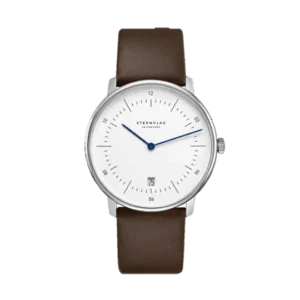
- Movement: Quartz
- Case Width: 38 mm
- Lug-to-Lug Distance: 41 mm
- Lug Width: 20 mm
- Crystal: Domed sapphire
- Water Resistance: 5 ATM
- Current Price: €229 on leather
The Naos is the clearest expression of the Sternglas idea. The white dial, blue hands, fine markings, and date at six give it enough detail to hold my interest without turning it into a busy watch. I would start here for a first Sternglas, an office watch, or a simple companion to a more substantial sports watch.
The current white quartz version is €229 on leather. The 38mm Naos Automatik White is €429. That €200 difference is worth pausing over. I would choose the automatic because I wanted the movement and exhibition back, not because the quartz version somehow fails to be a proper watch.
Size is another useful reason to choose Naos. The Naos XS is 33mm, the standard watch is 38mm, and the Naos XL is 42mm. The XS Silver quartz and XL White quartz are both listed at €229 in their shown configurations. The XS automatic uses a Miyota 6T15; the XL automatic uses the 8215. Both listed examples are €449.
The XS automatic is also longer from lug to lug than the XS quartz, so I would not assume that choosing the same family name gives you the same fit. I would start with the size I actually enjoy wearing and then decide on the movement.
Naos Solar, Big Date, And Moonphase: Different Ways To Use The Same Idea
The Naos Solar White is €299 and retains a 38mm case. Its Epson AS32 charges from light and offers up to four months of reserve when fully charged. For someone who wears one watch often and likes the Naos appearance, this would be high on my list.
The Naos Solar Edition Titanium adds a Grade 2 titanium case at €349. I like the logic of this combination: solar convenience and a lighter case, with a more casual dial treatment. I would compare its appearance and strap with the steel version rather than buy it solely because titanium sounds like an automatic upgrade.
The Naos Big Date Alabaster, also €299, keeps the 38mm format and uses a TMI VJ76 quartz movement. The larger date display is the attraction. If checking the date is one of the things you regularly use a watch for, that is a more tangible benefit than another decorative dial detail.
The Naos Moonphase is €299 in Moon Silver, with a Miyota 6P20 quartz movement, day and date indications, and a moonphase display. I would choose it for the pleasure of the display. It has more going on than the plain Naos, which will be either the reason to buy it or the reason to stay with the simpler dial.
Naos Pro And Pro GMT: The Mechanical Upgrades
The Naos Pro Automatik Alabaster costs €699. Its 38mm diameter, Miyota 9015, and slimmer case make it the Naos I would compare most seriously if I already knew I wanted an automatic. The move from a standard automatic to a Pro should earn its price through proportions, finishing, and the movement you prefer.
For travel, the Naos Pro Automatik GMT Silver is €799. Its Miyota 9075 lets you adjust the local hour hand independently in one-hour steps, which is useful when crossing time zones. It keeps a 38mm diameter and adds a second time-zone display without adopting the usual large-bezel GMT appearance.
This would be my more interesting upgrade if I would actually use the travel function. If I only wanted a clean mechanical three-hander, I would compare the regular Pro and save the difference. My guide to GMT watches explains how this type of local-hour adjustment differs from other GMT arrangements.
Hamburg: More Dial Presence And Maritime Character
The Hamburg Silver quartz is €279. Its 42mm case and instrument-like markings give it a different presence from the 38mm Naos. I would start here if I liked the Sternglas approach but found the Naos a little too delicate or spare.
The Hamburg Automatik Silver is €449, with the Miyota 8215 and up to 42 hours of reserve. The Hamburg Pro Automatik Alabaster is €699, with the Miyota 9015. Both are 42mm wide, but Sternglas lists the Pro’s case at 9mm excluding the crystal, compared with 12mm excluding the crystal for the standard automatic.
That is the reason I would investigate the Pro: less case height beneath the same broad dial, together with the upgraded movement. Its lug-to-lug span is slightly longer, though, so slimmer does not mean smaller in every direction.
The Hamburg Solar White is €329. It brings the Epson AS32 and up to four months of fully charged reserve to the 42mm Hamburg shape. If the design is what attracts you, I would give this as much consideration as either automatic.
Hamburg Chrono: My Pick For More Personality
Hamburg Chrono Dark Green
- Reference: S01-HC35-VI17
- Movement: TMI VK64 mecha-quartz
- Case Width: 42 mm
- Lug-to-Lug Distance: 46 mm
- Lug Width: 20 mm
- Case Material: Stainless steel with bronze-tone PVD
- Water Resistance: 5 ATM
- Current Price: €379
This is the Sternglas I would show someone who thinks minimalist watches are all a little too quiet. The dark green dial, warm case color, and orange accents give the Hamburg Chrono a clear personality while leaving the time easy to pick out.
My Hamburg Chrono Dark Green review goes into the case, dial, movement, and strap in detail. The useful points for choosing one are its relatively short 46mm lug-to-lug span, its expansive dial, and the way the leather strap softens the overall appearance.
The VK64 gives you quartz timekeeping with a mechanically assisted chronograph and a quick reset. It has no continuously running seconds hand, and the 24-hour register follows the main time display. I would not choose it expecting a second time zone or a long-duration hour counter.
I like this configuration for casual and office wear. If you prefer a cooler palette, the wider Hamburg Chrono range offers steel-cased alternatives; the Silver model is listed at €349. I would choose by the dial and case combination you want to wear, since those differences are a large part of the appeal.
Berlin: A More Traditional Everyday Choice
The Berlin Metro Silver is €249, with a 38mm case and a Miyota GM02 quartz movement. The day-date display and curved, satin-finished dial give it a more traditional character than the Naos. Its 45mm lug-to-lug span is worth considering alongside the otherwise modest diameter.
This is the Sternglas I would try if I wanted a watch to wear with shirts and knitwear, but found the Naos a little too austere. The weekday is also useful if you like your watch to answer more than one question at a glance.
The Berlin Automatik Midnight Blue costs €449 and uses a Miyota 8205 with day and date. It retains the 38mm diameter, but adds the thicker construction associated with its mechanical movement. I would compare the two on the wrist before assuming the automatic is the nicer everyday watch for me.
Lumatik: Color, Lume, And A Longer Reserve
The Lumatik costs €499 in the light-blue configuration. It combines a 38mm case with two-tone luminous details and a Miyota 8315 automatic movement offering a 60-hour reserve.
This is the more playful automatic I would put alongside the Naos. The brighter details make it feel less formal, and the longer reserve is useful if you alternate watches. It is still rated to 5 ATM, so the sporty colors should not be confused with the more substantial water resistance of the Marus.
I would choose it if the dial made me smile and I liked its fit. A longer reserve is a useful bonus, but it should not persuade you to buy a color combination you would rarely wear.
Marus 2.0: The Sports-Watch Option
The Marus 2.0 Black is €549 on its steel bracelet. It has a 42mm case, a 50mm lug-to-lug span, a TMI NH35 automatic movement, and 20 bar water resistance. The current design uses a rotating aluminum bezel, broader markers, and a screw-down crown.
This is a substantial change from the original Marus. I would consider it for a more casual everyday role, particularly if I wanted a bezel, stronger visual markers, and a bracelet. Its length still makes a fitting worthwhile; a dive-watch shape does not automatically make a 42mm watch compact.
The Original Marus Black I Reviewed
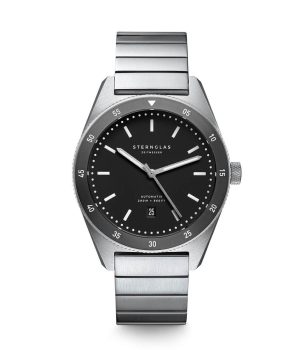
- Reviewed Model: Original Marus Black Automatik
- Movement: Miyota 8215 automatic
- Case Width: 42 mm
- Lug-to-Lug Distance: 53.8 mm
- Water Resistance: 200 m
- Status: Earlier generation; specifications from my original review
My Marus Black review covers the earlier watch with a ceramic bezel and Miyota movement. I liked the combination of a simple dial and a sportier case. Its 53.8mm lug-to-lug measurement is also a useful reminder of how long that original version was.
I include it because it remains relevant to someone considering an older Marus, and because it shows how the collection developed. I would not use its bracelet observations or dimensions as a review of the current NH35-powered 2.0.
Tachymeter 2.0: The Larger Chronograph
The Tachymeter 2.0 Black is €449, with a 44mm case, a 50mm lug-to-lug span, a TMI VK63 mecha-quartz movement, and 10 ATM water resistance. Sternglas currently includes the 2.0 models in its Last Chance selection, so I would check the exact configuration before settling on one.
Compared with the Hamburg Chrono, this is the more overtly sporty choice: a tachymeter bezel, three subdials, a larger case, and stronger contrast. I would choose between them by the appearance and size I preferred. The Tachymeter 2.0 is a separate model from the earlier quartz watch below.
The Original Tachymeter I Reviewed
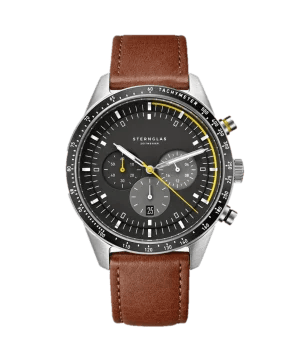
- Reviewed Reference: S01-TY03-MO11
- Movement: Miyota 0S20 quartz
- Case Width: 42 mm
- Lug-to-Lug Distance: 50 mm
- Water Resistance: 50 m
- Status: Earlier generation; specifications from my original review
My original Tachymeter review covers the black-and-yellow design with the Miyota 0S20. Its overlapping subdials and matching yellow accents were much of the attraction, while the 50mm case length was a point to consider for smaller wrists.
That review gives context for an older purchase. It does not describe the movement, dial, or water-resistance specification of the larger VK63-powered 2.0.
Special Editions And Older Collections
Neuwerk, Küste, Bauhaus, and other editions often add a color scheme, material, or dial treatment to an existing family. I would choose the underlying watch first, then decide whether an edition improves it for my taste. A Hamburg Chrono and a Hamburg Automatik do different jobs even when they share an edition name.
The current catalog also includes smaller Naos editions with mother-of-pearl and other decorative treatments. Those deserve the same attention to case size and movement as the more understated versions.
Older names such as Kanton, Sedius, and Merion appear in the watch archive. I would treat archive pieces as a separate shopping exercise, checking the exact reference and condition. The older Taiga GMT from the previous version of this article is not a current core recommendation; the Naos Pro GMT is the travel model I would investigate first today.
Sternglas Vs Other Watch Brands
For a broader view of this design style, my Bauhaus and minimalist watch guide is a useful next stop. A clean dial alone does not make two watches interchangeable. I would compare the case, movement, finish, and price before deciding which interpretation suits me.
Against Laco, I would start with the design I actually wanted: Sternglas for its Naos and Hamburg approach, Laco if a pilot-watch dial was the attraction. My Laco brand review covers its wider range, so that choice does not have to rest on one familiar Flieger photograph.
Against Vaer, I would ask how much of the watch’s life would be spent outside an office or casual daily routine. Compare the exact water resistance, strap, and size rather than treating all solar or quartz watches as the same proposition. My Vaer brand review gives that comparison more room.
If I were considering a €699 Pro, I would also spend time with alternatives in that budget before buying. The reason to choose Sternglas should be the whole watch, not the assumption that the most expensive version of a familiar design must be the best value.
Which Sternglas Would I Buy?
My shortlist would depend on what I wanted from it:
- A simple first Sternglas: Naos White quartz. It delivers the core design without the automatic premium.
- Convenience with a little more technology: Naos Solar, with the titanium version alongside it if a lighter case appeals.
- The strongest personality: Hamburg Chrono Dark Green. This is my pick for its color combination and chronograph layout.
- A compact mechanical watch: Naos Pro Automatik, if I preferred its proportions enough to justify the price.
- A larger mechanical dial: Hamburg Pro Automatik, after comparing its fit with the standard Hamburg.
- Travel: Naos Pro GMT, if I would use the independently adjustable local hour hand.
- Something sportier: Marus 2.0, with a careful look at its case length and bracelet fit.
I would leave with the quartz or solar watch if that was the one I enjoyed wearing most. The automatic options make sense when they add something I want to live with. For me, that is the best way to approach Sternglas: choose the design and fit first, then pay for the movement or feature that will actually make ownership more enjoyable.
Frequently Asked Questions
Are Sternglas watches made in Germany?
Sternglas is based in Hamburg and designs its watches there. Its production overview describes suppliers in Germany, Switzerland, China, and Japan, plus strap fitting and final quality checks in Hamburg. It is more accurate to describe the watches as German-designed than to assume every component is made in Germany.
Should I buy a quartz or automatic Sternglas?
I recommend quartz or solar for straightforward everyday convenience. I would choose an automatic when the mechanical movement is part of the appeal. Compare the actual case and price as well: a standard automatic and a Pro can wear differently even when they share a family name.
What is different about the Sternglas Pro automatics?
The standard Naos and Hamburg automatics use the Miyota 8215, while their Pro versions use the higher-frequency Miyota 9015 and slimmer cases. Both movement types are listed with up to 42 hours of power reserve, so the Pro upgrade is not a longer reserve.
Which Sternglas would I consider for a smaller wrist?
I would start with the 33mm Naos XS, then compare the 38mm Naos and Berlin options. Check the exact version: the XS automatic is longer from lug to lug than the XS quartz, and broad dials can make a watch look larger than its diameter suggests.
Is the Hamburg Chrono an automatic watch?
No. The Hamburg Chrono uses a battery-powered TMI VK64 mecha-quartz movement. It combines quartz timekeeping with a mechanically assisted chronograph. Its 24-hour subdial follows the main time display and is not an independent GMT.
Do the Marus and Tachymeter reviews cover the current 2.0 models?
No. My Marus Black and Tachymeter reviews cover earlier generations. The current Marus 2.0 uses a TMI NH35 automatic movement, while the Tachymeter 2.0 uses a TMI VK63 mecha-quartz movement. Their specifications should not be substituted for those of the older reviewed watches.
What warranty does Sternglas offer?
Sternglas publishes a two-year warranty for material and workmanship defects, subject to its terms and exclusions. Keep the purchase documentation and check the applicable conditions before arranging a repair.