BENRUS Watches Review: Quality, Collections, and My Recommendations
BENRUS gets more interesting when I put its watches next to one another. The little DTU-2A/P looks like it belongs on a well-worn canvas strap. The Ultra-Deep has cathedral hands and the charm of an old diving photograph. Then the carbon-and-titanium Type 3X turns up looking considerably more modern. There is a shared history here, but these watches suit different people.
That is what I want this guide to help you sort out: which BENRUS makes sense for you, what distinguishes it from the neighboring models, and where I think the price needs justification. The name on the dial is a useful starting point. The case, movement, and way you plan to wear the watch should make the final decision.
My dedicated reviews cover the Type 3X Zulu, Ultra-Deep, Sea Lord, and Orbit Robot Skindiver. All four are included below. I draw on those articles for the watches they cover; the other models are researched recommendations, not watches I am claiming to have tested.
Jump to DTU, #3061, Type 1, Type 2, Type 3X, Sky Chief, Ultra-Deep, or my recommendations.
If you buy through the product links in this article, I may receive a commission at no extra cost to you. Thank you for your support.
BENRUS Watches At A Glance
| Category | My Take |
|---|---|
| Founded | 1921 in New York by Benjamin, Oscar, and Ralph Lazrus |
| Identity | American heritage with modern Swiss-made production |
| Current range | DTU, #3061, Type 1, Type 2, Type 3, Sky Chief, and Ultra-Deep |
| Movements | ETA automatics and GMT/chronograph calibers; Soprod P024 in the Ultra-Deep |
| Checked US prices | $990 for DTU-2A/P through $3,950 for Sky Chief |
| Size choices | From the 34mm DTU-2A/P to the 42mm Type 3X |
| Main strengths | Distinctive archive designs, compact options, and useful variety within the range |
| Main tradeoffs | Mostly 38–42-hour reserves, some thick cases, and substantial premiums for particular designs |
| Warranty | Two years, with a third year available through online registration under BENRUS’s terms |
| My dedicated reviews | Type 3X Zulu, Ultra-Deep, Sea Lord, and Orbit Robot Skindiver |
Prices are the US-dollar amounts displayed on BENRUS’s US storefront, checked October 10, 2026, for the configurations shown. The current models below displayed an add-to-cart option at the check; stock, taxes, shipping, and regional prices can change. Older reviewed watches have their original price context labeled separately. Product specifications are BENRUS’s listings unless identified as information from my review.
Quick Verdict: Are BENRUS Watches Good?
Yes, especially if a particular design speaks to you. I think BENRUS is strongest when it offers something specific: the compact twin-crown Ultra-Deep, the restrained Type 1 MIL SPEC, or the unusually small Sky Chief chronograph. Those are easier purchases to explain than a general claim that every watch with an ETA movement is good value.
My first everyday recommendation is the DTU Shield. For a bracelet watch, I would look at the #3061 BOR. For the side of BENRUS I find most charming, I keep coming back to the Ultra-Deep. The Type 3X belongs on a different shortlist, where its GMT function and case materials matter more than vintage proportions.
The reservations are straightforward. A 42-hour reserve is modest at these prices, a compact diameter can hide a thick case, and military history does not mean that every current model is issued to armed forces. I would buy the individual watch for its merits and treat the history as part of the enjoyment.
BENRUS History And Where The Watches Are Made
BENRUS began in New York in 1921, founded by the Lazrus brothers. Its name combines Benjamin’s first name with the family surname. That American background still explains much of the catalog, from field watches to aviation chronographs.
The brand’s collection histories date the Sky Chief to 1940, the military DTU-2A/P to 1964, and the Type I to 1972. The #3061 represents the civilian branch of the field-watch story and has the Steve McQueen connection through Bullitt. I find those origins useful because they explain the shapes and dial layouts still visible today.
I would keep the historical watches and their modern interpretations distinct. A current 41.5mm Type 1 M1 is a contemporary development, and the California-dial #3061 GT is not a literal copy of the watch seen in the film. Likewise, the Type 3X uses the older military designs as a starting point for a new GMT.
The checked current BENRUS product pages describe Swiss-made production, with the brand identifying La Chaux-de-Fonds as its manufacturing location. American heritage and Swiss manufacture are both part of the story. I would not describe these as American-made watches or assume the modern company has operated unchanged since 1921.
Quality, Fit, And Everyday Ownership
Size Is About More Than Diameter
BENRUS gives smaller-watch enthusiasts some interesting choices. The 34mm DTU-2A/P, 36mm Sky Chief, and 36.5mm Ultra-Deep are noticeably more compact than the 41.5mm Type 1 M1 and Type 2 UJ.
But I would read the whole set of dimensions. The Ultra-Deep is 13.8mm thick, while the broader #3061 BU, GT, and BOR are listed at 9.95mm. The larger Type 1/2 variants reach 49.85mm from lug to lug. Those differences matter when deciding whether a watch will sit comfortably or slide beneath a cuff.
The Type 3X has short, tucked-in lugs, but BENRUS does not publish a lug-to-lug measurement on the checked product page. My dedicated review discusses an approximate measurement; I would not present it here as a factory specification.
Materials And Bezels Need A Closer Look
The DTU UB and Type 2 UJ are bronze PVD-coated stainless steel, not solid bronze cases. I would choose them for their warmer appearance, without expecting the same patina development as an uncoated bronze watch.
The MIL SPEC Type 1 and Type 2 list bidirectional bezels and 36.5 ATM water resistance. Their larger M1 and UJ relatives list unidirectional ceramic-insert bezels and 20 ATM. A shared collection name does not make those specifications interchangeable.
Most of the checked watches use sapphire. The Ultra-Deep deliberately uses acrylic, which suits its vintage appearance but is more susceptible to surface scratches. Its twin crowns and internal bezel also describe its layout; they do not, by themselves, establish that it uses a pressure-operated super-compressor case mechanism.
Warranty, Returns, And Servicing
BENRUS’s support terms state a two-year warranty for qualifying purchases, with an additional year available through online registration. I would register promptly and keep the purchase documentation. Coverage has exclusions, and the brand requires authorized service for warranty work.
The same page identifies service locations in New York and La Chaux-de-Fonds. That is useful information to have before buying, although I am not claiming personal experience of a BENRUS warranty repair.
I would confirm the return deadline before ordering. The support page currently gives both 14-day and 30-day return windows in different sections. Rather than promise the longer period, I would ask BENRUS to confirm which terms apply to the order. I would also check the final total for the delivery country.
BENRUS Movements: What Changes Across The Range?
| Movement | Where It Fits And What I Would Consider |
|---|---|
| ETA 2671 | The compact DTU-2A/P; 38-hour listed reserve. A different movement from the larger DTUs. |
| ETA 2892 | Most current three-hand DTU, #3061, and Type 1/2 models; 42 hours. Compare case, dial, and bracelet rather than expecting a reserve upgrade as prices rise. |
| ETA 2893 GMT | Type 3X; 42 hours. A caller GMT with an independently adjustable 24-hour hand. |
| ETA 2894 chronograph | Sky Chief; 42 hours. Its current specification also lists COSC certification. |
| Soprod P024 | Ultra-Deep; 38 hours. Also used in the older Sea Lord and Orbit Robot I reviewed. |
These are supplied Swiss movements, not a range of BENRUS in-house calibers. I see that as a sensible approach, although a familiar movement alone does not guarantee a cheap service bill. Case parts, seals, and chronograph work still affect ownership costs.
The short reserves are worth considering if you rotate watches. A fully wound 38–42-hour watch will not necessarily keep running from Friday evening until Monday morning. I would also keep COSC claims model-specific: the checked Sky Chief lists certification, which should not be extended to every ETA-powered BENRUS.
DTU: The Field-Watch Family
DTU is where I would start for a straightforward BENRUS field watch. The key decision is between the deliberately small 34mm reissue and the three 38mm interpretations. The latter share their dimensions and movement, with different finishes, dials, and straps.
DTU-2A/P: The Compact Reissue

- Reference: DTU-SS-B-034-01
- Movement / Reserve: ETA 2671 automatic; 38 hours
- Width / Height: 34 mm / 10.9 mm
- Lug to Lug: 40.2 mm
- Case / Crystal: Sandblasted steel / sapphire
- Water Resistance: 100 m
- Configuration: Brown leather Bund; green NATO also included
- Price: US$990
This is the DTU I would choose for someone who enjoys smaller vintage proportions. Its 34mm case and short 40.2mm lug span are a meaningful part of its appeal. The Bund strap adds visual presence; the included NATO gives you another way to wear it.
At $990, it is also the lowest-priced watch in the checked current range. I would not buy it merely to spend less than on the 38mm DTUs: the proportions need to be what you want. The ETA 2671 and its 38-hour reserve distinguish it mechanically as well as visually.
DTU Shield: My Everyday Starting Point

- Reference: DTU-SS-S-038-01
- Movement / Reserve: ETA 2892 automatic; 42 hours
- Width / Height: 38 mm / 10.7 mm
- Lug to Lug: 44.9 mm
- Case / Crystal: Sandblasted steel / sapphire
- Water Resistance: 100 m
- Configuration: Fabric strap
- Price: US$1,595
The Shield is my easiest field-watch recommendation in this catalog. The light dial and uncoated steel case look relaxed enough for everyday clothing, while the compact dimensions keep the military styling from becoming cumbersome.
I like it most as a complete design, not as a bargain movement purchase. At $1,595, I would want the dial and case to appeal more than the alternatives from Hamilton or other field-watch specialists. It is a watch to choose because you like wearing this particular design.
DTU Phantom: The Black-Coated Option

- Reference: DTU-BB-B-038-01
- Movement / Reserve: ETA 2892 automatic; 42 hours
- Width / Height: 38 mm / 10.7 mm
- Lug to Lug: 44.9 mm
- Case / Crystal: Black PVD-coated steel / sapphire
- Water Resistance: 100 m
- Configuration: Fabric strap
- Price: US$1,595
The Phantom keeps the Shield’s basic proportions and movement but gives the watch a darker appearance through its black PVD case and black dial. It is the one I would pick if that understated tactical look is the attraction.
The practical question is whether I prefer the black finish enough to live with how wear may show on it. A coated case is not immune to scratches, and exposed steel can be more noticeable against black. The $1,595 price buys a different look, not additional power reserve.
DTU UB: Warm Color Without A Solid-Bronze Case

- Reference: DTU-BR-G-038-03
- Movement / Reserve: ETA 2892 automatic; 42 hours
- Width / Height: 38 mm / 10.7 mm
- Lug to Lug: 44.9 mm
- Case / Crystal: Bronze PVD-coated steel / sapphire
- Water Resistance: 100 m
- Configuration: Brown leather strap
- Price: US$1,595
The UB is the warmer-looking member of the 38mm trio, combining a bronze-colored coating, green dial, and brown leather strap. I would consider it for someone who finds the Phantom too dark and the Shield too restrained.
Its construction deserves clear wording: the base case is stainless steel with bronze PVD. This is an appearance choice rather than a watch I would recommend for the evolving patina of solid bronze. The leather strap also makes this a different everyday proposition from the fabric-strapped options.
#3061: The Everyday Collection
The #3061 family takes BENRUS in a slightly more polished direction. BU, GT, and BOR share slim listed dimensions, but their dial treatments and straps give them different personalities. The 250th edition adds a distinct commemorative design.
The 12/24-hour numerals on the BU and BOR are a reading aid, not a GMT complication. Their hour hands still follow an ordinary 12-hour cycle.
#3061 BU: The Black-Dial Choice

- Reference: 3061-SS-B-039-01
- Movement / Reserve: ETA 2892 automatic; 42 hours
- Width / Height: 39.5 mm / 9.95 mm
- Lug to Lug: 47 mm
- Case / Crystal: Steel / sapphire
- Water Resistance: 100 m
- Configuration: Black leather strap
- Price: US$1,895
The BU is where I would start for the cleanest expression of this collection. Its black dial and leather strap are easy to imagine with everyday clothes, and the mixture of brushed and polished steel gives it a more finished appearance than the sandblasted DTUs.
At $1,895, this is still a substantial purchase for a three-hand watch. The reason to choose it is the combination of design and slender case, not an extra mechanical function over the less expensive field watches.
#3061 BOR: My Bracelet Pick

- Reference: 3061-SS-S-039-03
- Movement / Reserve: ETA 2892 automatic; 42 hours
- Width / Height: 39.5 mm / 9.95 mm
- Lug to Lug: 47 mm
- Case / Crystal: Steel / sapphire
- Water Resistance: 100 m
- Configuration: Beads-of-rice steel bracelet
- Price: US$1,995
The BOR is my favorite #3061 for someone who wants a bracelet from the start. The silver-toned dial and beads-of-rice bracelet feel well suited to the collection’s mix of field-watch origins and everyday polish.
Its $1,995 price is $100 above the BU and GT at the check. That does not make the designs interchangeable, but it gives the bracelet option a clear place in the comparison. I would try the bracelet fit if possible, particularly because 47mm of lug-to-lug length is more relevant than the diameter alone.
#3061 GT: The California Dial

- Reference: 3061-SS-G-039-02
- Movement / Reserve: ETA 2892 automatic with date; 42 hours
- Width / Height: 39.5 mm / 9.95 mm
- Lug to Lug: 47 mm
- Case / Crystal: Steel / sapphire
- Water Resistance: 100 m
- Configuration: Orange leather strap
- Price: US$1,895
The GT makes the strongest visual statement of the regular #3061 models. Its mixed Roman-and-Arabic California dial, green tone, and orange strap are a distinctive combination. It also lists a date display.
I would choose it because that combination makes me smile, rather than because I want an exact movie-watch recreation. The wider #3061 story has the Bullitt connection; this particular dial and strap are a modern interpretation. If you like the case but prefer quieter styling, compare the BU and BOR first.
#3061 250th: The Commemorative Edition

- Reference: 250-SS-W-039-01
- Movement / Reserve: ETA 2892 automatic; 42 hours
- Width / Height: 39.5 mm; height not listed
- Case / Crystal: Steel / sapphire
- Water Resistance: 100 m
- Configuration: Limited edition of 250 numbered pieces
- Price: US$1,776
This edition marks the 250th anniversary of the United States, not 250 years of BENRUS. The Declaration of Independence text on the dial, $1,776 price, and 250-piece edition size all follow that theme.
I would treat it as a choice for someone who specifically wants the commemorative design. The checked page does not list case height or lug-to-lug length, so I have not borrowed those measurements from the regular #3061 watches. It displayed an add-to-cart option, but I would confirm remaining stock before planning around it.
Type 1: The Military Diver And Its Modern Sibling
The Type 1 family is an especially useful reminder to compare references. The MIL SPEC and M1 have related design roots, but the M1 changes the dimensions, finish, bezel, caseback, and water-resistance rating.
Type 1 MIL SPEC: The Restrained Tool Watch

- Reference: T1MS-SS-B-395-01
- Movement / Reserve: ETA 2892 automatic; 42 hours
- Width / Height: 39.5 mm / 14.4 mm
- Lug to Lug: 47.66 mm
- Case / Crystal: Sandblasted steel / sapphire
- Water Resistance: 36.5 ATM, as specified
- Configuration: Black rubber strap; bidirectional bezel
- Price: US$1,795
This is my pick for the most direct expression of the Type 1 design. The black dial, geometric markers, and sandblasted case give it a purposeful appearance without much decoration.
Its 39.5mm diameter is manageable on paper, but the 14.4mm height deserves attention. I would also note the bidirectional bezel rather than assuming the usual one-way dive bezel. BENRUS specifies 36.5 ATM in the technical block; I use that figure instead of the differently rounded depth in its collection-wide marketing copy.
Type 1 M1: A Larger, More Polished Interpretation

- Reference: T1C1-SS-S-415-01
- Movement / Reserve: ETA 2892 automatic; 42 hours
- Width / Height: 41.5 mm / 13.7 mm
- Lug to Lug: 49.85 mm
- Case / Crystal: Steel / sapphire
- Water Resistance: 200 m
- Configuration: Fabric strap; unidirectional ceramic-insert bezel
- Price: US$1,995
The M1 brings a champagne dial, polished bevels, ceramic bezel insert, and display back to a larger 41.5mm case. I find it easier to imagine as an expressive everyday sports watch than as a restrained historical reissue.
The changes involve tradeoffs: it is a little thinner than the MIL SPEC, but its longer 49.85mm lug span may be more demanding. Its own specification lists 200m, not the MIL SPEC model’s 36.5 ATM. I would choose between them on fit and design rather than treating the M1 as an upgrade in every respect.
Type 2: Numerals And A Different Personality
Type 2 substitutes a numerical 12/24-hour dial for Type 1’s simpler markers. I would decide which dial I prefer before getting caught up in the names. Here, too, the heritage-oriented and contemporary models have distinct specifications.
Type 2 MIL SPEC: The Numerical Alternative

- Reference: T2MS-SS-B-395-01
- Movement / Reserve: ETA 2892 automatic; 42 hours
- Width / Height: 39.5 mm / 14.4 mm
- Lug to Lug: 47.66 mm
- Case / Crystal: Sandblasted steel / sapphire
- Water Resistance: 36.5 ATM, as specified
- Configuration: Black rubber strap; bidirectional bezel
- Price: US$1,795
If you like the Type 1 MIL SPEC case but prefer a dial with more information, this is the natural comparison. The numbers give it more of a field-watch character, while the dimensions, rubber strap, and listed water resistance keep it close to its sibling.
My preference would come down to legibility at a glance: the Type 1’s markers feel simpler, while the Type 2 makes the 24-hour reading more immediate. That inner scale does not indicate a second time zone. For that function, I would move to the Type 3X.
Type 2 UJ: The Bronze-Colored Contemporary Model

- Reference: T2CI-BR-G-415-01
- Movement / Reserve: ETA 2892 automatic; 42 hours
- Width / Height: 41.5 mm / 13.7 mm
- Lug to Lug: 49.85 mm
- Case / Crystal: Bronze PVD-coated steel / sapphire
- Water Resistance: 200 m
- Configuration: Brown leather strap; unidirectional ceramic-insert bezel
- Price: US$1,995
The UJ has the larger case architecture of the Type 1 M1, with a bronze-colored PVD finish, green dial, and brown leather strap. It is the Type 2 I would consider for its color and character, rather than for closeness to the original military watch.
Again, this is coated stainless steel, not a solid-bronze case. The longer lugs and leather strap also make fit and intended use worth considering. At $1,995, I would compare it directly with the M1 and decide which dial and finish I would enjoy over time.
Type 3: The Type 3X Zulu GMT
Type 3X Zulu Green: The Model In My Dedicated Review
- Reference: T3XG-BC-B-420-01
- Movement / Reserve: ETA 2893 automatic GMT; 42 hours
- Width / Height: 42 mm / 12.5 mm
- Case / Crystal: Composite carbon and titanium / sapphire
- Water Resistance: 200 m
- Configuration: Green fabric strap; rubber strap also included
- Price: US$2,950
The Type 3X is the modern counterpoint to the reissues. The carbon-and-titanium case, GMT hand, and tucked-in lugs give it a separate identity. The pictured Green and the Black version share the core specifications; the Black pairs its dial with a tan fabric strap, while both configurations include rubber as well.
Its ETA 2893 is a caller GMT: the 24-hour hand adjusts independently, rather than the local hour jumping separately. I would find that useful for following another time zone, while frequent travel is a reason to compare flyer GMT alternatives.
At $2,950, the case construction and design need to justify the purchase; the reserve is still 42 hours. Read my Type 3X Zulu review for the fuller discussion of both colors, the straps, and the case geometry.
Sky Chief: The Compact Chronograph
Sky Chief Stratus Grey

- Reference: SKY-SS-B-036-01
- Movement / Reserve: ETA 2894 automatic chronograph; 42 hours
- Width / Height: 36 mm / 11.9 mm
- Lug to Lug: 42.5 mm
- Case / Crystal: Steel / sapphire
- Water Resistance: 100 m
- Configuration: Grey leather strap; COSC-certified movement
- Price: US$3,950
The Sky Chief is one of the most distinctive propositions here: a 36mm automatic chronograph with a 42.5mm lug span. That is the reason I would put it on a shortlist for someone who likes vintage chronograph proportions. BENRUS also lists COSC certification for the current movement.
The pictured Stratus Grey has the quieter palette; Cirrus White offers a lighter dial. They share the same movement and listed case dimensions.
At $3,950, I would take my time. The small case is an attraction if it fits your taste, but it does not automatically make the watch better value than a larger chronograph. I would want to see the subdials and try the proportions before committing.
Ultra-Deep: The Small Diver With Character
Ultra-Deep: My Twin-Crown Pick
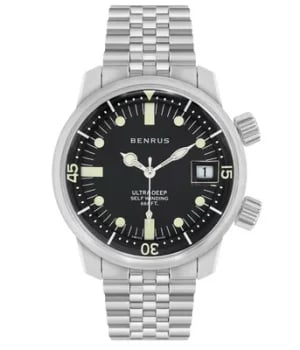
- Reference: UD-SA-BK-SS
- Movement / Reserve: Soprod P024 automatic; 38 hours
- Width / Height: 36.5 mm / 13.8 mm
- Lug to Lug: 41.5 mm
- Case / Crystal: Steel / acrylic
- Water Resistance: 200 m
- Configuration: Jubilee-style steel bracelet; blue NATO also included
- Price: US$1,195
The Ultra-Deep is still the BENRUS I would point to when someone asks for charm. The cathedral hands, internal timing bezel, and acrylic crystal give the watch a character that its diameter alone cannot explain. The bracelet and included NATO also offer two quite different looks.
My main qualification is its height: 36.5mm wide does not mean especially thin, and the acrylic deserves realistic expectations about scratches. BENRUS describes the current screw-down construction as inspired by the original Supercompressor; I would not promise the historical pressure-operated mechanism.
Read my Ultra-Deep review for the detailed look at the dial, case, and bracelet. The $1,195 above is the current checked price, rather than the earlier price recorded in that review.
Earlier BENRUS Watches I Reviewed
The Sea Lord and Orbit Robot deserve a place here because they show another side of the brand and have dedicated hands-on coverage. Neither appears in the checked current catalog, and their former official shopping pages return 404s. I would look at these as older-model research, with availability dependent on a separate search for remaining stock or pre-owned examples.
Sea Lord: The Vintage-Style Diver
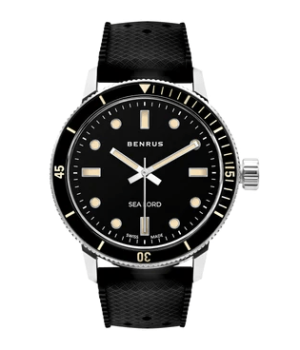
- Movement / Reserve: Soprod P024 automatic; 38 hours
- Width / Height: 39 mm / 13 mm
- Lug to Lug: 45 mm
- Configuration Reviewed: Black dial and rubber Tropic strap
- Price at Review: Under US$900
- Availability: Not in the checked current catalog
The Sea Lord was sent to me on loan for my review. I liked the straightforward black dial, warm-toned markers, and rubber Tropic strap. Its 39mm case and 45mm lug span made it a useful comparison with the smaller-looking but thicker Ultra-Deep.
I would still keep it in mind if the design is exactly what you want, but the old sub-$900 price is historical context, not a current offer. My Sea Lord review covers the watch as reviewed, including its ceramic bezel and lack of a date display.
Orbit Robot Skindiver: The Seventies Design
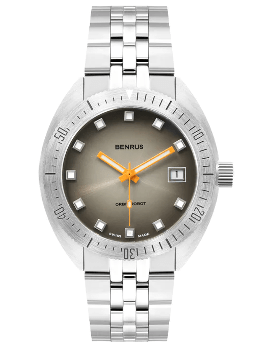
- Reviewed Reference: OR-BR-FU-SS
- Movement / Reserve: Soprod P024 automatic; 38 hours
- Case Width / Lug to Lug: 41 mm / 43 mm
- Case / Crystal: Steel / sapphire
- Water Resistance: 200 m
- Configuration Reviewed: Grey fumé dial and steel bracelet
- Price at Review: Under US$1,000
- Availability: Not in the checked current catalog
The Orbit Robot is the playful one: a cushion-shaped case, grey fumé dial, and broad orange hands. I like the contrast between the strong dial treatment and the more elegant bracelet. It feels quite different from the current military-centered catalog.
Its 41mm width comes with a short 43mm lug-to-lug measurement in my review. That gives you a better starting point for judging fit than the diameter alone. Read my Orbit Robot review for the case, friction bezel, and bracelet details before considering an older example.
BENRUS Compared With Other Brands
BENRUS Vs Hamilton
I would compare the DTU with Hamilton if I wanted a field watch and was open to different interpretations of that style. BENRUS makes a strong case when its particular proportions or finish appeal to you. Hamilton deserves a look before deciding how much that preference is worth. My Hamilton brand review is a starting point for that comparison.
BENRUS Vs Vaer
Vaer belongs in the conversation if American identity and practical everyday use are the priorities. I would compare the exact model’s assembly origin, movement, and total price, rather than treating every watch from either brand as American-made. My Vaer guide explains its collection choices.
BENRUS Vs DOXA
For a diver, I would compare BENRUS’s restrained military designs and small Ultra-Deep with the different case shapes and dial personalities in my DOXA guide. The most useful question is which watch fits and reads well on your wrist. A larger depth-rating number alone would not make the decision for me.
Which BENRUS Would I Choose?
- For an everyday field watch: DTU Shield. It is my balanced starting point for size and styling.
- For deliberately small proportions: DTU-2A/P. Buy it because you want the 34mm format.
- For a bracelet watch: #3061 BOR. I like its more polished everyday appearance.
- For the military-diver design: Type 1 MIL SPEC, or Type 2 MIL SPEC if you prefer numerals.
- For a larger contemporary interpretation: Type 1 M1 or Type 2 UJ, after checking the longer lug span.
- For a GMT: Type 3X, if its case construction and caller-GMT function suit your needs.
- For a compact chronograph: Sky Chief, with its price and small dial layout considered carefully.
- For vintage-diver character: Ultra-Deep. Its acrylic crystal and thickness are part of the decision.
My overall view is that BENRUS has enough variety to reward a proper comparison. I would start with the design I want to wear, check its dimensions and practical limitations, and then decide whether the price feels right. The strongest reason to buy one is finding a watch whose character you would miss elsewhere.
BENRUS Watches FAQ
Are BENRUS watches American-made?
The checked current BENRUS watches are described as Swiss Made. BENRUS was founded in New York in 1921, so American heritage is part of its identity, but I would not describe the current range as manufactured in the United States.
What is the difference between Type 1 and Type 2?
The clearest distinction is the dial: Type 1 uses geometric hour markers, while Type 2 adds a numerical 12/24-hour layout. Compare the exact versions as well. The 39.5mm MIL SPEC watches differ in dimensions, bezel construction, and water resistance from the 41.5mm M1 and UJ models.
Are the DTU UB and Type 2 UJ solid bronze?
No. Their checked specifications describe stainless steel with a bronze PVD coating. I would choose them for the bronze-colored appearance without expecting the same patina development as an uncoated solid-bronze case.
Is the Type 3X a flyer GMT?
No. Its ETA 2893 is a caller GMT, with an independently adjustable 24-hour hand. It does not offer the independently jumping local hour associated with a flyer GMT. I would choose according to how I use a second time zone.
Are all BENRUS watches COSC-certified?
I would not assume that. The checked current Sky Chief specifications explicitly list COSC certification. That statement should not be applied to the whole range simply because other models also use ETA movements.
Which BENRUS watches would I consider for a smaller wrist?
I would compare the 34mm DTU-2A/P, 36mm Sky Chief, and 36.5mm Ultra-Deep. Their listed lug-to-lug measurements are 40.2mm, 42.5mm, and 41.5mm respectively. The Ultra-Deep is also 13.8mm thick, so diameter alone is not enough to judge fit.
Can I still buy the Sea Lord and Orbit Robot from BENRUS?
Neither appeared in the current official catalog I checked, and their former product pages returned 404s. My reviews remain useful for researching older examples, but their original prices are not current offers. Any remaining stock or pre-owned purchase needs a separate availability and condition check.
What warranty does BENRUS offer?
BENRUS publishes a two-year warranty for qualifying purchases, with an additional year available through online registration. Coverage conditions and exclusions apply, and warranty work requires authorized service. I recommend keeping the purchase documents and checking the official terms for the exact order.