BALL Watches Review: All Eight Collections and My Picks
BALL is the sort of brand I would recommend to someone who enjoys the details: a dial that glows without being charged, an unusually substantial crown guard, or a power-reserve hand that tells you when the watch needs winding. There is plenty to explore beyond the railroad story on the dial.
My everyday starting point is the Engineer III Marvelight Chronometer 40. It brings together the qualities I find most appealing about BALL in a relatively straightforward watch. For something more distinctive, I would look at the Hydrocarbon Original or the Roadmaster Challenger Power Reserve, both of which have dedicated reviews here.
This guide covers all eight collections in BALL’s current official catalog, with one representative watch card per collection and galleries showing selected configurations. I have included my Hydrocarbon Original review and my Roadmaster Challenger review. My wider recommendations draw on those articles and current official specifications; I have not tested every model pictured.
Jump to Hydrocarbon, Master II, Engineer II, Engineer III, Engineer M, Roadmaster, Trainmaster, Fireman, or my recommendations.
Prices below are the official store’s displayed EUR prices, checked November 6, 2026. Regional prices, taxes, and delivery estimates can differ. Product images and buttons link directly to BALL. The Jomashop browsing link later in this guide is an affiliate link; I may earn a commission at no extra cost to you.
BALL At A Glance
| What I Would Want To Know | The Short Answer |
|---|---|
| Background | American railroad heritage; Swiss-made watches today |
| Current range | Engineer Hydrocarbon, Engineer Master II, Engineer II, Engineer III, Engineer M, Roadmaster, Trainmaster, Fireman |
| Signature feature | Self-illuminating tritium micro gas tubes |
| My everyday starting point | Engineer III Marvelight Chronometer 40 |
| My lower-priced pick here | Fireman Victory 40, listed at €1,390 |
| Main strengths | Distinctive illumination, useful complications, and substantial technical specifications on selected references |
| Main reservations | Overlapping names, sometimes bulky cases, varying delivery times, and specifications that change with the exact reference |
My Verdict: Are BALL Watches Good?
Yes. I think BALL is particularly interesting if you want a Swiss mechanical watch with a practical feature you will actually appreciate. The gas tubes give the brand a recognizable identity, while choices such as the Challenger’s reserve indicator and the Skindiver III’s 80-hour movement offer different reasons to buy.
I would still choose carefully. A Hydrocarbon Original is a substantial watch, and the Skindiver III’s 41.5mm diameter conceals a 52mm lug-to-lug length. Some models have COSC-certified movements; others do not. Anti-magnetic ratings and power reserves also vary considerably.
My advice is to choose the design first, then check the reference, dimensions, and delivery terms. BALL’s range rewards that extra look, especially when two very similar names describe quite different watches.
From American Railroads To Swiss Watchmaking
BALL’s official heritage account traces its identity to Webb C. Ball and the aftermath of the 1891 Kipton railway accident in Ohio. His work on watch inspection and timekeeping standards helped make dependable timing central to railroad operations. That connection explains the RR markings and names such as Trainmaster and Fireman.
The modern company is based in La Chaux-de-Fonds, Switzerland, as listed by the Federation of the Swiss Watch Industry. Today’s watches are Swiss-made. I find the American history more meaningful as context for the designs than as a reason to assume where a current watch is manufactured.
What Makes BALL Different?
The most recognizable feature is tritium micro gas tubes. They provide continuous illumination without sunlight, a lamp, or a battery charging them first. I like the idea of a dial whose nighttime usefulness does not depend on remembering to expose it to light before bed.
They do lose brightness over time. BALL’s owner’s manual explains that replacing the affected tubes can restore brightness, so I would not describe the glow as everlasting. The manufacturer’s night image in the Master II gallery illustrates the tube layout, rather than serving as my own brightness test.
BALL also offers anti-shock and anti-magnetic systems, but they are reference-specific. The Hydrocarbon below lists SpringLOCK, SpringSEAL, and a mu-metal shield; the simpler Fireman has a different specification. Likewise, the featured Engineer M uses a manufacture-designated RRM7309-C with an 80-hour reserve, while the Challenger has a 42-hour RR1702-C. Neither one describes the entire catalog.
Engineer Hydrocarbon: The Distinctive Tool Watch
Engineer Hydrocarbon is where I would start for BALL’s more assertive tool-watch designs. The current range includes Original 40 and 43, AeroGMT II with Patriot, Meteorite, Blackbird, and Sled Driver versions, Submarine Warfare and its chronograph, NEDU, Hope, EOD, and DeepQUEST II/Ceramic. These are different branches, not simply colors of one watch.
My representative is the Original 43, with the green rubber-strap reference from my dedicated Hydrocarbon review. Its protected crown, recessed luminous markers, and curved sapphire bezel give it a personality I would recognize across a room.

- Reviewed Reference: DM2218B-P2CJ-GR
- Movement: RR1102-CSL automatic; COSC chronometer
- Case: Steel; 43mm × 15.3mm; approximately 54mm lug-to-lug
- Crystal / Bezel: Convex AR sapphire / rotating sapphire bezel
- Water Resistance / Lug Width: 200m / 21mm
- Illumination: 30 micro gas tubes
- Official Prices: €3,130 green on rubber; €3,230 pictured bracelet versions
The gallery shows the reviewed green DM2218B-P2CJ-GR on rubber, plus blue and black bracelet versions. BALL listed all three with a 15-business-day dispatch window when checked. The rubber version is €100 less than the two pictured bracelet configurations.
The catch is size: 43mm wide, 15.3mm thick, and approximately 54mm lug-to-lug. I would try it on before buying, especially if I usually wore thinner watches. Its 200m rating and 80,000 A/m anti-magnetic specification are useful features, but they do not make that case disappear on the wrist.
Engineer Master II: Divers And Instrument-Style Watches
Engineer Master II includes Diver, Diver Chronometer, Ballistic Diver, Diver Worldtime, and Skindiver Heritage, alongside Doolittle Raiders, Endurance 1917, Normandy, and Snoopy Flying Ace. The mix is broader than the name suggests, with different sizes and both chronometer and non-chronometer choices.
I would begin with the Diver Chronometer 42. The two crowns and internal rotating bezel give it a distinctive instrument-like appearance without the Hydrocarbon’s large crown-protection structure.

- References: DM2280A-S1C-BKR (Rainbow) / DM2280A-S1C-BK (Classic)
- Movement: RR1101-C automatic; COSC chronometer
- Case: Steel; 42mm × 13.5mm; 50mm lug-to-lug
- Crystal / Bezel: AR sapphire / rotating sapphire inner bezel
- Water Resistance / Lug Width: 300m / 21mm
- Illumination: 36 micro gas tubes
- Official Price: €2,460 for either pictured configuration
Both pictured configurations have black dials: BKR uses Rainbow tubes; BK uses Classic tubes. The third image is BALL’s night view of the Rainbow version. Both were listed at €2,460 with a 15-business-day dispatch window.
The 42mm case is still substantial at 50mm lug-to-lug. I would compare the crown access and internal-bezel operation with a conventional external dive bezel before deciding which I preferred. This reference combines 300m water resistance, COSC certification, and 80,000 A/m anti-magnetic protection.
Engineer II: A Good Place To Explore Complications
Engineer II currently spans Skindiver Heritage, M Skindiver Heritage, Moon Phase, Moon Phase Chronometer, Navigator World Time Chronograph, Timetrekker, Galloping Horse, and Dazzle. I would not use the Roman numeral as a simple generation or quality ranking; these families overlap in purpose.
My pick here is the Moon Phase Chronometer 41. I like how the moon display gives the dial a softer, more decorative character while retaining the broad markers and automatic movement I associate with BALL.
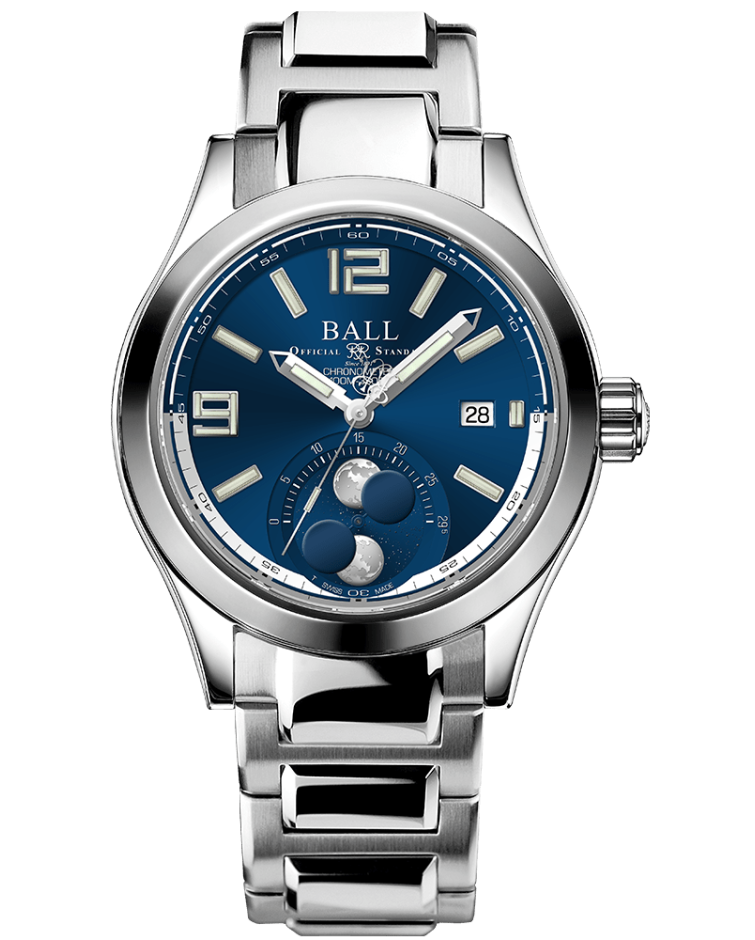
- Featured Reference: NM2282C-S1C-BE (blue)
- Movement: RR1804-C automatic; COSC; double moon-phase indication
- Case: Steel; 41mm × 13.95mm; approximately 47.6mm lug-to-lug
- Crystal / Water Resistance: AR sapphire / 100m
- Lug Width / Illumination: 20mm / 22 micro gas tubes
- Official Listed Price: €2,280 for each pictured color
- Availability: Blue estimated 1 month; black and green out of stock
The gallery shows blue, black, and green versions, all listed at €2,280. Blue had an estimated one-month lead time; black and green were out of stock on November 6. I have kept those two images for comparison and labeled their status rather than implying they can be ordered immediately.
This is not an ultra-thin dress watch: the case is 13.95mm thick. I would choose it because I wanted the moon-phase display, with the 100m rating and approximately 47.6mm lug-to-lug length helping it remain a plausible everyday option.
Engineer III: My Everyday Starting Point
Engineer III is a large family. Marvelight covers several sizes, Day-Date, Meteorite, and Patriot versions. Other branches include Pioneer/Pioneer II, Legend/Legend II/Legend Arabic, Ohio, King, Dreamer/TiC, and travel-oriented Outlier, Maverick GMT, and Endurance 1917 GMT. Bright Path, Snoopy Flying Ace, Invigorating Serpent, 00BLU, and 00RED add more distinctive dial treatments.
I would start with the Marvelight Chronometer 40. Its straightforward dial makes the tube markers the focus, and the 46.6mm lug-to-lug length is easier to accommodate on paper than several of the divers below and above.

- Featured Reference: NM9026C-S6CJ-BK (black)
- Movement: RR1103-C automatic; COSC chronometer
- Case: 904L steel; 40mm × 12.45mm; 46.6mm lug-to-lug
- Crystal / Water Resistance: AR sapphire / 100m
- Anti-Magnetism: 80,000 A/m; mu-metal shield
- Lug Width / Illumination: 20mm / 14 micro gas tubes
- Official Price: €2,250 for each pictured color
The gallery shows black, blue, and ice blue from the S6CJ bracelet series, at €2,250 each. Black had a one-month estimate; blue and ice blue showed the 15-business-day dispatch window. Other Marvelight configurations have different prices, bracelets, tube arrangements, or dimensions.
For me, this is the most balanced introduction to BALL: 100m water resistance, a COSC-certified automatic, and a 904L steel case without a rotating bezel dominating the design. I would still check bracelet fit; the listed weight is approximately 180g.
Engineer M: Longer Reserves And A Different Movement Proposition
Engineer M includes Ascension, Star Magna, Marvelight/Patriot, Pioneer/Pioneer II, Endurance, Normandy, Challenger, Challenger Bronze, Best Bronze, and Skindiver III/Beyond. Familiar names recur here, which is a good reason to check the caliber instead of assuming two Marvelights are mechanically identical.
The Skindiver III 41.5 is my pick for someone who wants a more traditional dive-watch shape and a longer reserve. BALL describes its RRM7309-C as a manufacture caliber, with COSC certification and 80 hours of power reserve.

- References: DD3100A-S1C-BK / DD3100A-S1C-BE
- Movement: RRM7309-C automatic; COSC; 80-hour reserve
- Case: Steel; 41.5mm × 13.8mm; 52mm lug-to-lug
- Crystal / Bezel: Domed AR sapphire / rotating sapphire bezel
- Water Resistance / Lug Width: 300m / 22mm
- Illumination: 40 micro gas tubes
- Official Price: €3,560 for either pictured color
Black and blue were both €3,560 with a 15-business-day dispatch window. I prefer black for its restrained appearance, though the blue version changes the feel considerably. The Beyond version is another current branch; it is not the blue S1C reference pictured here.
The detail I would not overlook is the 52mm lug-to-lug length. This is not automatically a compact watch because its diameter begins with 41. The 80-hour reserve is attractive if I want to leave it off for a weekend, but fit would still decide whether I bought it.
Roadmaster: Travel Watches And Useful Complications
Roadmaster has the broadest mix here. Marine GMT, including Meteorite and Moon Phase versions, Pilot GMT, Vanguard/Vanguard II, and Worldtime cover travel. Challenger/Archangel Power Reserve, Challenger Moonphase, M Archangel II, Ocean Explorer, Perseverer/M Perseverer, and Marvelight Bronze/M Marvelight Bronze offer other approaches.
There are also CSAR and its chronograph, First Responder, Rescue Chronograph, MSF 55, TMT, StarLight Bronze, and M Model A, with Rotor-LOCK variants in selected branches. I would narrow this collection by function before comparing dial colors.
My choice is the Challenger Power Reserve DP3006A-S2CJ-WH, covered in my dedicated Roadmaster review. The reserve indicator is the feature that attracts me most: it gives a useful answer to whether a watch in rotation needs winding.
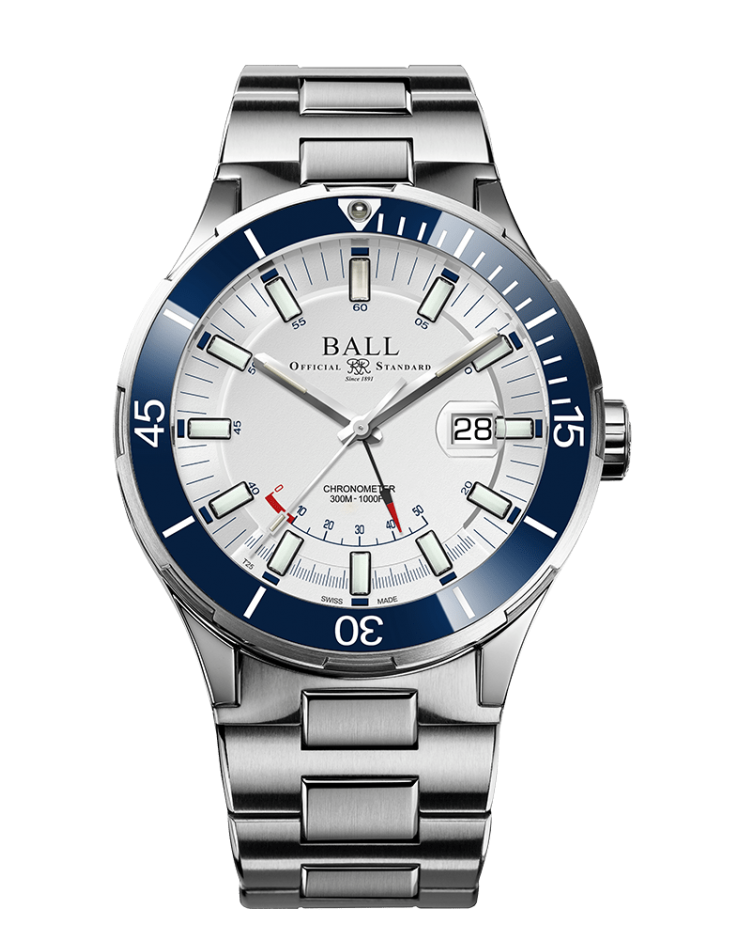
- Reviewed Reference: DP3006A-S2CJ-WH
- Movement: RR1702-C automatic; COSC; 42-hour reserve indicator
- Case: Steel; 40mm × 13.2mm; 47.8mm lug-to-lug
- Crystal / Bezel: AR sapphire / rotating ceramic-insert bezel
- Water Resistance / Lug Width: 300m / 20mm
- Illumination: 16 micro gas tubes, plus bezel Super-LumiNova
- Official Price: €2,100 for each pictured 40mm configuration
- Estimated Lead Times: White 3 months; blue and green 2 months
These are 40mm DP3006A references. The larger 43mm DP3306A is a different case, and I would not mix its measurements into the smaller watch’s specifications. The white dial with blue bezel remains my preference; blue and green alternatives appear in the gallery.
All three were listed at €2,100, with three months estimated for white and two months for blue and green. This is an online-exclusive limited edition, so I would confirm the current delivery estimate before paying. The 42-hour reserve is modest beside the Engineer M’s 80 hours, although the indicator makes the remaining reserve easy to monitor.
Trainmaster: The Dressier Side Of BALL
Trainmaster brings the railroad connection into a more traditional-looking range. The current catalog includes Legend, Eternity/Eternity Ladies, Titanium, MSF Humanity, MSF 55, and the Secometer Pocket Watch. The pocket watch is worth knowing about even if a wristwatch is the more practical purchase for most people.
I would start with the Legend. The silver dial, Arabic numerals, and slimmer profile give it a different character from the divers. It is the BALL I would consider first if I wanted something more comfortable alongside a shirt cuff.

- References: NM9080D-S1J-SL / NM9080D-L1J-SL
- Movement: RR1103 automatic; date
- Case: 904L steel; 40mm × 11.45mm; approximately 46mm lug-to-lug
- Crystal: AR sapphire; sapphire display back
- Water Resistance / Lug Width: 30m / 20mm
- Illumination: 14 micro gas tubes
- Official Price: €1,750 on bracelet or pictured leather strap
The steel-bracelet and brown-leather versions were both €1,750, with the 15-business-day dispatch window. I like the leather option for its warmer appearance, while the bracelet makes the design feel more contemporary.
The important qualification is 30m water resistance and a push crown. I would treat this as the dressier choice, rather than assume it shares the capabilities of a 300m Roadmaster. BALL lists an RR1103 here without COSC certification.
Fireman: My Lower-Priced Starting Point
Fireman includes Victory, Victory MOP, Victory Ladies, Enterprise, 2-Tone in 31mm and 40mm sizes, and Ducks Unlimited Camouflage. It is where I would look for a simpler route into BALL’s gas-tube dials, without paying for the more elaborate complications.
The Victory 40 is my pick. I have chosen the Clous de Paris dial pattern in black, blue, and silver; other Victory references use different textures and tube arrangements.

- Featured Reference: NM2098C-S5J-BK; Clous de Paris dial
- Movement: RR1103 automatic; date
- Case: Steel; 40mm × 11.3mm; 48.5mm lug-to-lug
- Crystal / Water Resistance: AR sapphire / 100m
- Lug Width / Illumination: 20mm / 14 micro gas tubes
- Official Price: €1,390 for each pictured color
- Estimated Lead Times: Black and silver 1 month; blue 3 months
All three pictured watches were €1,390. Black and silver had one-month estimates, while blue showed three months. I would choose black for versatility, though the silver dial is a useful alternative if the darker BALL designs feel too heavy visually.
The RR1103 is not listed as COSC-certified, and the 4,800 A/m anti-magnetic rating is lower than the featured Marvelight’s. On the other hand, the Victory gives me sapphire, 100m water resistance, and a relatively slim 11.3mm case at the lowest price among these eight picks.
Quality And Ownership: What I Would Check
Read the reference, not just the collection name. COSC certification, anti-magnetic protection, reserve, dimensions, and bracelet configuration can change between closely related watches. The selections above range from 30m to 300m water resistance; there is no single brand-wide specification.
Consider the actual fit. My first checks would be lug-to-lug length, thickness, weight, and bracelet adjustment. The 40mm Marvelight and 40mm Fireman do not have identical proportions, and the 41.5mm Skindiver is longer than either.
Treat delivery labels as estimates. BALL’s FAQ explains that “15 Days” means dispatch within 15 business days. Month-based labels are estimated shipping lead times. I would also read the cancellation terms before placing a preorder, especially for a watch I need by a particular date.
Check the warranty attached to the seller. The same FAQ lists four years for the authorized-dealer Premium International Warranty and two years for the online-boutique Standard International Warranty. Each can gain an extra year through registration within 90 days. I would keep the warranty certificate and purchase documentation, and check whether another retailer supplies its own warranty instead.
For a retailer comparison, browse BALL watches at Jomashop. This is a general selection link, so I would match the complete reference before comparing its price with the official-store figures above. Retailer stock and warranty terms may differ.
My BALL Recommendations
| If I Wanted… | I Would Start With… | Why |
|---|---|---|
| One everyday BALL | Engineer III Marvelight Chronometer 40 | Straightforward dial, COSC movement, and relatively manageable length |
| A lower-priced automatic | Fireman Victory 40 | Sapphire, 100m rating, and gas tubes at €1,390 |
| The most distinctive tool-watch design here | Hydrocarbon Original 43 | Crown protection, sapphire bezel, and the reference covered in my review |
| An internal-bezel diver | Master II Diver Chronometer 42 | Two-crown layout and a choice of tube colors |
| A decorative complication | Engineer II Moon Phase Chronometer | Moon-phase display within a sporty case |
| A diver with a longer reserve | Engineer M Skindiver III | 80-hour manufacture-designated movement |
| A useful reserve display | Roadmaster Challenger Power Reserve | Central reserve indicator and 300m rating |
| A dressier watch | Trainmaster Legend | Traditional dial and a slimmer profile |
For alternatives, I would compare Mido for a broad Swiss range, Hamilton for field and pilot watches, or DOXA for a more concentrated dive-watch identity. BALL’s continuous gas-tube illumination is the feature that most clearly separates it from those choices.
My shortlist begins with the Marvelight 40, Challenger Power Reserve, and Hydrocarbon Original. They offer three different ways into the brand: an everyday watch, a useful complication, and a distinctive tool watch. I would let fit and the feature I actually wanted decide between them.
BALL Watches FAQ
Are BALL watches American or Swiss?
BALL has American railroad roots associated with Webb C. Ball and the timekeeping reforms that followed the 1891 Kipton accident. The modern company is based in La Chaux-de-Fonds, Switzerland, and sells Swiss-made watches. Its American heritage does not mean its current watches are made in the USA.
Which BALL watch would I recommend first?
My everyday starting point is the Engineer III Marvelight Chronometer 40. I would consider the Fireman Victory for a lower-priced automatic, the Engineer M Skindiver III for an 80-hour dive watch, or the Roadmaster Challenger if a power-reserve indicator appeals to you.
Do BALL gas tubes need charging, and do they last forever?
The tritium gas tubes glow without charging from an external light source or using a battery. They gradually lose brightness over the years; BALL’s manual explains that replacing the affected tubes can restore it. They are not a promise of unchanged brightness forever.
Does BALL make all its own movements?
I would not make that blanket claim. BALL uses several movement families. The featured Skindiver III has the RRM7309-C, described by BALL as a manufacture caliber with an 80-hour reserve. Other featured watches use RR-series calibers, and not every BALL is COSC-certified.
Are all the pictured watches available immediately?
No. On November 6, 2026, several selected references had estimated lead times of one to three months. BALL marked the black and green Engineer II Moon Phase Chronometers out of stock. Even its 15 Days label means dispatch within 15 business days, rather than immediate delivery. Check the exact configuration before ordering.
What warranty does BALL offer?
BALL’s FAQ lists a four-year Premium International Warranty for purchases through authorized dealers and a two-year Standard International Warranty for its online boutique. Both can gain one extra year through registration within 90 days of purchase. I would confirm the seller’s eligibility and documentation; an independent retailer’s own warranty can differ.