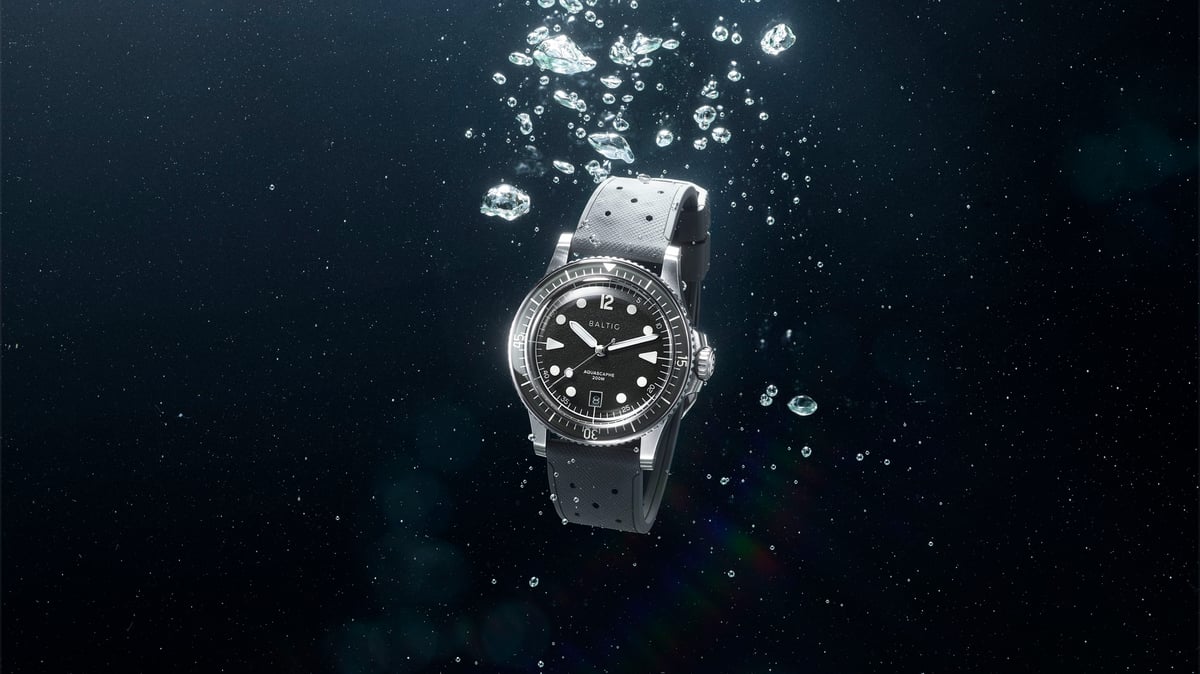
Hamilton Watches Review: Collections, Quality, and My Picks
Hamilton is easy to recommend for a field watch. The more interesting question is whether that is the Hamilton you would actually enjoy most. A Pilot Pioneer brings a different kind of vintage charm, an Intra-Matic adds a chronograph, and the triangular Ventura looks like almost nothing else in this price range.
The Murph 38 would be my everyday starting point, with the Khaki Field Mechanical as my simpler, lower-priced alternative. But I would spend a little time with the other collections before deciding. Hamilton’s range is much broader than the familiar black-dial field watch.
This guide covers all six collections in Hamilton’s current US catalog: Khaki Field, Khaki Aviation, Khaki Navy, American Classic, Jazzmaster, and Ventura. Ten representative watch cards keep the choices manageable; galleries show selected color and strap alternatives. I have also included my dedicated reviews of the Pilot Pioneer, Scuba Auto, Frogman, and Intra-Matic Auto Chrono. My recommendations draw on those articles and current official specifications, without implying that I have tested every watch pictured.
Jump to Khaki Field, Khaki Aviation, Khaki Navy, American Classic, Jazzmaster, Ventura, or my recommendations.
The shopping links below are affiliate links. I may receive a commission if you buy through them, at no extra cost to you. Prices are Hamilton’s US list prices in USD, checked November 4, 2026; taxes, regional pricing, and availability can differ.
Hamilton At A Glance
| What I Would Want To Know | The Short Answer |
|---|---|
| Background | Founded in Lancaster, Pennsylvania, in 1892; Swiss-made watches today; part of Swatch Group |
| Current collections | Khaki Field, Khaki Aviation, Khaki Navy, American Classic, Jazzmaster, Ventura |
| My everyday starting point | Khaki Field Murph 38 |
| My lower-priced mechanical pick | Khaki Field Mechanical 38 |
| My chronograph pick | Intra-Matic Auto Chrono |
| Main strengths | Recognizable designs, a broad choice of sizes and movements, and useful reserves on many mechanical models |
| Main reservations | Similar names conceal different specifications; some cases are large or thick; not every model has sapphire |
My Verdict: Are Hamilton Watches Good?
Yes. I think Hamilton is especially compelling when you want an established Swiss brand with a clear design identity. The strongest reason to buy one is the watch itself: the clean field-watch dial, the Pilot Pioneer’s cathedral hands, or the Intra-Matic’s contrasting chronograph registers.
There is useful substance behind those designs. Several watches below have 80-hour reserves, while the featured Scuba and Frogman offer 300m water resistance. Those advantages belong to specific references, though. A Boulton with mineral glass and 30m water resistance is a different proposition, and an 80-hour reserve is not an accuracy certification.
I would choose Hamilton for a design I wanted to wear, then check the dimensions and movement against my routine. Buying the famous name within the range is less useful than choosing the right version.
American Origins, Swiss Watchmaking Today
Hamilton’s official history begins in Lancaster, Pennsylvania, in 1892. Railroad timekeeping, military supply, and aviation helped shape the practical side of its identity. During the Second World War, Hamilton stopped civilian production to concentrate on supplying the US armed forces.
There is a less conventional side to that history, too. The 1957 Ventura was an electric wristwatch with a striking asymmetric case; today’s quartz and automatic Venturas carry that visual idea forward. The PSR recalls Hamilton’s early digital-watch era. These designs explain why I would look beyond the Khaki families when exploring the brand.
Hamilton now makes Swiss watches and belongs to Swatch Group. Its American heritage is real, but it does not mean a current Hamilton is manufactured in Pennsylvania.
Khaki Field: My First Stop For An Everyday Hamilton
Khaki Field includes hand-wound Mechanical models, straightforward Auto versions, King day-date, Murph, Titanium, Expedition, Quartz, and Auto Chrono. The Mechanical range also includes bronze cases and a Power Reserve model with a visible reserve indicator. Smaller 33mm quartz and 36mm mechanical options broaden the choices beyond the familiar 38mm and 42mm watches.
I would begin with winding preference. Quartz is convenient if the watch will spend weeks in a drawer. An automatic suits regular wear, while the hand-wound Mechanical makes winding part of the appeal. Film and game collaborations add other dial and strap choices, but their availability deserves a separate check.
Khaki Field Mechanical 38: Simple And Satisfying
This is my pick for someone who enjoys a clear dial and a watch that asks for a little interaction. The black version on a textile strap feels closest to the practical field-watch idea; the white dial gives it a lighter appearance.
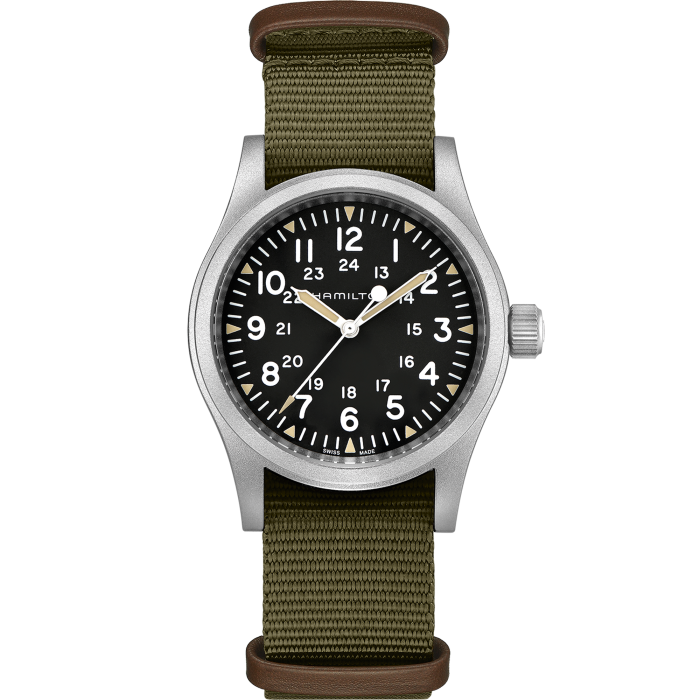
- References: H69439931 / H69439511
- Movement: H-50 hand-wound; up to 80 hours
- Case: Steel; 38mm × 9.5mm; 47mm lug-to-lug
- Crystal / Water Resistance: Sapphire / 50m
- Lug Width: 20mm
- US List Prices: $675 black; $695 white
The gallery shows black H69439931 at $675 and white H69439511 on brown leather at $695. Both are 38mm wide, 9.5mm thick, and 47mm lug-to-lug. That last measurement matters: a modest diameter does not guarantee a tiny footprint. I would also keep the 50m rating in mind when comparing it with the Murph.
Murph 38: My More Versatile Choice
The Murph’s cathedral hands and uncluttered dial make it a little dressier to my eye. I would choose the 38mm version for a watch that could move between casual clothes and a shirt without much thought. The larger 42mm Murph remains another option.
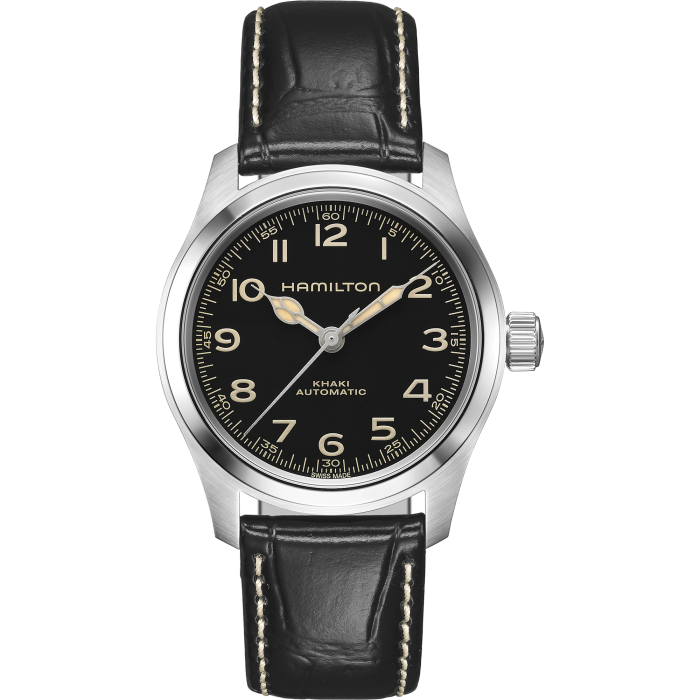
- References: H70405730 / H70405710 / H70405740
- Movement: H-10 automatic; up to 80 hours
- Case: Steel; 38mm × 11.1mm
- Crystal: Sapphire with AR coating
- Water Resistance / Lug Width: 100m / 20mm
- US List Price: $995 each, on leather
The pictured black, white, and blue leather-strap versions are $995 each. They share an H-10 automatic, an 80-hour reserve, and 100m water resistance. I like the black dial’s warm detailing, while blue changes the personality considerably. Bracelet configurations are also listed by Hamilton; the card’s price applies to the three leather versions shown.
Khaki Aviation: More Than One Kind Of Pilot Watch
Khaki Aviation groups three main branches: Pilot, Pilot Pioneer, and X-Wind. Pilot Day Date has the large, legible instrument-style dial. Pilot Pioneer ranges from compact hand-wound designs to the round automatic below, larger mechanical models, and a mechanical chronograph. X-Wind adds a much busier look through day-date, automatic chronograph, and quartz GMT chronograph options.
My choice is the 38mm Pilot Pioneer H76205530, which I covered in my dedicated Pilot Pioneer review. Its textured black dial, cathedral hands, and rotating countdown bezel make an appealing combination of dressier details and practical styling.
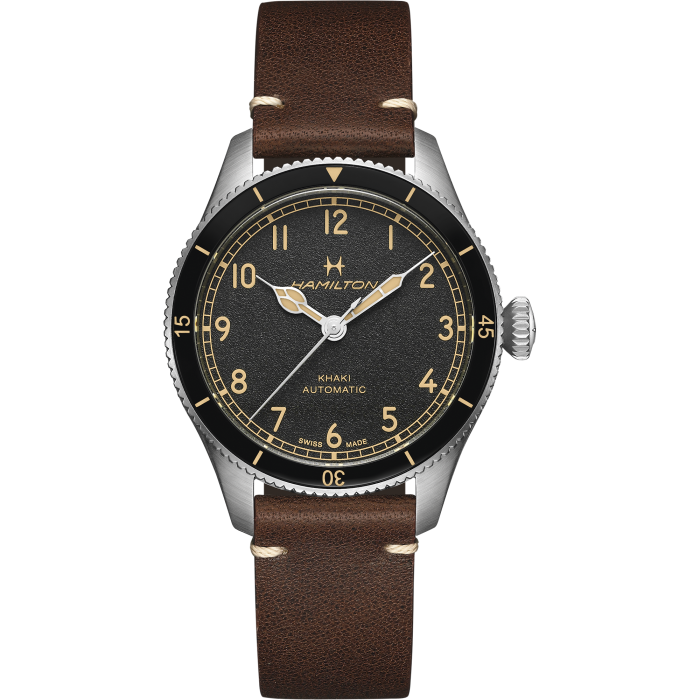
- Reference: H76205530
- Movement: H-10 automatic; up to 80 hours
- Case: Steel; 38mm × 11.4mm
- Crystal: Sapphire with AR coating
- Water Resistance / Lug Width: 100m / 18mm
- Strap: Brown leather
- US List Price: $1,095
The current list price is $1,095, compared with the roughly $1,000 discussed in my older review. I still find the dial and bezel pairing more persuasive than the basic leather strap. I would try it alongside the Murph: both offer an H-10 and 80 hours of reserve, but the Pioneer has a more instrument-like character.
A shared Pilot Pioneer name does not mean a shared movement or case. I would check the reference carefully before ordering a mechanical version after reading about this automatic.
Khaki Navy: Scuba, Frogman, And BeLOWZERO
Khaki Navy is the collection I would explore for a dive-watch layout. Scuba offers the most conventional starting point, including 40mm and 43mm models and Scuba GMT versions in steel or bronze. Frogman adds a more prominent crown guard, with 41mm and 46mm choices. The titanium BeLOWZERO takes the large, angular tool-watch look further.
Scuba Auto 43: My Straightforward Sports Pick
The blue H82505140 is the reference featured in my Scuba Auto review. I like its clear dial and ceramic bezel, and the current black and green versions offer two worthwhile alternatives.
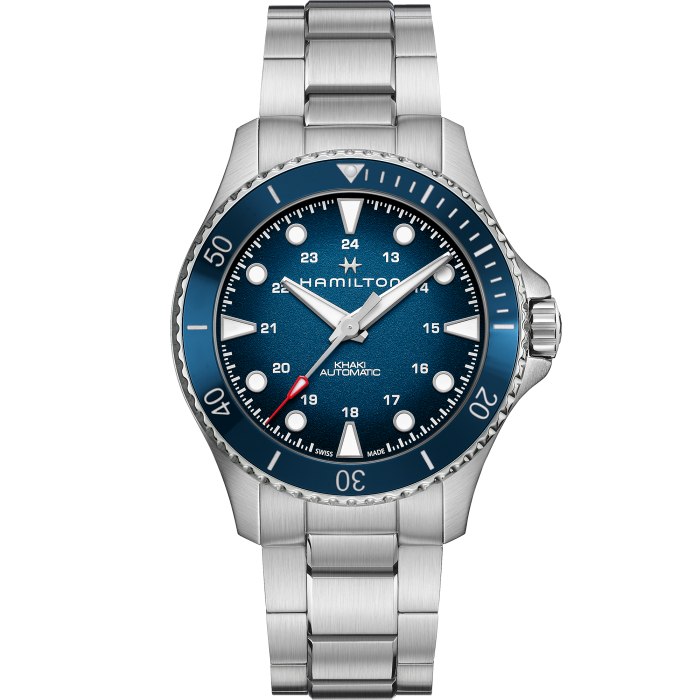
- References: H82505140 / H82515130 / H82525160
- Movement: H-10 automatic; up to 80 hours
- Case: Steel; 43mm × 12.58mm
- Bezel / Crystal: Ceramic insert / sapphire with AR
- Water Resistance: 300m; screw-down crown
- Bracelet / Lug Width: Stainless steel / 22mm
- US List Price: $1,225 each
All three pictured bracelet versions list at $1,225. The 300m rating, sapphire crystal, screw-down crown, and 80-hour reserve make a useful package. At 43mm, however, this is a watch I would try before buying if smaller cases usually suit me better.
The 40mm Scuba and Scuba GMT have their own specifications. I would not carry this card’s dimensions or water-resistance rating across the entire family.
Frogman 46: My Bolder Alternative
My Frogman H77815130 review covers the steel-bracelet version. Hamilton now labels that exact reference Past collection, and it is unavailable in the US online store. It still belongs in this guide because the review gives a closer look at the 46mm Frogman’s distinctive case and crown protection.
The first gallery image below shows the currently available H77825330 on black rubber. The second shows the reviewed bracelet reference, clearly identified as a past model.
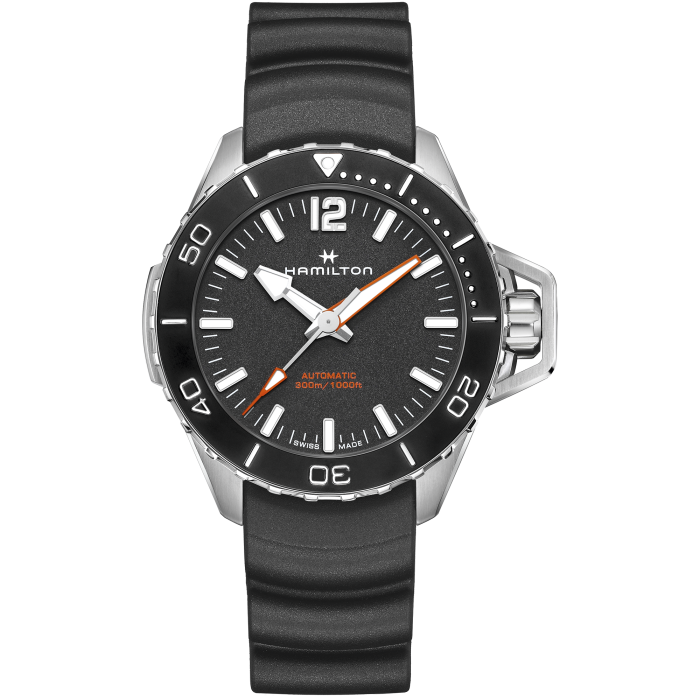
- Current Reference: H77825330, black rubber
- Reviewed Past Reference: H77815130, steel bracelet; unavailable online
- Movement: H-10 automatic; up to 80 hours
- Case: Steel; 46mm × 13.58mm
- Crystal: Sapphire with AR coating
- Water Resistance / Lug Width: 300m / 22mm
- US List Price: $1,395 for H77825330 on rubber
The shared 46mm diameter and 13.58mm thickness tell me this is a deliberate choice for someone who likes a substantial watch. The rubber version costs $1,395; that price is not an offer for the discontinued bracelet model. I would consider the smaller Frogman or the Scuba if the crown guard and case size felt excessive.
American Classic: Chronographs, Shaped Cases, And Digital Nostalgia
American Classic is Hamilton’s most varied collection. Intra-Matic covers retro chronographs, while Boulton, Ardmore, and Cushion Mechanical explore shaped cases. PSR and PSR 74 revisit digital design; Pan Europ offers a sportier day-date approach, and Spirit of Liberty provides a more traditional round automatic.
The catalog also lists smaller Hamilton Vintage Quartz, a Hamilton Necklace watch, and the Lancaster Special Exclusive Pocket Watch. Pocket watches sit within American Classic rather than a separate current collection. The new Cushion Mechanical comes in 30mm and 34mm formats; some finishes were marked “Available soon” when checked.
Intra-Matic Auto Chrono: My Chronograph Pick
The green H38416560 is the reference linked in my Intra-Matic Auto Chrono review. I like how the contrasting registers and dial-mounted tachymeter combine a sporting function with a relatively restrained outline.
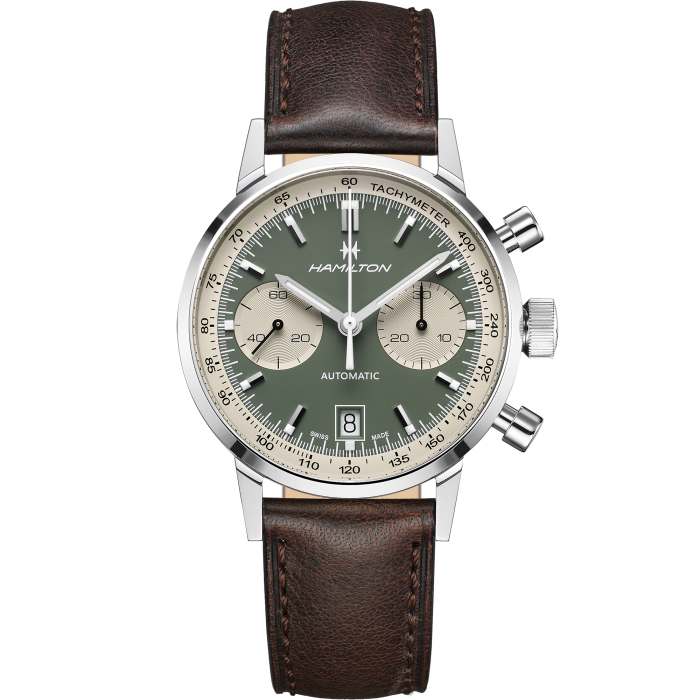
- References: H38416560 / H38416711 / H38416541
- Movement: H-31 automatic chronograph; 60 hours
- Case: Steel; 40mm × 14.45mm
- Crystal: Sapphire with AR coating
- Water Resistance: 100m; screw-down crown
- Strap / Lug Width: Leather / 20mm
- US List Price: $2,595 each
The pictured green, white, and blue leather versions are $2,595 each. Their H-31 automatic chronograph offers 60 hours of reserve. The important fit detail is the 14.45mm thickness: this may be 40mm wide, but it will not wear like a slim dress watch.
I would also compare the hand-wound Intra-Matic Chronograph H if I preferred manual winding. Its movement and dial details need to be assessed separately from this Auto Chrono.
Boulton Quartz: My Smaller Dressier Pick
The Boulton’s curved rectangular shape is the reason I would choose it. This yellow-PVD version on brown leather has an appealing warmth without the price of a solid-gold case.
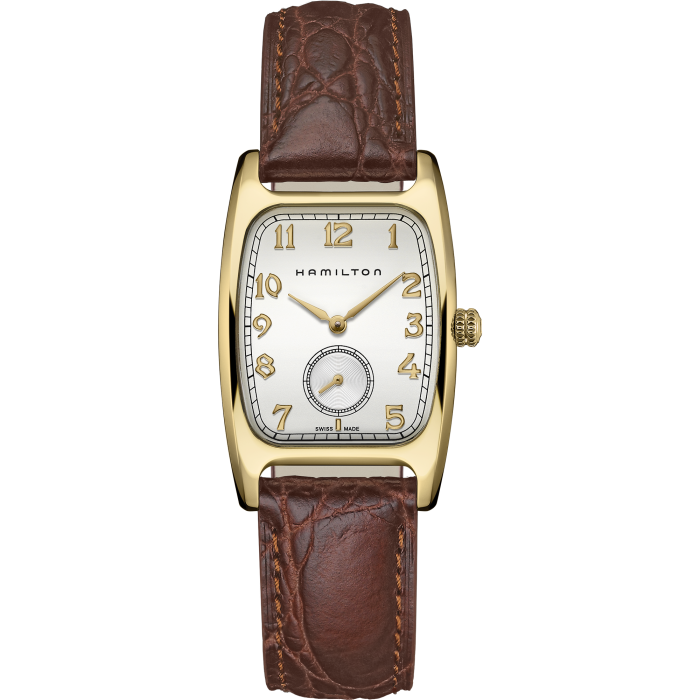
- Reference: H13431553
- Movement: 980.163 quartz
- Case: Yellow-PVD steel; 27 × 32mm; 7.8mm thick
- Crystal / Water Resistance: Mineral / 30m
- Strap / Lug Width: Brown leather / 18mm
- US List Price: $845
At 27 × 32mm and 7.8mm thick, it is a very different proposition from the chronograph above. Quartz makes it easy to pick up after time off the wrist. The trade-offs are mineral glass and 30m water resistance. I would buy it for its shape and proportions, with a sportier watch for swimming. Larger Boulton Mechanical and smaller Ardmore alternatives are worth comparing if this exact shape or size does not suit.
PSR: My Pick For Something Completely Different
The PSR’s red digital display and broad steel case make it one of my favorite visual departures in the range. Its LCD/OLED display offers a modern interpretation of the early digital-watch look.
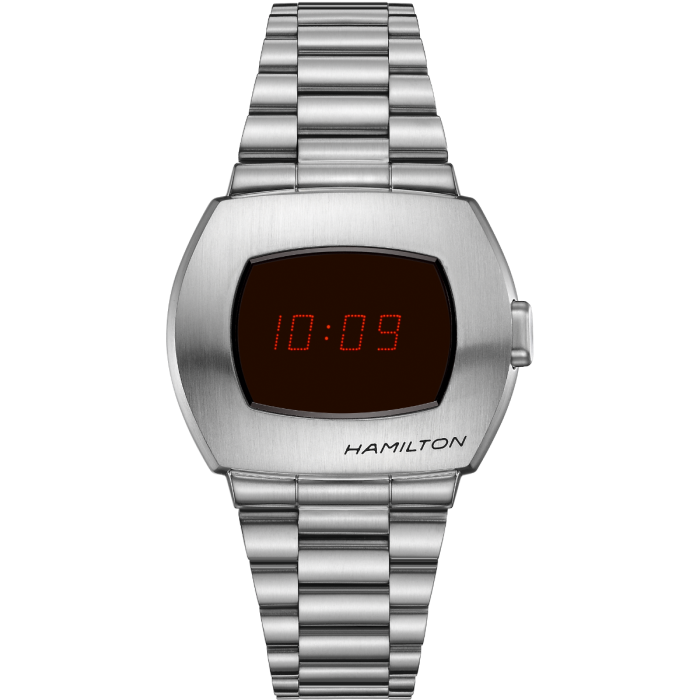
- Reference: H52414130
- Movement: H-10e digital quartz
- Case: Steel; 41 × 35mm; 13.3mm thick
- Lug-to-Lug: 46mm
- Crystal / Water Resistance: Sapphire with AR / 100m
- Bracelet / Lug Width: Stainless steel / 24mm
- US List Price: $925
This $925 reference has a sapphire crystal and 100m water resistance. Its 41 × 35mm case should be judged as a shaped watch, not compared with a round watch by width alone. I would also look at the PSR 74 for a different case and bracelet treatment; those models have their own dimensions and prices.
Jazzmaster: Everyday Dress Watches With A Mechanical Twist
Jazzmaster includes Open Heart, Skeleton, Day Date, Viewmatic, and Quartz/Gent Quartz models. Open Heart leaves part of the dial intact while revealing the movement; Skeleton makes the mechanism more prominent. Viewmatic and Day Date are the calmer alternatives, while quartz options include smaller 32mm watches.
My representative pick is the 40mm Open Heart. The blue bracelet version strikes a balance I like: enough of the movement is visible to make the watch interesting, with a conventional round case and recognizable hour markers.
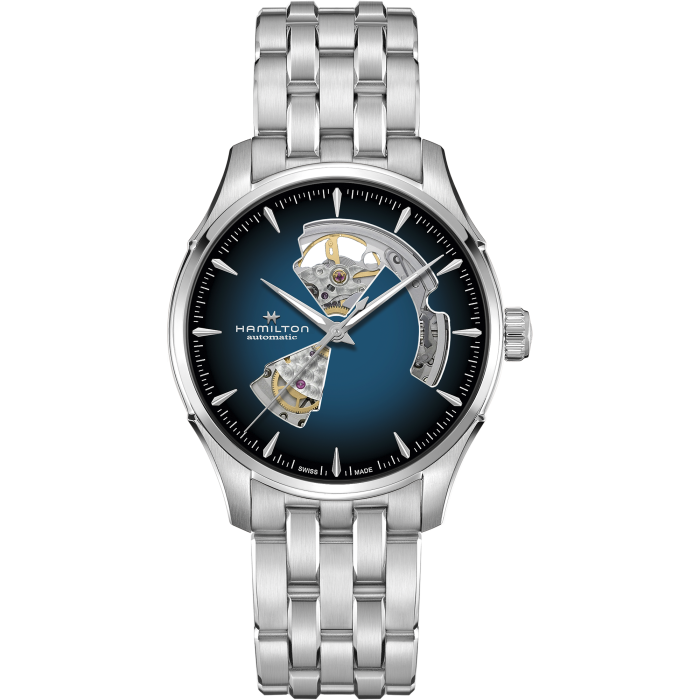
- References: H32675140 / H32675560 / H32675141
- Movement: H-10 automatic; up to 80 hours
- Case: Steel; 40mm; 11.05–11.1mm thick
- Crystal: Sapphire with AR coating
- Water Resistance / Lug Width: 50m / 20mm
- US List Prices: $1,245 on leather; $1,295 on steel
The gallery shows blue H32675140 at $1,295, green on leather H32675560 at $1,245, and smoky turquoise H32675141 at $1,295. The first two are 11.05mm thick; the smoky turquoise version is 11.1mm. All three list an H-10, 80 hours of reserve, sapphire, and 50m water resistance.
My reservation is readability: the dial opening competes with the hands. I would compare it in person with a cleaner Viewmatic before deciding that seeing the movement matters more than a quick glance at the time.
Ventura: The Hamilton I Would Choose For Its Shape
Ventura is the least conventional collection here. Alongside the classic Quartz are S Quartz, Chrono Quartz, Elvis80, XXL, and Edge Skeleton versions, with automatic and skeletonized options as well as Dune-inspired designs. These are substantially different watches built around the same willingness to use an unusual case.
I would start with the classic 32 × 50mm quartz Ventura. Its clean dial makes the triangular outline the main attraction. Black on leather is the restrained choice; turquoise on a flexible steel bracelet is much more playful.
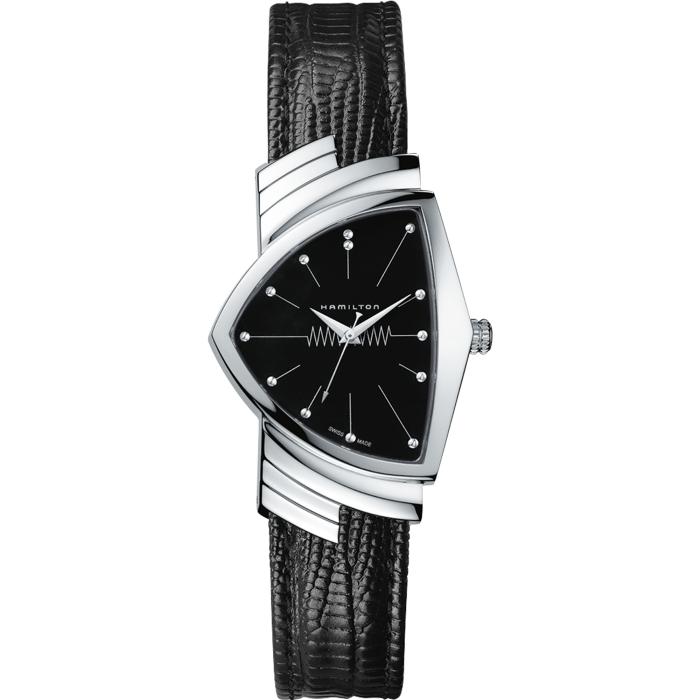
- References: H24411732 / H24411143 / H24301941
- Movement: Quartz; caliber varies by reference
- Case: Steel; 32 × 50mm; 9.27mm thick
- Crystal / Water Resistance: Mineral / 50m
- Lug Width: 17mm
- US List Prices: $1,075 black or turquoise; $1,125 blue/PVD
The pictured black leather H24411732 and turquoise bracelet H24411143 are $1,075 each. The yellow-PVD H24301941 with blue dial and blue Alcantara strap is $1,125. The shared specifications in the card describe this case family; the exact quartz caliber and strap construction vary by reference.
The mineral crystal is worth knowing about at this price. So is the shape: I would try a Ventura rather than use its 32mm width to predict the fit. I would choose it because I enjoyed looking at it, not because it beat a conventional round watch on a specification list.
Quality And Ownership: What I Would Check
Start with the movement. The H-50 in the featured Field Mechanical needs hand winding; the H-10 automatics wind through wrist movement. Both offer up to 80 hours here. The H-31 chronograph offers 60 hours. Quartz and digital models bring a different kind of convenience, so I would match the movement to how often I expect to wear the watch.
Look beyond diameter. The Field Mechanical’s 47mm lug-to-lug length, the Intra-Matic’s thickness, and the Ventura’s asymmetric outline are more useful fit clues than the headline width alone. I would check the bracelet adjustment or strap fit before committing, particularly if ordering online.
Read the exact material and water-resistance specifications. The featured Boulton and Ventura use mineral glass; the other picks use sapphire. A 30m dress watch and a 300m Scuba serve different purposes. A leather strap also needs different treatment from steel or rubber.
Hamilton’s international warranty runs for two years from purchase and covers qualifying material or manufacturing defects. Normal wear, batteries, and accidental damage are excluded. I would keep the receipt and warranty documentation.
For purchases from Hamilton’s US online store, the return policy allows unworn, undamaged goods to be returned within 14 days of delivery, with their original packaging and components. Cut-to-size rubber straps cannot be returned. Dealer and regional policies can differ, so I would read the terms attached to the actual purchase.
My Hamilton Recommendations
| If I Wanted… | I Would Start With… | Why |
|---|---|---|
| One versatile everyday Hamilton | Murph 38 | Clean dial, automatic winding, and 100m water resistance |
| A simpler mechanical watch | Khaki Field Mechanical 38 | Slim case, clear dial, and the pleasure of hand winding |
| A vintage-style pilot watch | Pilot Pioneer H76205530 | Textured dial, cathedral hands, and countdown bezel |
| A conventional dive-watch layout | Scuba Auto 43 | Ceramic bezel, steel bracelet, and 300m rating |
| A large, distinctive tool watch | Frogman 46 | Prominent crown protection and a strong visual identity |
| A retro chronograph | Intra-Matic Auto Chrono | Contrasting registers and a 60-hour automatic movement |
| A smaller dressier watch | Boulton Quartz | Curved rectangular case and simple quartz ownership |
| Something more unusual | PSR or Ventura | A distinctive display or case rather than another round dial |
For comparison, I would look at Mido for another broad Swiss range, Laco for pilot watches, or Stowa for restrained German designs. The strongest Hamilton choice depends on which part of the range appeals to you.
My own shortlist begins with the Murph 38, Pilot Pioneer, and Intra-Matic Auto Chrono. They show three different sides of Hamilton while retaining the design clarity that makes the brand easy to enjoy.
Hamilton Watches FAQ
Are Hamilton watches American or Swiss?
Hamilton was founded in Lancaster, Pennsylvania, in 1892. Its current watches are Swiss-made, and the brand belongs to Swatch Group. The American history influences many designs, but it does not mean a current Hamilton is manufactured in the United States.
Which Hamilton watch would I recommend first?
I would start with the Murph 38 for an everyday automatic or the Khaki Field Mechanical 38 for a simpler hand-wound watch. My other starting points are the Pilot Pioneer H76205530, Scuba Auto 43, and Intra-Matic Auto Chrono, each covered in a dedicated review.
Are all Hamilton watches automatic?
No. Hamilton makes hand-wound mechanical, automatic, and quartz watches, including digital quartz models. The featured Field Mechanical uses the hand-wound H-50, several automatics use the H-10, and the Intra-Matic Auto Chrono uses the H-31. Their power reserves and functions differ.
Do all Hamilton watches have sapphire and the same water resistance?
No. The featured Boulton and classic quartz Ventura have mineral crystals and ratings of 30m and 50m respectively. The featured Scuba Auto 43 and Frogman 46 have sapphire crystals and 300m ratings. I would check the exact reference rather than apply one model's specifications to a collection.
Is the Frogman from my review still available?
On November 4, 2026, Hamilton marked the reviewed H77815130 bracelet model as Past collection and unavailable in its US online store. The H77825330 on black rubber remained available at $1,395. Both appear in the gallery, with their status clearly identified; retailer availability can differ.
What warranty and returns does Hamilton offer?
Hamilton states a two-year international warranty for qualifying material or manufacturing defects. Its US online store accepts unworn, undamaged returns within 14 days of delivery, with original packaging and components; cut-to-size rubber straps cannot be returned. I would check the seller's current terms and keep the purchase documentation.