Shinola Watches Review: Collections and My Picks
Shinola is easy to recognize when it leans into what it does well: bold numerals, good-looking colors, and watches that feel connected to its Detroit identity. The Runwell is the obvious starting point, but the current range stretches from small bracelet watches to mechanical divers, GMTs, and a surprisingly interesting automatic Duck.
I would start with Runwell for the signature look, Duck Automatic for an accessible mechanical option, or the 39mm Monster for a more substantial dive watch. My dedicated Runwell 41 Green review takes a closer look at the design that first drew my attention to the brand.
This guide covers all ten main collections currently listed by Shinola, including the separately highlighted Circadian Monster. I have grouped related versions into 13 representative watch cards, with 23 color and dial examples. These are my buying recommendations based on the existing Runwell review and current official information; I have not worn every watch featured here.
This article contains affiliate links. I may earn a commission if you buy through them, at no extra cost to you.
Jump to Runwell, Canfield, Monster, Mechanic, Duck, Detrola, Vinton, Birdy, Runabout, Derby, or my buying advice.
Shinola’s Detroit Story
Shinola established its Detroit business in 2011, built its watch factory in the Argonaut Building in 2012, and introduced the Runwell to the public in March 2013. The factory shares a building with the College for Creative Studies, a fitting setting for a brand whose appeal depends so much on design. Shinola’s official history also traces its expansion into leather goods and other accessories.
I would describe the watches as assembled in Detroit using imported components. Shinola’s Argonite quartz movements are assembled and tested there using Swiss and other imported parts, while the mechanical range uses supplied movements from companies including Sellita and Miyota. Detroit assembly matters, but it does not make every component American-made.
That distinction also explains the brand’s earlier controversy. A 2016 FTC letter questioned unqualified US-origin marketing and described Shinola’s plan to clarify the imported content. I would judge the current watches on their design, specifications, and price, with that manufacturing story stated clearly.
The Range At A Glance
| Collection | Why I would consider it | Featured movement | Featured price |
|---|---|---|---|
| Runwell | The signature numerals and small seconds | Argonite quartz | $750 |
| Canfield | A cleaner dial and several sportier branches | Argonite quartz | $895 |
| Monster | Divers, GMTs, and the smaller Circadian | Sellita automatic | $1,695–$2,295 |
| Mechanic | A cushion case and hand-wound movement | Sellita manual wind | $1,750 |
| Duck | Colorful everyday sports watches | Miyota automatic / Argonite quartz | $895 / $595 |
| Detrola | Playful colors in a resin case | Argonite quartz | $495 |
| Vinton | A straightforward steel bracelet watch | Argonite quartz | $750 |
| Birdy | A round case with a very narrow bracelet | Argonite quartz | $825 |
| Runabout | A small, sculpted bracelet watch | Argonite quartz | $875 |
| Derby | A shaped case and decorative dial options | Argonite quartz | $975 |
Prices are USD from Shinola’s US storefront, checked October 23, 2026, before applicable taxes. They refer to the watches pictured below, not the full price range of each collection. All pictured examples were available when checked. Galleries show selected colors; collection buttons open the wider range. Gallery photography is supplied by Shinola, and the opening image comes from my existing Runwell review.
Quartz, Automatic, Or Hand-Wound?
A Shinola logo does not tell the whole movement story. Argonite is the name used for Shinola’s quartz movements, with several calibers serving different sizes and functions. The everyday attraction is convenience: a battery-powered watch that does not need winding after a few days off the wrist.
The mechanical options deserve separate attention. Monster uses Sellita automatics, Mechanic uses a hand-wound Sellita, and the current Duck Automatic uses Miyota. The reserve varies by model, so I would check the exact reference instead of assuming every Monster or Duck shares the same specification.
My main reservation is price. At $750–$895 for several featured quartz models, there are mechanical alternatives from brands such as Hamilton and Mido worth comparing. That does not automatically make quartz a poor choice. I would buy a Shinola because its design appeals to me and its convenience suits my routine, rather than expecting the movement alone to justify the price.
Runwell: My Starting Point
Runwell still makes the strongest introduction to Shinola. The large Arabic numerals, small-seconds display, and rounded crown give it a friendly, slightly old-fashioned character. Green with a tan leather strap remains my favorite combination; white is the quieter alternative.
The 41mm quartz model below is the natural companion to my Runwell 41 Green review. That article covers an earlier reference and historical pricing; this card uses the current listing. The wider family also includes different sizes, date, chronograph, moonphase, automatic, and Runwell Sport models, including Black Blizzard. I would begin with the simple small-seconds version before exploring those variations.
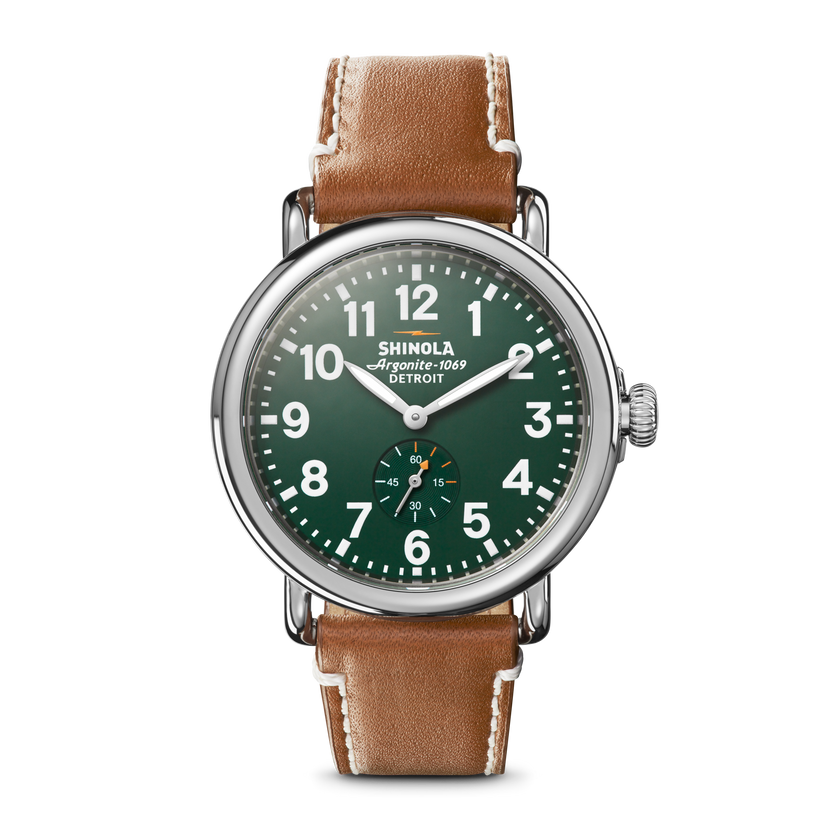
- Movement: Argonite 1069 quartz; small seconds
- Case Width: 41mm
- Lug-to-Lug: 46mm
- Thickness: 10.1mm
- Case Material: Stainless steel
- Lug Width: 20mm
- Crystal: Double-domed sapphire
- Water Resistance: 50m; screw-down crown
- Strap: Leather
- Listed Price: $750 in either pictured color
Canfield: A Cleaner Everyday Look
Canfield is where I would turn if Runwell’s big numerals feel too prominent. The 38mm three-hand model has a more open dial, a date, and a compact 43.3mm lug-to-lug length. The Astro Blue dial and tan strap soften the design nicely; black on black leather is easier to dress up.
This is also a broad collection. C56, Canfield Sport, and the automatic Canfield Speedway take the family in sportier directions, with chronographs among the choices. I would choose the simple 38mm model for everyday use and explore those branches if a stopwatch or a busier dial is part of the appeal.
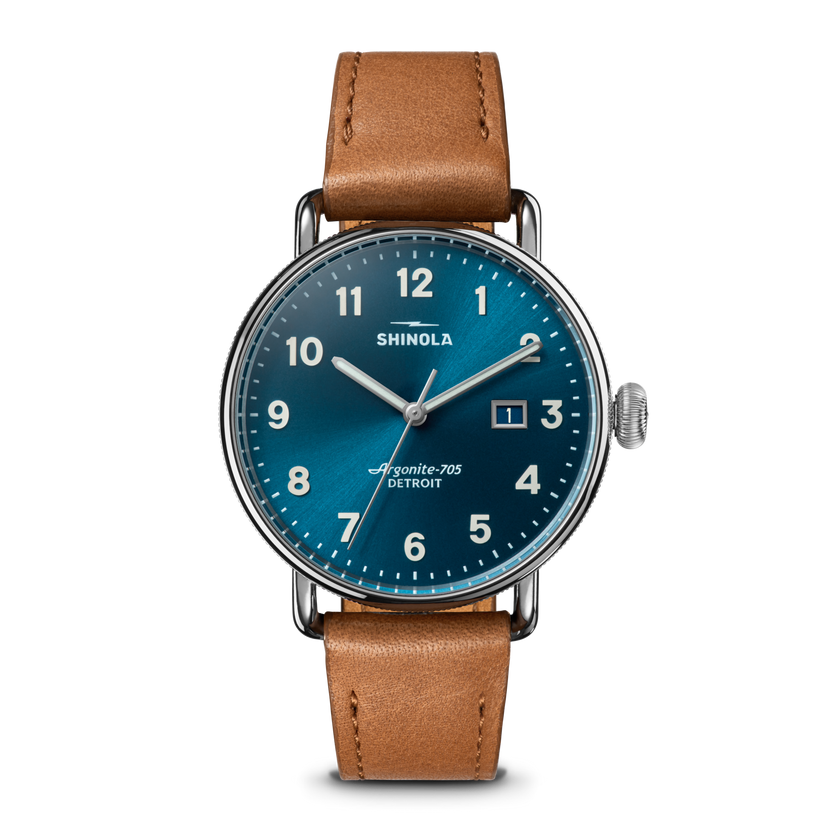
- Movement: Argonite 705 quartz; date
- Case Width: 38mm
- Lug-to-Lug: 43.3mm
- Case Material: Stainless steel
- Lug Width: 18mm
- Crystal: Double-curved sapphire
- Water Resistance: 50m
- Strap: Leather
- Listed Price: $895 in either pictured color
Monster: The Mechanical Sports-Watch Family
Monster is the part of the range I would compare most closely with established Swiss sports watches. It spans divers in different sizes and materials, GMTs, and the smaller Circadian. Bronze, ceramic, and forged-carbon versions, along with Worldtimer GMT models, give the family plenty of variety; the three cards below show its most useful starting points.
The 39mm Monster Diver
The Lake Ontario and Lake Michigan 39mm models pair a 300m rating with a Sellita SW200-2 Elaboré movement and a brand-listed 65-hour reserve. Their green and blue mother-of-pearl dials give a familiar diver layout some personality. I prefer Ontario’s green, although Michigan’s blue is an easy choice for a watch named after the Great Lakes.
The bracelet’s tool-free link adjustment and micro-adjustment are useful details at this price. I would still compare the 47.68mm case length with a watch I already wear comfortably. The specifications here apply to these current 39mm models, not every older 43mm Monster.
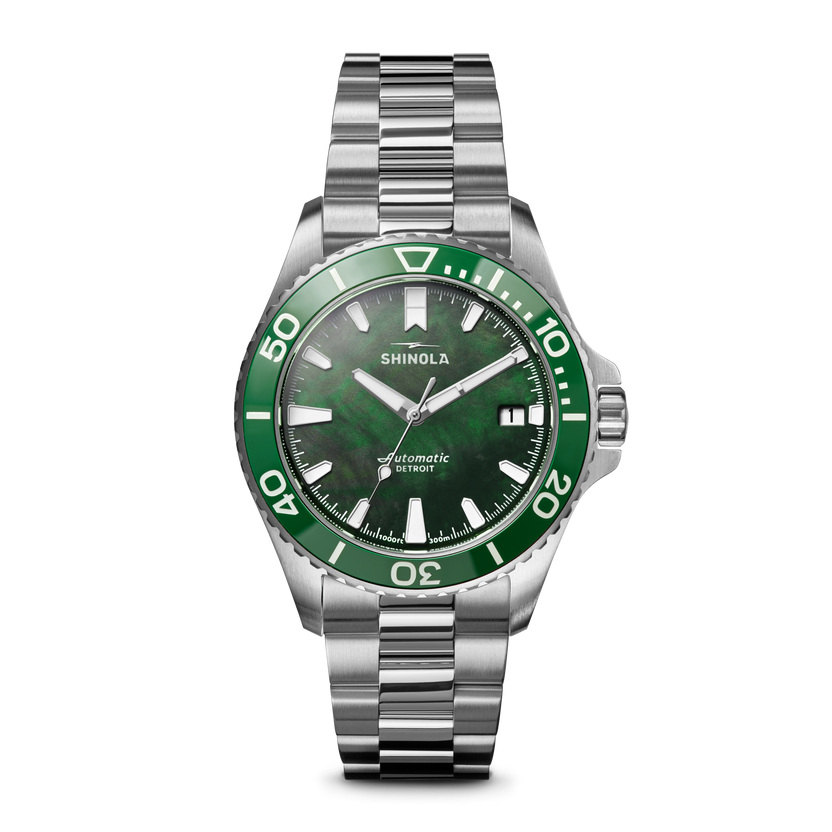
- Movement: Sellita SW200-2 Elaboré automatic; date
- Power Reserve: 65 hours, stated by Shinola
- Case Width: 39mm
- Lug-to-Lug: 47.68mm
- Case Material: Stainless steel
- Lug Width: 20mm
- Crystal: Single-domed sapphire with AR coating
- Water Resistance: 300m; screw-down crown
- Features: Unidirectional bezel; adjustable steel bracelet
- Listed Price: $2,195 in either pictured color
Monster GMT: For A Second Time Zone
The 40mm Monster GMT replaces the diver’s timing scale with a 24-hour bezel and adds a GMT hand. Navy and black both look restrained enough for everyday wear. I would choose navy for a little color without losing that versatility.
These models use the Sellita SW330-2, with Shinola listing a 56-hour reserve and 100m water resistance. The GMT is a different proposition from the 300m diver, so I would choose according to the function I would actually use.
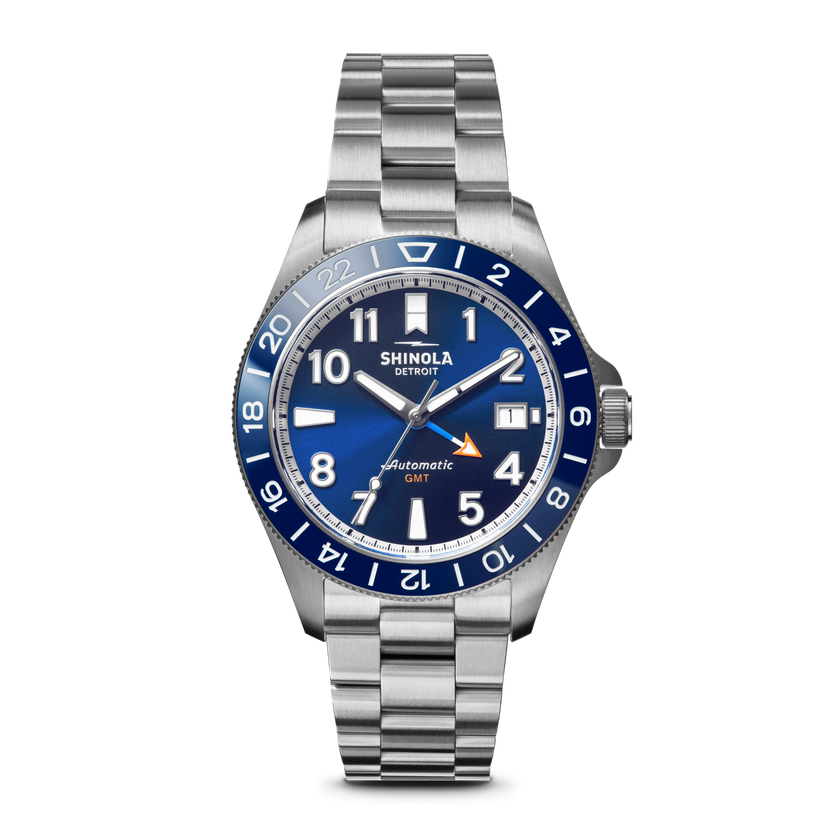
- Movement: Sellita SW330-2 automatic GMT; date
- Power Reserve: 56 hours, stated by Shinola
- Case Width: 40mm
- Lug-to-Lug: 48.4mm
- Case Material: Stainless steel
- Lug Width: 20mm
- Water Resistance: 100m; screw-down crown
- Features: Ceramic 24-hour bezel; steel bracelet
- Listed Price: $2,295 in either pictured color
Circadian Monster: My Smaller Automatic Pick
Circadian is listed separately in Shinola’s women’s navigation, but I would consider it for anyone who prefers a 36mm automatic. Its simple bezel and steel bracelet make it a quieter everyday option than the dive models. Daylight Blue is my pick; Alabaster looks a little warmer and more traditional.
The movement is a Sellita SW200-1 Elaboré, with a listed 41-hour reserve. It also keeps a useful 100m rating and screw-down crown. At $1,695, it is the least expensive Monster pictured here, while offering a noticeably shorter 43.83mm lug-to-lug length.
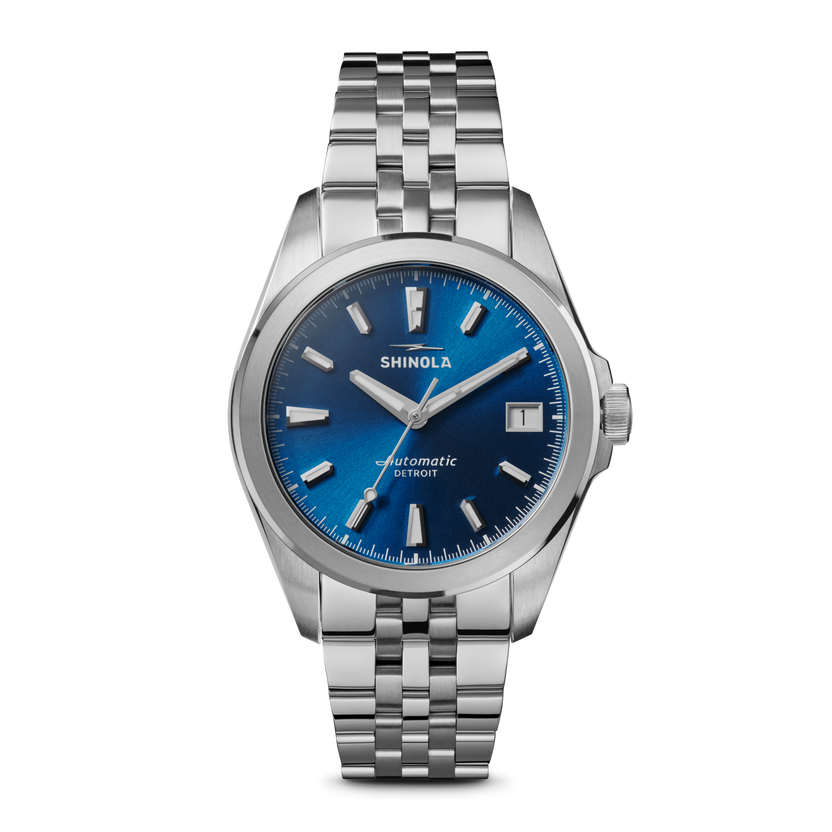
- Movement: Sellita SW200-1 Elaboré automatic; date
- Power Reserve: 41 hours, stated by Shinola
- Case Width: 36mm
- Lug-to-Lug: 43.83mm
- Case Material: Stainless steel
- Lug Width: 18mm
- Crystal: Double-curved sapphire
- Water Resistance: 100m; screw-down crown
- Bracelet: Stainless steel
- Listed Price: $1,695 in either pictured color
Mechanic: A Little More Character
Mechanic is the Shinola I would try when a conventional round case feels too familiar. Its 39mm cushion shape and prominent numerals give it a different presence from both Runwell and Monster. Alabaster on brown leather is the softer choice; the black dial’s orange numerals are much more assertive.
The Sellita SW210-1 is hand-wound, so there is a small daily ritual involved. I like that fit between the movement and the design, though I would choose quartz or automatic if winding by hand sounds like a chore. The case is 12.5mm thick, worth bearing in mind despite the modest width.
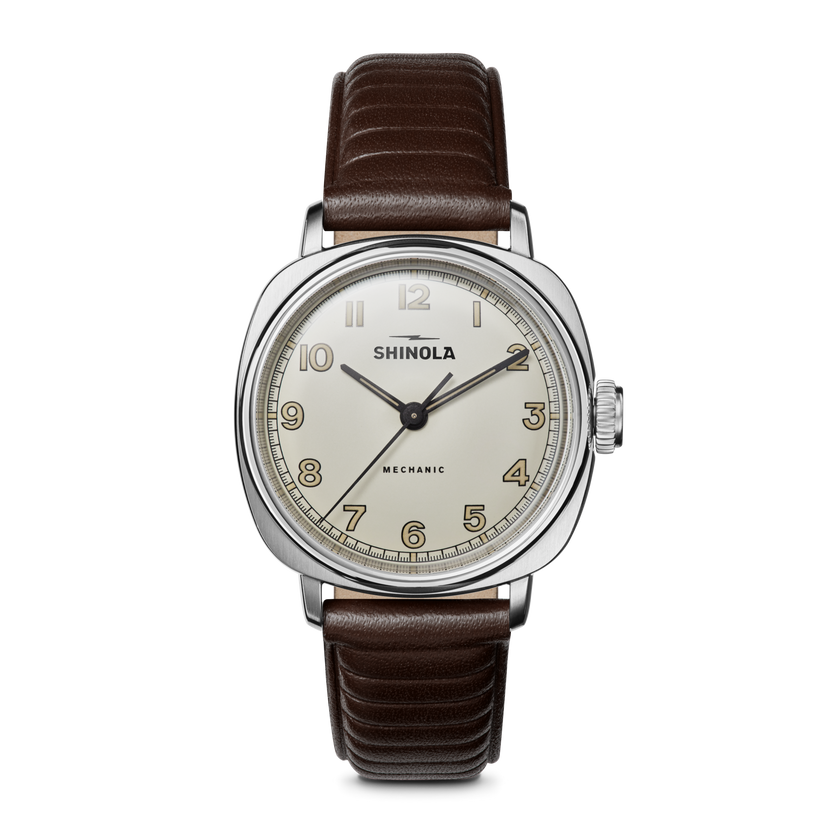
- Movement: Sellita SW210-1 manual wind
- Power Reserve: Approximately 45 hours in current technical data
- Case Width: 39mm
- Lug-to-Lug: 46.82mm
- Thickness: 12.5mm
- Case Material: Stainless steel
- Lug Width: 20mm
- Water Resistance: 50m; push/pull crown
- Strap: Leather
- Listed Price: $1,750 in either pictured color
Duck: My First Stop For A Casual Sports Watch
Duck is the collection that makes the current Shinola range more interesting to me. There are now automatic and quartz versions, with different sizes, movements, and prices. I would compare them directly before assuming that the less expensive watch is simply the same model with a battery.
Duck Automatic: Compact And Colorful
The 38mm Duck Automatic uses a Miyota 9015, a sapphire crystal, and a steel H-link bracelet. Black with turquoise and pink accents is the playful choice; Alabaster is easier to pair with different clothes. Both are $895, making this my starting point for a mechanical Shinola without moving into Monster pricing.
There is also a Duck Automatic 9085 at $1,095, with a different Miyota movement, an approximately 80-hour reserve, and an additional rubber strap. The two pictured 9015 models have a 42-hour reserve. I would pay the extra if leaving it off for a long weekend is a regular part of my routine.
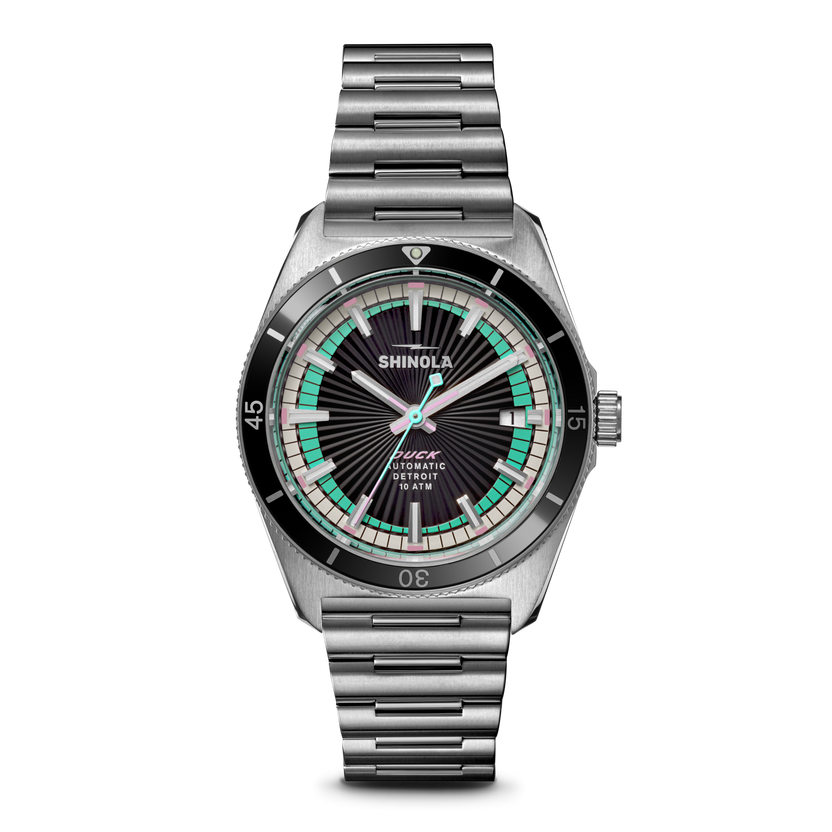
- Movement: Miyota 9015 automatic; date
- Power Reserve: Approximately 42 hours
- Case Width: 38mm
- Lug-to-Lug: 46.32mm
- Thickness: 11.2mm
- Case Material: Stainless steel
- Lug Width: 20mm
- Crystal: Flat sapphire
- Water Resistance: 100m; screw-down crown
- Bracelet: Quick-release steel H-link
- Listed Price: $895 in either pictured color
Duck Quartz: The Simpler, Less Expensive Option
The 40mm quartz Duck keeps the sporty character but comes on rubber and costs $595. It is slightly longer across the wrist than the automatic, so I would not choose it purely on price without checking the dimensions.
Black is my preference for an everyday beater-style look; blue is more cheerful. Both use the Argonite 715 with a date display and share the automatic’s 100m rating and screw-down crown. For someone who wants to pick up a watch and go, this is the more convenient Duck.
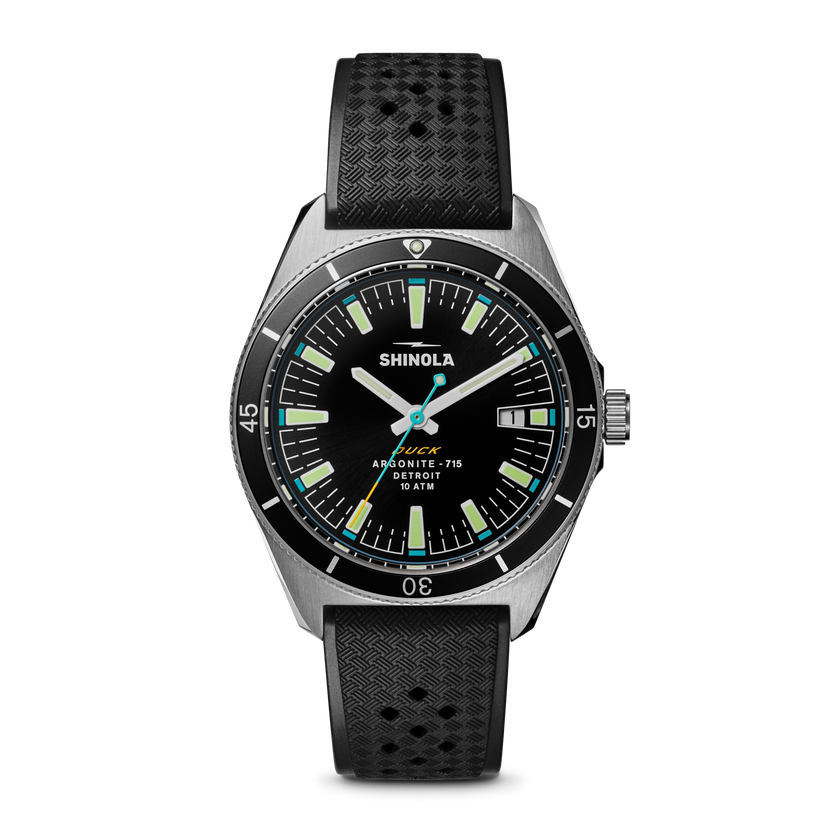
- Movement: Argonite 715 quartz; date
- Case Width: 40mm
- Lug-to-Lug: 48.33mm
- Thickness: 11.25mm
- Case Material: Stainless steel
- Lug Width: 20mm
- Crystal: Flat sapphire
- Water Resistance: 100m; screw-down crown
- Strap: Rubber
- Listed Price: $595 in either pictured color
Detrola: The Playful One
Detrola is where I would look for a casual watch with color as the main attraction. The current 41mm Color Theory models combine a TR90 resin case with a steel core, a sapphire crystal, and patterned dials. Warm pairs orange with contrasting shapes; Cool takes the same idea into blue and pink.
At $495, these are the least expensive watches featured here, although I would still be buying for the design rather than a bargain specification. Detrola has appeared in other sizes and materials, so the card is deliberately specific to these current Color Theory versions.
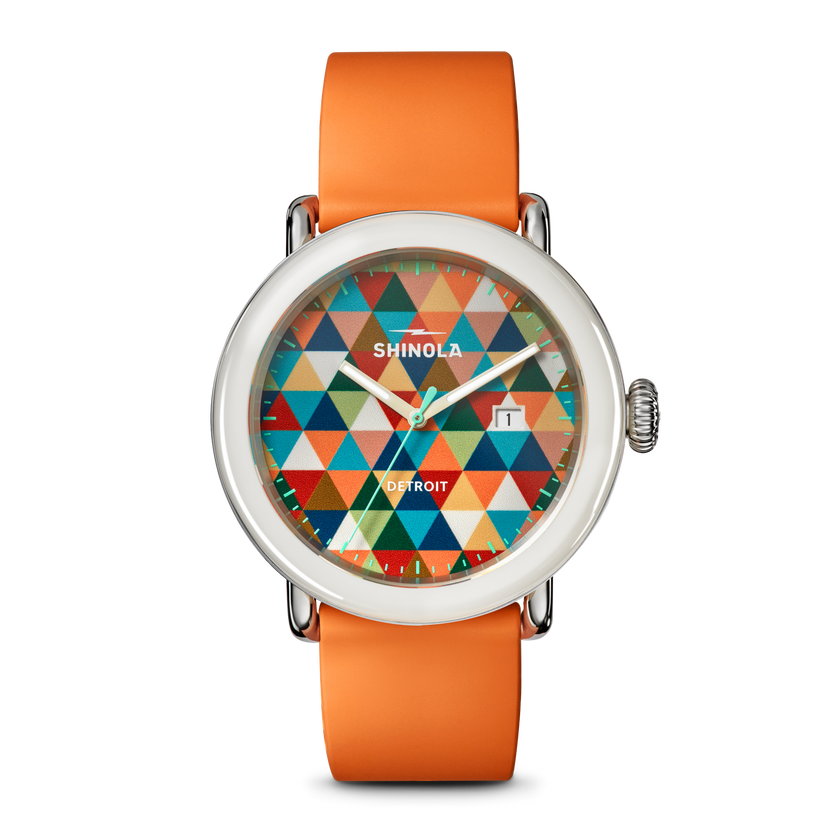
- Movement: Argonite 705 quartz; date
- Case Width: 41mm
- Lug-to-Lug: 45mm
- Thickness: 9.72mm
- Case Material: TR90 resin with stainless-steel core
- Lug Width: 20mm
- Crystal: Flat sapphire
- Water Resistance: 50m
- Strap: Rubber
- Listed Price: $495 in either pictured color
Vinton: The Understated Bracelet Watch
Vinton is my suggestion for someone who likes Shinola but wants fewer visual flourishes. The 38mm case, date window, and steel bracelet make it a straightforward everyday option. Black is the most neutral choice; Midnight Blue adds some depth without changing the mood very much.
Its listed 9.02mm thickness is appealing on paper, particularly if a watch needs to sit under a cuff. I would choose Vinton over Runwell for the bracelet and simpler dial, while keeping in mind that both featured versions are quartz and priced at $750.
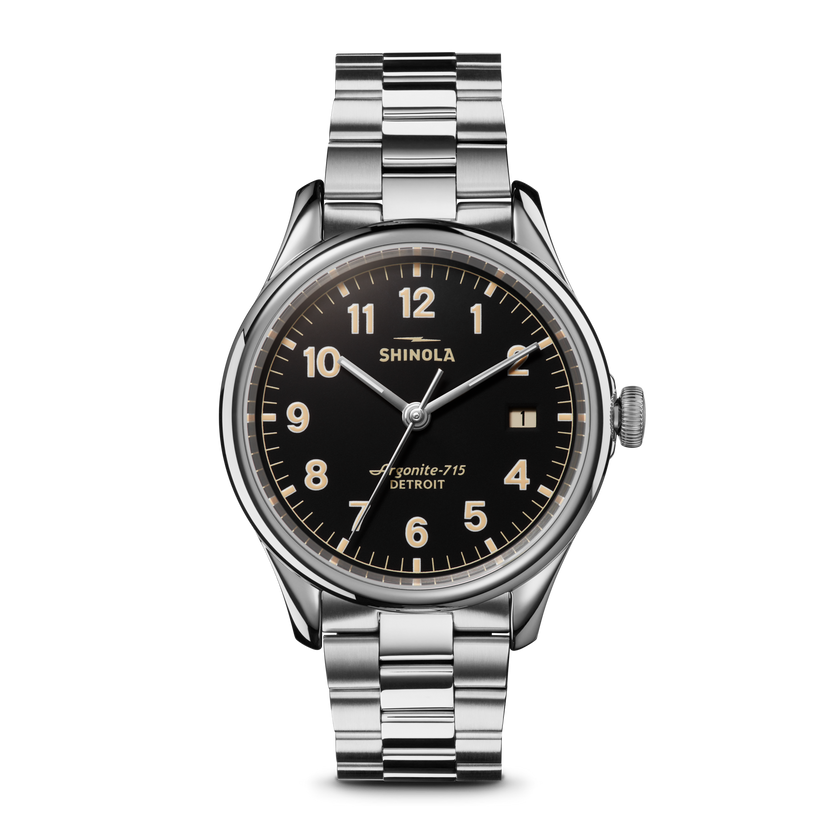
- Movement: Argonite 715 quartz; date
- Case Width: 38mm
- Lug-to-Lug: 45.48mm
- Thickness: 9.02mm
- Case Material: Stainless steel
- Lug Width: 18mm
- Crystal: Double-domed sapphire
- Water Resistance: 50m; push/pull crown
- Bracelet: Stainless steel
- Listed Price: $750 in either pictured color
Birdy: A Watch With A Jewelry-Like Profile
Birdy’s defining feature is the contrast between a round case and a narrow strap or bracelet. I would choose it for that silhouette, especially if a conventional sports-watch bracelet feels too substantial. The family also includes moonphase versions, but the 34mm Petoskey dial is the one that catches my eye.
The stone’s pattern gives each dial its own appearance, framed here by a two-tone steel and gold-PVD finish. The bracelet is only 8mm wide, so the overall impression is much more delicate than the case diameter alone suggests.
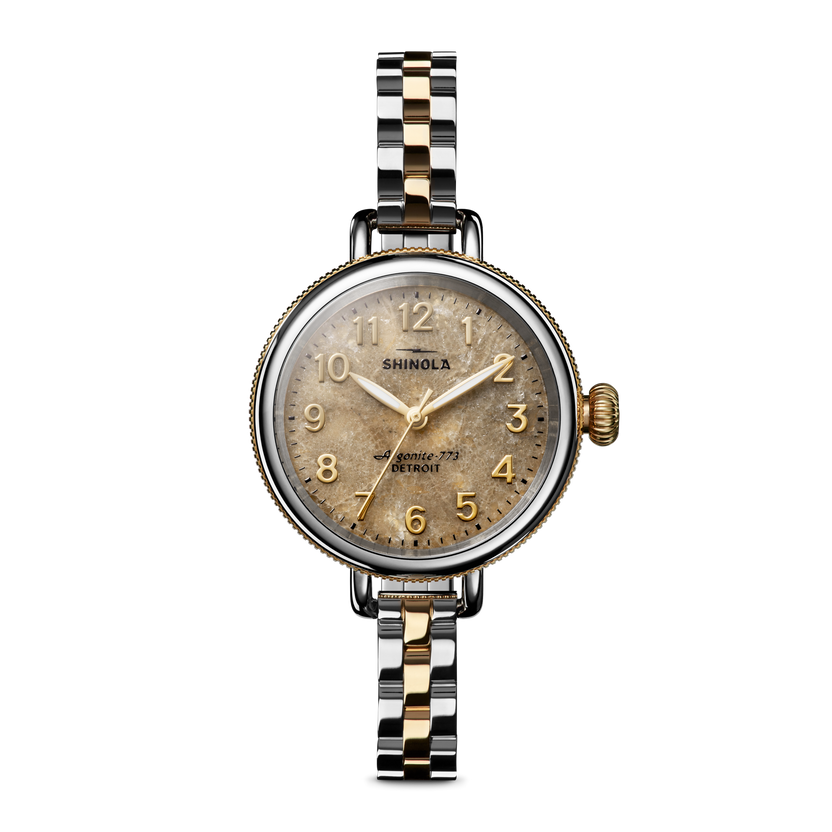
- Movement: Argonite 773 quartz
- Case Width: 34mm
- Lug-to-Lug: 42mm
- Thickness: 9.4mm
- Case Material: Stainless steel with gold-PVD details
- Lug Width: 8mm
- Crystal: Double-domed sapphire
- Water Resistance: 50m; push/pull crown
- Dial: Petoskey stone; pattern varies
- Listed Price: $825
Runabout: Small And Sculpted
Runabout is my pick when the bracelet is as important as the dial. The 25mm Cream model combines a very small round case with curved gold-tone links, giving it an almost bangle-like appearance. It is easy to imagine as a daily piece of jewelry that also happens to tell the time.
The official dial specification is light silver opaline, despite the Cream product name. Its gold color comes from PVD over stainless steel, not solid gold. I would look at Runabout alongside Birdy: Runabout emphasizes the sculpted bracelet, while Birdy gives more visual space to the dial.
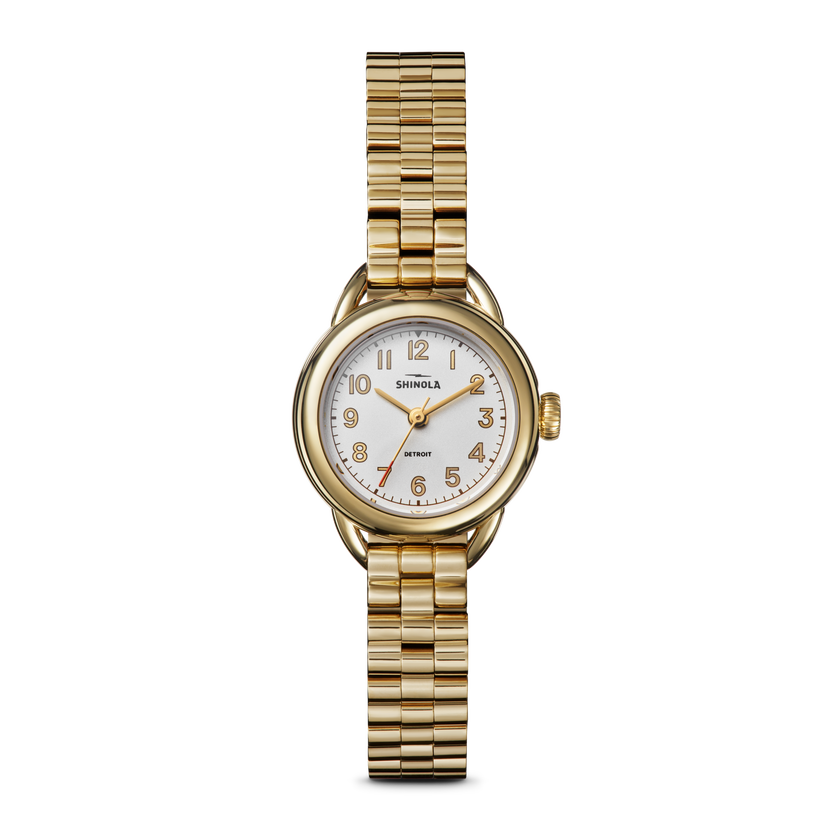
- Movement: Argonite 753 quartz
- Case Width: 25mm
- Lug-to-Lug: 31.84mm
- Thickness: 7.2mm
- Case Material: Stainless steel with gold PVD
- Lug Width: 10mm
- Crystal: Double-curved sapphire
- Water Resistance: 50m; push/pull crown
- Bracelet: Gold-PVD stainless steel
- Listed Price: $875
Derby: A Different Shape For Dressier Days
Derby offers the strongest change of shape in the dressier part of the range. Its rounded, shaped case and bracelet give it a more decorative feel than Vinton, with stone, diamond-set, and Day/Night versions among the options.
I would choose Malachite for the green dial against the gold-tone case and bracelet. At roughly 30mm wide, this is a compact design, and the gold finish is PVD over steel. It is the one I would shortlist when the watch needs to work as an accessory first.
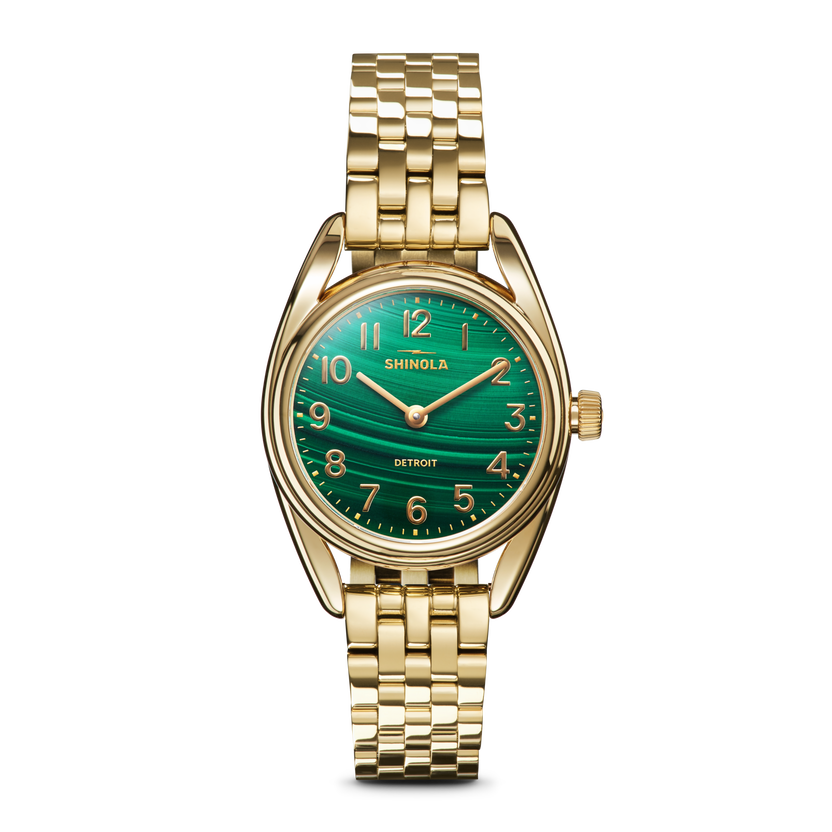
- Movement: Argonite 772 quartz; two hands
- Case Width: 30mm in official technical data
- Lug-to-Lug: 39.95mm
- Case Material: Stainless steel with gold PVD
- Lug Width: 14mm
- Crystal: Double-curved sapphire
- Water Resistance: 50m; push/pull crown
- Dial: Malachite
- Bracelet: Gold-PVD stainless steel
- Listed Price: $975
What I Would Check Before Buying
My first recommendation is to choose the design, then compare the exact specification. Runwell gives me the clearest Shinola identity. Duck Automatic is the mechanical option I would investigate first under $1,000. The 39mm Monster is my dive-watch pick, while Circadian is more appealing for a smaller everyday automatic. For a compact bracelet watch, Runabout and Birdy offer something quite different from the usual sports-watch formula.
I would be more cautious if maximum specification per dollar is the main priority. Compare the mechanical models with Mido, Alpina, or Longines at a similar budget. Shinola’s design and Detroit assembly should be part of what appeals to you, rather than a substitute for checking dimensions, movement, and water resistance.
The current warranty is five years, with registration required. Shinola’s limited-warranty terms cover qualifying defects in materials and workmanship, with exclusions including batteries, straps, bracelets, normal wear, and misuse. Purchases made before October 1, 2026 may have different terms, so older references to a lifetime warranty should not be assumed to apply to a new purchase.
For fit, I would check the return conditions before shortening a bracelet or adding engraving. The standard return window is 30 days from purchase, subject to condition and packaging requirements; customized pieces, final-sale items, and resized metal bracelets have exclusions. That makes trying the size before committing particularly useful.
Frequently Asked Questions
Where are Shinola watches made?
Shinola is based in Detroit and assembles watches there using imported components. Its Argonite quartz movements are assembled and tested in Detroit using Swiss and other imported parts; mechanical models use supplied movements from companies including Sellita and Miyota. Detroit assembly does not mean every component is American-made.
Are all Shinola watches quartz?
No. Many collections use Argonite quartz movements, but Monster includes Sellita automatics, Mechanic uses a hand-wound Sellita, and the current Duck Automatic uses Miyota. I would check the exact model because movement and power reserve vary within the broader range.
Which Shinola would I recommend first?
I would start with Runwell for the signature Shinola look, Duck Automatic for a mechanical option below $1,000, or the 39mm Monster for a diver. My dedicated Runwell 41 Green review explores the classic design in more detail; this guide uses current official specifications and prices.
What is the difference between the quartz and automatic Duck?
The featured quartz Duck is 40mm, uses an Argonite 715, comes on rubber, and costs $595. The pictured automatic is 38mm, uses a Miyota 9015 with an approximately 42-hour reserve, comes on a steel bracelet, and costs $895. Both have sapphire crystals and 100m ratings. A separate $1,095 Duck 9085 has an approximately 80-hour reserve.
Which Shinola models would I consider for a smaller wrist?
I would start with the 36mm Circadian Monster for an automatic, or the 38mm Canfield for a straightforward quartz watch. Runabout at 25mm and Birdy at 34mm offer smaller, jewelry-like options. Case length and bracelet shape matter as well as diameter, so I would compare those dimensions before choosing.
How long is the Shinola watch warranty?
The current limited warranty is five years and requires watch registration. It covers qualifying defects in materials and workmanship under Shinola’s terms, with exclusions such as batteries, straps, bracelets, normal wear, and misuse. Purchases before October 1, 2026 may have different terms; I would check the policy that applies to the original purchase.