Laco Watches Review: Quality, Collections, and Best Models
Laco is an easy brand to recognize and a slightly harder one to shop. You see the clear numerals, the triangle at twelve, and the oversized crown, and you know roughly what you are looking at. Then you discover Basic, Original, and PRO versions that can look quite similar in a small photograph. Where does the extra money go?
That is the question I would start with. Laco’s history gives the watches context, but the differences in case shape, movement, size, and customization are what will matter when you wear one. And there is more here than traditional pilot watches: the Frankfurt GMT, Scorpion sport watches, and unusual Atacama deserve attention in their own right.
We have published dedicated reviews of the Hamburg DIN 8330, Frankfurt GMT, Atacama Quartz UTC, and the Himalaya, Amazonas, Atlantik, and Mojave sport watches. Those articles inform the relevant sections below. The other recommendations are based on the current catalog and published specifications, rather than additional hands-on testing.
My short answer: Laco is worth considering if you like readable watches with a distinct purpose. Start with Basic for an affordable pilot watch, Original for the traditional details, or Flieger PRO if you want more control over the finished watch. If a conventional flieger leaves you cold, look at the Frankfurt or Atacama before moving on.
By clicking on the product links in this article, we may receive a commission fee at no cost to you. Thank you for your support.
Laco Watches At A Glance
| Category | TWR Take |
|---|---|
| Founded | 1925 in Pforzheim, Germany, as Lacher & Co. |
| Production | German watchmaking and assembly in Pforzheim, using externally supplied movements |
| Collections covered | All ten current catalog groups, with representative watches rather than every reference |
| Movements | Japanese Miyota automatics, Swiss Sellita automatic and hand-wound movements, and quartz options |
| Representative prices | Augsburg 39 at $460; Karlsruhe PRO from $1,140; Münster at $1,190; Frankfurt GMT at $2,220 |
| Warranty | Two years from purchase, according to Laco’s published service information |
| Main strengths | Clear dials, meaningful choices within the pilot range, customization, and distinctive tool watches |
| Main tradeoffs | Overlapping names, large cases in some families, and a substantial price jump between entry models and specialist watches |
| Dedicated TWR coverage | Hamburg DIN 8330, Frankfurt GMT 43mm, Atacama Quartz UTC, and the four Scorpion designs |
Prices are the US-dollar amounts displayed by Laco’s international storefront, excluding VAT, shipping, and possible delivery charges. Options can increase the total. Catalog, price, and availability checks were completed on September 24, 2026; regional pricing may differ. Older reviews retain the prices and versions discussed when published.
Quick Verdict: Are Laco Watches Good?
Yes, with a little care over which Laco you choose. The strongest part of the range is that the watches have a clear identity. An Original pilot watch prioritizes the familiar observation-watch layout; a Flieger PRO lets you adapt that idea to everyday preferences; an Atacama approaches readability and comfort through a completely different case design.
Our Hamburg review highlights a useful balance between a substantial case and relatively short lugs. The Frankfurt adds a second time zone without turning the dial into a jumble. The Atacama is the more surprising one: its hinged lugs are central to the appeal, even though its 46mm diameter initially sounds daunting.
I would be more cautious about buying on heritage alone. The Original’s straight lugs may suit the design better than your wrist. A chronograph adds both cost and thickness. And a more expensive movement option is only worth paying for if its particular benefits matter to you. Laco gives you choices; the best purchase starts with deciding which of them you actually want.
Laco Brand History And Where The Watches Are Made
Laco began as Lacher & Co. in Pforzheim in 1925. Its official history traces the business through its connection with the movement manufacturer Durowe and the development of its pilot watches.
During the Second World War, Laco was one of five suppliers of observation watches to the German Luftwaffe. That military history explains the design of today’s traditional fliegers: highly legible displays, prominent crowns, and restrained cases. It is historical context, rather than a reason in itself to prefer one modern watch over another.
Laco continues to operate in Pforzheim. Its manufacturing account describes component inspection, case work, assembly, movement adjustment, and final checks. The movements come from outside suppliers, including Miyota and Sellita. “Made in Germany” should therefore not be read as a claim that every component is German or that Laco manufactures its own current calibers from scratch.
What interests me more is how the company uses that background. Original keeps the historical appearance, while PRO, DIN 8330, and the modern tool watches give buyers different reasons to consider the brand today.
Laco Quality, Movements, And Ownership
Understand What The Movement Name Means
Laco uses its own caliber numbers for movements based on familiar suppliers. In the models covered here, Laco 2S is based on Miyota 82S0, Laco 200 on Sellita SW200, and Laco 330 on Sellita SW330-2. The Cuxhaven’s Laco 261 is hand-wound; the Atacama Quartz UTC uses a Ronda quartz movement. The product sections below identify the relevant type so you can compare like with like.
For an everyday watch, quartz is a perfectly reasonable choice if you want to pick it up and go. An automatic suits someone who enjoys the mechanics and wears it regularly. Hand winding makes that interaction more deliberate. None is automatically the right answer just because the brand has a long history.
Some Lacos offer movement-grade upgrades and decorative finishing. Check the option itself: a higher grade and a decorated movement are different purchases. Laco’s movement FAQ explains that decoration does not change performance. I would decide on the watch’s size, layout, and winding method before adding extras.
Fit Matters More Than The Diameter Suggests
This is particularly important with Laco. The 42mm Münster has a 50mm lug-to-lug span and straight lugs. A 40mm Flieger PRO has a listed 47.5mm span and curved lugs. Both have recognizable pilot-watch styling, but their proportions make them different starting points for a fitting.
The Atacama is a separate case again. Its articulated strap attachment changes how the large watch sits, so the 63mm published overall lug-to-lug measurement needs context. Our dedicated review discusses that design in detail. It does not mean a 46mm watch becomes a universal fit.
Also consider the strap you plan to wear. A leather-strapped pilot watch and a steel-bracelet sport watch can feel very different through a long day, even before you compare their case dimensions.
Warranty And Servicing
Laco’s service page states a 24-month guarantee from the date of purchase. It also offers repairs and recommends a mechanical-watch revision after about five years, with the cost dependent on condition and movement type.
That gives buyers a published route for support. We are describing Laco’s stated service provision here, rather than reporting a warranty claim we have personally tested. For a used watch, I would want to know its service history and condition as well as its original specifications.
Basic Vs Original Vs Flieger PRO
These are the three collections most likely to leave a first-time buyer wondering why similar-looking watches cost different amounts. Here is where I would start:
| Range | Why Choose It | Example |
|---|---|---|
| Basic | A lower-cost introduction to the pilot-watch design | Augsburg 39 automatic, $460 |
| Original | Traditional case details and dial presentation | Münster 42mm automatic, $1,190 |
| Flieger PRO | Customization and more contemporary proportions | Karlsruhe PRO, from $1,140 |
Laco’s Basic and Original comparison is useful here. Original adds details such as thermally blued hands, a domed crystal, and historical case engravings. The familiar Basic automatics use a flatter crystal, curved lugs, and a Miyota movement. PRO offers a configurable alternative with curved lugs and 200m water resistance.
I would choose Basic for price, Original for its particular historical design, and PRO for the ability to make the watch suit my preferences. Spending more only makes sense if you want what the other version adds.
Laco Collections And Watches To Consider
Laco’s current catalog navigation separates ten groups. Some overlap: Kiel chronographs also appear under Special Models, for example. The sections below cover all ten without treating every strap, color, or case size as a separate collection.
1. Pilot Watches Basic: The Accessible Starting Point
The Augsburg 39 is the automatic I would investigate first on a tighter budget. At $460, it offers a 39mm steel case, sapphire crystal, Miyota-based Laco 2S movement, and 50m water resistance. Its listed lug-to-lug measurement is 46.5mm.
Augsburg uses the straightforward Type A arrangement, with hours around the dial. Aachen takes the Type B approach, putting minutes around the outside and hours on a smaller inner ring. I find Type A quicker to grasp at a glance; Type B has a more distinctive instrument-like appearance. Choose the layout you enjoy reading, rather than assuming one is the more serious watch.
There are 42mm versions, bracelets, blue-dial “Blaue Stunde” models, and darker case treatments. The Basic catalog also includes the 40mm Genf.2 and Zürich.2 quartz families, listed from $350. Basic therefore does not mean automatic-only. Those quartz options deserve a look if winding and resetting are chores you would rather avoid.
2. Pilot Watches Original: The Traditional Laco
Münster 42mm
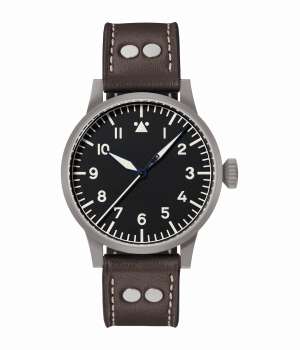
- Movement: Laco 200 / Sellita SW200 automatic
- Case Width: 42 mm
- Lug-to-Lug Distance: 50 mm
- Case Thickness: 12.8 mm
- Water Resistance: 100 m
- Current Price: $1,190
The Münster is where the appeal of Original becomes easy to explain. The dark sandblasted case, clean Type A dial, blued hands, and prominent crown create a coherent whole. The money goes toward this particular execution as well as the Swiss movement; it is not simply an Augsburg with a different name.
The Original collection offers automatic and hand-wound choices, Type A and Type B dials, and different sizes. The Erbstück versions add deliberate aging; bronze and blue-dial variants take the appearance in other directions. I would start with a standard version unless one of those finishes is a substantial part of the attraction.
For a smaller wrist, investigate the 39mm Originals before ordering a 42mm Münster. Still pay attention to the lugs: choosing Original means choosing its case design too.
3. Flieger PRO: The One I Would Configure For Myself
Flieger PRO is my starting point if the traditional dial appeals but I want more say over the rest of the watch. Stuttgart PRO uses Type A; Karlsruhe PRO uses Type B. Both offer 37mm, 40mm, and 43mm cases.
The Karlsruhe PRO starts at $1,140. Options include automatic or hand winding, brushed or dark sandblasted finishing, crown position, dial details, and caseback choice. The collection now includes green as well as black and blue dial options. The important practical features are curved lugs, a screw-down crown, and 200m water resistance.
My own starting configuration would be 40mm with a restrained dial and the fewest extras needed to make it feel right. Someone who dislikes crown pressure against the back of the hand might investigate the left-side crown option. This is where customization becomes useful rather than merely decorative. Check the final price before comparing it with a fixed-specification Original.
4. DIN 8330: A Different Kind Of Pilot Watch
Hamburg DIN 8330
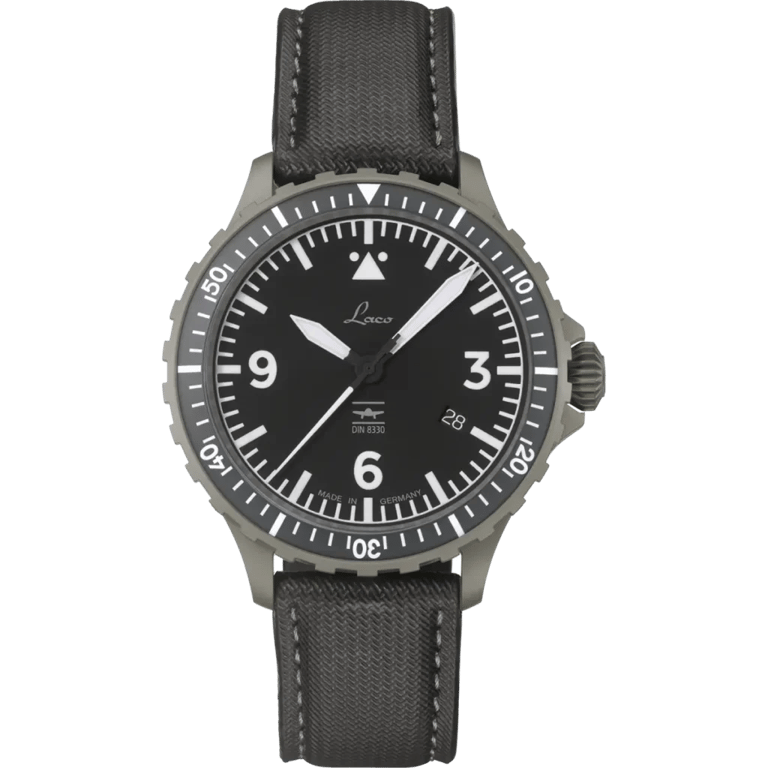
- Reference: 862164
- Movement: Laco 200 / Sellita SW200, Top grade
- Case Width: 43.5 mm
- Lug-to-Lug Distance: 49.8 mm
- Case Thickness: 13.6 mm
- Water Resistance: 200 m
- Current Price: $2,250
Hamburg belongs to Laco’s dedicated DIN 8330 range, with certification to the German pilot-watch standard. Its current specification includes a 904L steel case, magnetic-field protection, a bidirectional ceramic bezel, and a Top-grade Sellita-based movement. That makes it a different purchase from a simple three-hand flieger.
Our Hamburg DIN 8330 review discusses the readability, dark finish, and the way the relatively short lugs help manage its size. The qualification is straightforward: 43.5mm wide and 13.6mm thick is still a substantial watch. I would buy it because I wanted this case and functionality, rather than treating certification as a requirement for ordinary daily wear.
The current strap listing specifies FiberTech. Check the exact configuration when comparing it with older reviews or photographs.
5. Pilot Watches Special Models: Frankfurt GMT And More
Frankfurt 43 GMT Grau
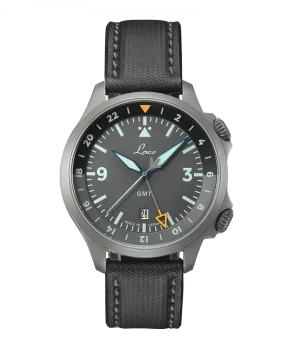
- Reference: 862121.2, the 43mm version covered by TWR
- Movement: Laco 330 / Sellita SW330-2 automatic GMT
- Case Width: 43 mm
- Lug-to-Lug Distance: 50 mm
- Case Thickness: 12.5 mm
- Water Resistance: 200 m
- Current Price: $2,220
Frankfurt is the Laco I would look at if tracking another time zone mattered more than keeping the traditional flieger layout untouched. It has an additional 24-hour hand and an internal rotating 24-hour scale, adjusted with the second crown. There is no chronograph function here: those extra controls serve the time-zone display.
Our Frankfurt GMT review covers the 43mm gray version, including its dark case, orange GMT detail, and clear dial. It also identifies size as something to consider carefully.
There is now a Frankfurt 40 GMT Grau, also listed at $2,220, with a 47mm lug-to-lug span and 11.9mm thickness. That is the version I would investigate first if the older watch seemed too large. Our 43mm review provides design context, but it is not a review of the new 40mm case. Black-dial versions are available in both sizes.
The Special Models group also includes Köln and overlaps with the Kiel chronographs. Think of it as a broader home for variations on the pilot-watch idea, rather than a collection with one shared specification.
6. Squad And Tool Watches: The Unconventional Atacama
Atacama Quartz UTC
- Reference: 862163
- Movement: Ronda 515.24 quartz with UTC display
- Case Width: 46 mm
- Published Lug-to-Lug Distance: 63 mm, with articulated lugs
- Case Thickness: 10.5 mm
- Water Resistance: 200 m
- Current Price: $710
The Atacama has more personality than its specification list can convey. The crown sits at twelve, the black case narrows toward the wrist, and the hinged lugs allow the strap to follow the wrist rather than project rigidly from the case. Its countdown bezel and additional time-zone display suit the practical character.
Our Atacama Quartz UTC review goes into the case, attachment system, and wearing experience. Quartz makes sense here: it keeps the watch ready between outings and helps keep the case relatively thin. I would still check the fit carefully, and buy replacement straps specifically compatible with its unusual attachment.
The Squad range also includes the automatic Atacama.3 and Seven Seas. These are alternatives within Laco’s more overtly utilitarian range, rather than reasons to assume every Squad watch wears like the Quartz UTC.
7. Sport Watches: Himalaya, Amazonas, Atlantik, And Mojave
Himalaya 42 MB
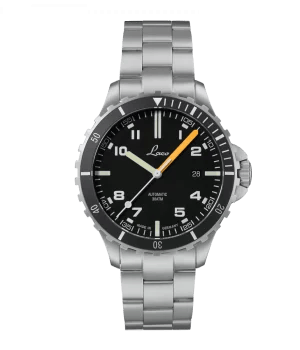
- Movement: Laco 200 / Sellita SW200 automatic
- Case Width: 42 mm
- Lug-to-Lug Distance: 50.5 mm
- Case Thickness: 13.4 mm
- Water Resistance: 300 m
- Bezel: Unidirectional, with ceramic insert
- Current Price: $1,260 on bracelet
These are the watches with the scorpion on the caseback, a bold rotating bezel, and a more conventional sports-watch shape than the Atacama. Our Laco Squad watches review covers Himalaya, Amazonas, Atlantik, and Mojave. The older title reflects the grouping used at the time; Laco now lists these Scorpion models under Sport Watches, separately from the Atacama-led Squad range.
The different accent colors give each version its own feel, while the black dial and bezel keep the family resemblance strong. Our review explores all four, so I would use it to narrow the appearance before choosing a size and strap.
The current Sport catalog includes 39mm as well as 42mm models. That matters: the 42mm bracelet watch is a substantial option, with a listed 50.5mm lug-to-lug span. If the design appeals but the dimensions do not, investigate the smaller version rather than assuming the whole family is too large.
8. Chronographs: Kiel.2
Kiel.2 Weiss
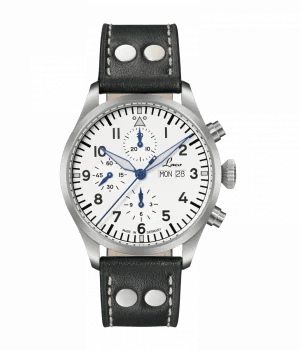
- Movement: Laco 500 / Sellita SW500 automatic chronograph
- Case Width: 43 mm
- Lug-to-Lug Distance: 51.5 mm
- Case Thickness: 14 mm
- Water Resistance: 100 m
- Current Price: $2,770
Kiel.2 is for someone who wants a mechanical stopwatch as well as Laco’s pilot-watch styling. The white dial and blued hands make the Weiss version an appealing change from the black-dial fliegers, while the subdials give it a busier face.
The compromise is size and price. At 14mm thick and $2,770, it is a different commitment from the simpler watches above. I would compare the proportions against a chronograph you already find comfortable. We have not published a dedicated Kiel.2 review, so this is a researched option to investigate, rather than a new claim about its wearing experience.
9. Navy Watches: A Quieter Alternative
Cuxhaven 39
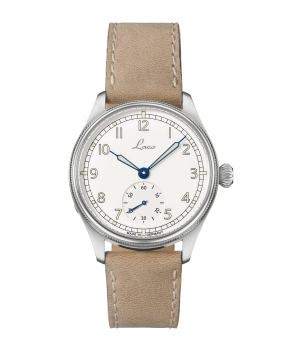
- Movement: Laco 261 / Sellita SW261, hand-wound
- Case Width: 39 mm
- Lug-to-Lug Distance: 46 mm
- Case Thickness: 10 mm
- Water Resistance: 100 m
- Current Price: $1,560
Cuxhaven would be my first stop if I liked Laco’s clear displays but wanted something dressier. The white dial, small seconds, blued hands, and fluted bezel give it a noticeably different character from the pilot watches. The 39mm diameter and 10mm thickness also make it an interesting option on paper for someone who finds the tool watches bulky.
This is a hand-wound watch, so include that daily interaction in the decision. The Navy collection offers a different side of the brand, but a cleaner appearance does not mean the ownership experience is identical to an automatic flieger.
10. Editions: Buy The Particular Design
The Editions category is best approached one release at a time. The current Stuttgart PRO WatchTime Edition was available at $1,750 when checked. It combines a 40mm case, taupe sunray dial, Top-grade Sellita-based automatic movement, 200m rating, and a steel bracelet plus an additional leather strap.
That is a useful example of an edition worth considering for its actual configuration. I would want the dial and included equipment to justify the purchase, rather than buying because a listing sounds exclusive.
The Laco × Circula ProLab is another example, but it was unavailable at our check. Its listed $2,990 was for a two-watch set, limited to 170 sets, rather than the price of one Laco. Older editions can remain visible after stock has gone, so a product page alone does not establish availability.
What About Laco Classics?
You may also encounter older Classics models, such as the hand-wound Plauen 40. That listing was marked unavailable, and Classics was absent from the main catalog navigation at our check. I would treat it as a separate lead for remaining dealer stock or the used market, rather than a current core collection to shop alongside the ten above.
Laco Vs Other Watch Brands
Laco Vs Sinn
Our Sinn brand review is a useful companion if the Hamburg or Frankfurt has caught your attention. With either brand, compare the actual case dimensions and functions you need, rather than assuming that a technical specification will make a watch more enjoyable to wear.
Within Laco, I would start with PRO for a configurable traditional dial, Frankfurt for a second time zone, and Hamburg for its particular certified pilot-watch design. Then compare those specific choices with the Sinn models that appeal to you. The right answer may come down to the dial, bezel, and fit more than the name on the watch.
Laco Vs Hamilton
If your interest begins with an affordable, readable watch, our Hamilton brand review offers another starting point. Decide whether you prefer the pilot-watch layout of an Augsburg or Aachen, or the field-watch appearance of a Khaki Field.
I would also compare winding routines and proportions early. Buying a hand-wound watch because you like its simplicity is a different decision from wanting an automatic you will wear every day. The same goes for Laco’s quartz options: convenience can be a positive reason to choose one.
Who Should Buy A Laco?
Laco makes the most sense if you enjoy a clear dial and can identify what draws you to a particular version. I would narrow the range this way:
- First Laco on a tighter budget: Augsburg or Aachen Basic; consider Genf.2 or Zürich.2 if you prefer quartz.
- Traditional flieger appearance: An Original in a size that suits your wrist, with Münster as the 42mm automatic reference point.
- A pilot watch tailored to your preferences: Stuttgart or Karlsruhe PRO, especially if 37mm or a left-side crown solves a specific problem.
- Second-time-zone display: Frankfurt GMT; compare the 40mm and 43mm cases before deciding.
- A distinctive practical watch: Atacama Quartz UTC, provided the fit and strap system work for you.
- A dressier alternative: Cuxhaven 39, if you enjoy hand winding.
The main reasons to hesitate are equally clear. Some of the strongest designs are large, movement and finish upgrades can raise the price, and several watches look similar enough that shopping by photograph alone can be misleading. If you want one watch to disappear under a cuff, start with dimensions before falling for a dial.
My preference would be a restrained 40mm PRO for a classic pilot-watch purchase. The Frankfurt 40 GMT is the alternative I would investigate for travel, while the Atacama remains the most individual choice among the watches we have reviewed. Laco’s range rewards that kind of specific decision more than a blanket verdict about the brand.
Frequently Asked Questions
Where are Laco watches made?
Laco is based in Pforzheim, Germany, where it describes carrying out watchmaking, assembly, adjustment, and checks. It uses externally supplied movements, including Japanese Miyota and Swiss Sellita calibers. German manufacture does not mean every component is German-made.
What is the difference between Laco Basic, Original, and PRO?
Basic is the lower-cost starting point, with automatic and quartz options. Original emphasizes traditional flieger details and offers Swiss automatic or hand-wound movements. Flieger PRO adds extensive customization, 37mm, 40mm, and 43mm cases, curved lugs, and 200m water resistance.
Are all Laco watches automatic?
No. Laco also makes hand-wound and quartz watches. Cuxhaven 39 is hand-wound, while Atacama Quartz UTC and the Genf.2 and Zürich.2 families use quartz movements. Check the exact reference rather than relying on the collection name.
Which Laco watches should I consider for a smaller wrist?
Start by comparing the 37mm Flieger PRO, 39mm Basic or Original models, 39mm sport watches, and Cuxhaven 39. Frankfurt GMT now also comes in 40mm. Lug shape, lug-to-lug length, thickness, and strap choice still matter; diameter alone cannot guarantee fit.
What warranty comes with a Laco watch?
Laco's published service information states a 24-month guarantee from the date of purchase. The company also provides repair and mechanical-watch servicing. Consult the purchase terms for the scope of coverage.