Tissot Seastar 1000 vs. TAG Heuer Aquaracer 300: Which to Buy?
The Seastar 1000 and Aquaracer 300 share ceramic bezels, 300m ratings, and 80-hour reserves. Compare what the TAG's premium adds in certification, fit, and design.
The Tissot Seastar 1000 is the stronger value purchase; the TAG Heuer Aquaracer Professional 300 is an upgrade in certification, bracelet adjustment, and design, not in depth rating or running time. That distinction matters when the TAG costs almost five times as much. You do not need the Aquaracer budget to get a ceramic-bezel Swiss automatic with a long power reserve.
The question is whether the TAG’s particular advantages are worth paying for in the watch you will wear. For someone choosing a first diver, the answer may be different from that of a Seastar owner considering a replacement.
This comparison covers the blue bracelet Tissot Seastar 1000 43mm T120.407.11.041.03 and TAG Heuer Aquaracer Professional 300 Date WBP5111.BA0013. Both are automatic date models. Smaller Seastars, quartz versions, and other Aquaracer generations need to be considered separately.
Compare these exact watches side by side
Tissot Seastar 1000 vs. Aquaracer 300 at a Glance
| Feature | Tissot Seastar 1000 | TAG Heuer Aquaracer Professional 300 |
|---|---|---|
| Case diameter | 43 mm | 42 mm |
| Case thickness | 12.7 mm | 12 mm |
| Movement | Powermatic 80 automatic | TH31-00 automatic, COSC-certified |
| Power reserve | Up to 80 hours | Up to 80 hours |
| Calendar | Date at six o’clock | Date at six o’clock, with magnifier |
| Water resistance | 300 m | 300 m |
| Bezel insert | Ceramic | Ceramic |
| Crystal | Sapphire | Sapphire |
| Case back | Exhibition | Closed steel |
| Bracelet | Steel, folding clasp with diver extension | Steel, folding clasp with fine adjustment |
| US list price, September 26, 2026 | $925 | $4,550 |
What the Seastar Already Gives You
At $925, the 43mm Seastar covers the obvious requirements unusually well. Its bezel material, stated water resistance, and maximum reserve all match the Aquaracer’s headline figures. The $3,625 price difference therefore needs an explanation beyond a longer feature list.
For everyday use, that shared reserve means you can leave either fully wound watch off for a normal weekend without expecting to reset it on Monday. Moving to the TAG does not extend that break. Nor does it add another calendar function: both show the date, without the weekday or a second time zone.
Equal specifications do not make the watches identical. They do make the Seastar a credible final choice, rather than something you must eventually replace. If its size suits you and you enjoy its appearance, there is no missing headline capability that requires spending several thousand dollars more.
The matching depth ratings also remove water resistance as a deciding advantage for the TAG. Neither rating makes maintenance optional; follow the maker’s care guidance and have a used watch checked before relying on it in water.
The Movement Upgrade: What Certification Adds
The Aquaracer’s TH31-00 is COSC-certified. This Seastar is not sold as a chronometer. Independent certification is a meaningful distinction if tested timekeeping is part of what you want from a mechanical watch.
It is not a measurement of how two particular examples will run on your wrist. A Seastar can perform well without that certificate, and the condition and servicing of an older Aquaracer still matter. We would pay attention to the certification, but would not translate it into a claim that the TAG is several times more accurate.
There is also a small reversal when you turn the watches over. The Tissot lets you see its movement through the case back; the TAG has a closed steel back. An exhibition back does not improve performance, but it can be part of the pleasure of buying your first automatic. The more expensive watch is not automatically the more interesting one to look at from every angle.
Dial Design: A Gradient or a Wave Pattern?
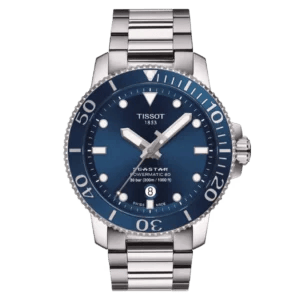
The Seastar uses broad hands, mostly round hour markers, and a blue dial that darkens toward its edge. The large bezel numerals give it a straightforward, sporty appearance. Its date window sits below the dial text without a magnifier interrupting the view.
The Aquaracer adds more geometry and surface detail: a twelve-sided bezel, angular markers, a wave-pattern dial, and an orange seconds hand. Its date also sits at six, but the magnifier makes that part of the dial more conspicuous. To our eyes, the TAG is the more elaborate design, while the Tissot is easier to take in as a single, simple arrangement.
Look at both from your normal reading distance, not just in enlarged photographs. If you find the TAG’s magnifier distracting, there is no reason to treat it as a compulsory improvement. If the waves and contrasting seconds hand are what you enjoy, those details are likely to matter more to you than another shared specification.
Fit and Bracelet: Two Different Upgrade Tests
The Aquaracer is 1mm narrower and 0.7mm thinner. Those reductions may help it feel less bulky, particularly beneath a sleeve, but neither watch is small. Compare how the case sits and where the bracelet begins to curve around your wrist before deciding that the TAG solves a fit problem.
The clasp deserves its own test. TAG’s Professional 300 brochure describes a fine-adjustment system with five positions across a 1cm range. For someone whose wrist changes size during a hot day, usable small adjustments can be a more noticeable benefit than the movement certificate.
Tissot specifies a safety folding clasp with a diver extension. Have the retailer demonstrate how each clasp adjusts, and check whether you can find a comfortable setting without leaving the watch too loose. The presence of a diver extension alone does not tell you how convenient small daily adjustments will be.
The Seastar also has a quick-release bracelet. That helps with changing the bracelet or strap; it is a different feature from adjusting its length while wearing it. Both references use a 21mm lug width, so check compatible strap choices rather than assuming that the move to TAG opens up a different range of widths.
Buying Your First Diver or Replacing One?
For a first mechanical diver, start with the Tissot unless you already have a clear reason to want the TAG. It gives you room to discover whether a large blue diver is the style you enjoy wearing. There is no need to use the full budget before you know whether bracelet comfort, dial texture, or a movement certificate matters most to you.
For an existing Seastar owner, identify what you want to change. If your watch feels too large, compare the Aquaracer’s actual fit. If the bracelet becomes uncomfortable during the day, spend time with its adjustment system. If the attraction is simply the TAG’s appearance, that is a valid preference, but it is different from needing more dive-watch capability.
Do not buy a Seastar solely as a temporary substitute if your mind is already made up about the Aquaracer and the latter is comfortably within budget. Equally, do not replace a watch you enjoy just because a more expensive model seems like the next expected step. Either can be the watch you keep.
Warranty is another concrete difference. Tissot lists two years for this Seastar. Eligible TAG purchases can receive a five-year total warranty through registration. Confirm the coverage attached to the actual watch, especially when comparing authorized-retailer and pre-owned offers.
If you want to explore the space between these prices, our Mido Ocean Star 200C vs. TAG Heuer Aquaracer comparison uses this same Aquaracer against a day-date alternative. Our Tissot Seastar 1000 vs. Mido Ocean Star 200 article instead covers the older, aluminum-bezel Mido.
Smaller Seastars and Other Aquaracers
The 40mm Seastar 1000 automatic T120.807.11.051.00 is worth trying if size is your main objection to the Tissot. It measures 12.48mm thick and retains an 80-hour reserve and 300m rating. However, Tissot specifies a mineral bezel ring for that reference, not the ceramic ring of the 43mm watch above. It is an alternative configuration, not simply the same watch scaled down.
If you want a more specialized dive watch rather than a smaller one, read our Seastar 1000 vs. Seastar 2000 comparison. The Professional offers another upgrade path within Tissot, but its case thickness is an important part of the decision.
Check the full reference when shopping for an Aquaracer as well. The Professional 200, GMT, and earlier Professional 300 models do not all share this watch’s movement, dimensions, and reserve. A cheaper Aquaracer listing is not necessarily a lower price for WBP5111.BA0013. Likewise, do not apply the Powermatic 80 specifications here to a quartz Seastar.
Final Verdict
Buy the Seastar 1000 for the watch it already is: a well-specified automatic diver with a simple date display and a substantial saving. It is our recommendation when you want the functionality and enjoy the design without needing the TAG’s specific extras.
Buy the Aquaracer Professional 300 for improvements you can identify and appreciate. Its certification and bracelet adjustment provide practical reasons to upgrade, while its dial and bezel provide the visual ones. With reserve and depth rating tied, the decision should turn on those differences, not on the assumption that a higher price makes every part of ownership better.
Frequently Asked Questions
Is the TAG Heuer Aquaracer worth the premium over the Tissot Seastar?
It can be if you value chronometer certification, the adjustable clasp, and the TAG’s design enough to justify the price difference. For buyers mainly seeking a ceramic-bezel automatic with a long reserve, the Seastar is the stronger value choice.
Does the Aquaracer have better water resistance or a longer power reserve?
Not in this comparison. Both exact references have a 300m rating and offer up to 80 hours from a full wind. Other Seastars and Aquaracers can have different specifications.
Is the Tissot Seastar 1000 a COSC-certified chronometer?
The T120.407.11.041.03 is not sold as a COSC-certified chronometer. The TH31-00-powered Aquaracer WBP5111.BA0013 is. Powermatic 80 names a movement family; it does not establish chronometer certification for every watch using it.
Should I choose the TAG if the 43mm Seastar feels too big?
Try it, but also try the 40mm Seastar automatic. The Aquaracer is only 1mm smaller in diameter than the watch compared here. A properly adjusted bracelet and the shape of the case matter alongside that measurement.