Tissot Seastar 1000 vs. Seastar 2000: Which Diver to Buy?
Compare the 43mm Seastar 1000 with the 46mm Seastar 2000: everyday fit, dive certification, dial design, and whether the $350 premium makes sense.
Choose the Tissot Seastar 1000 for everyday wear; choose the Seastar 2000 Professional when you want its more specialized dive-watch construction and genuinely enjoy a large watch. The 2000 has the stronger underwater credentials, but its size is a cost you carry throughout the day. It is not an automatic upgrade for every Seastar buyer.
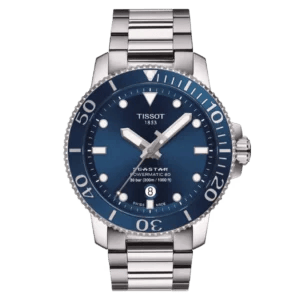
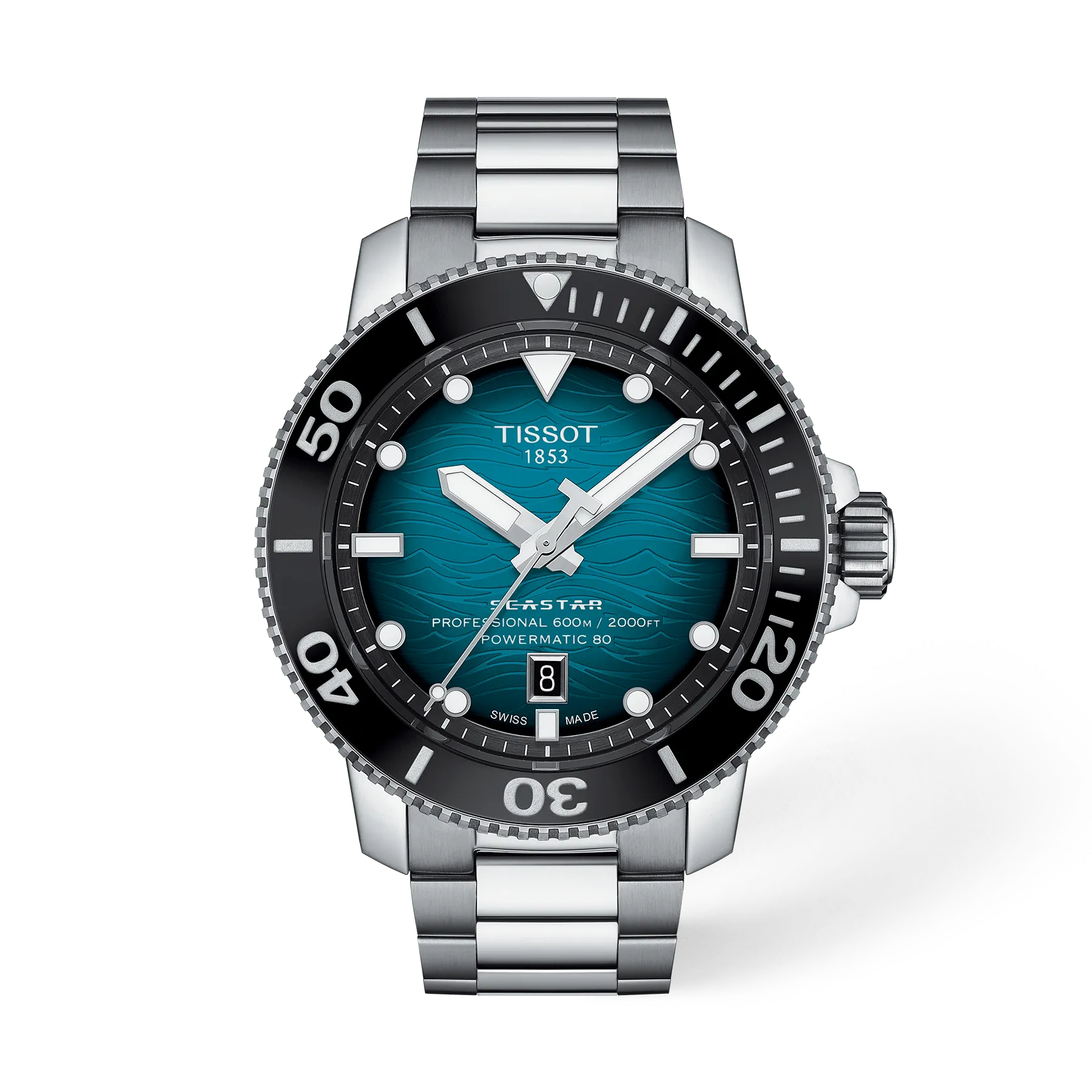
The main comparison here is between the blue steel-bracelet Seastar 1000 43mm T120.407.11.041.03 and Seastar 2000 Professional 46mm T120.607.11.041.00. Tissot also makes a newer 44mm Seastar 2000 and smaller Seastar 1000 models; those alternatives get their own section below.
Compare these exact watches side by side
Seastar 1000 vs. Seastar 2000 at a Glance
| Feature | Seastar 1000 | Seastar 2000 Professional |
|---|---|---|
| Case diameter | 43 mm | 46 mm |
| Case thickness | 12.7 mm | 16.25 mm |
| Tissot-listed weight | 184 g | 206 g |
| Lug width | 21 mm | 22 mm |
| Movement | Powermatic 80 automatic | Powermatic 80 automatic |
| Power reserve | Up to 80 hours | Up to 80 hours |
| Water resistance | 300 m / 30 bar | 600 m / 60 bar |
| Dive certification | Not advertised as ISO-certified | ISO 6425:2018 |
| Helium escape valve | No | Automatic |
| Bezel insert | Ceramic | Ceramic |
| Crystal / case back | Sapphire / exhibition | Sapphire / exhibition |
| US list price, September 26, 2026 | $925 | $1,275 |
Start With Thickness, Not the Number on the Dial
The difference between these watches is easiest to underestimate in a front-on photograph. A wide dial can look balanced on screen while telling you little about what happens when you bend your wrist, pull on a jacket, or rest your arm at a desk.
The 46mm Seastar 2000 is 3.55mm thicker than the 43mm Seastar 1000. That is the dimension we would pay particular attention to during a fitting. Try the watch with the clothes you normally wear, and look at it from the side. Do you like that raised profile, or are you already hoping to get used to it?
A substantial watch can be satisfying when that is what you want. The mistake is buying one reluctantly because the specification sheet makes the smaller option feel inadequate. For a watch worn from breakfast through the working day, comfort should not be an apology you make on its behalf.
Neither watch is a compact choice. We would not decide suitability from wrist circumference alone: the shape of your wrist, bracelet fit, and tolerance for weight all matter. Tissot’s listed weights are a useful comparison, not a prediction of what each bracelet will weigh after sizing.
What the 2000’s Dive Specification Actually Adds
The Seastar 2000 Professional does more than double the depth figure. Tissot identifies this reference as an ISO 6425:2018-certified diver. The standard concerns dive-watch requirements and testing, including a secured way to indicate diving time that remains visible in darkness. This is a different claim from simply printing a water-resistance rating on a dial.
That makes the Professional the more purposeful choice if dive-watch engineering is central to the purchase. It does not mean the Seastar 1000 is unsuitable for every water activity, or that a higher rating makes the owner safer. Choose equipment for the actual activity and follow the maker’s instructions; neither a collection name nor a depth figure substitutes for that.
The automatic helium valve is even more specialized. As Tissot’s original Seastar 2000 announcement explains, it addresses gas pressure associated with saturation diving. It is not a feature you need for swimming or ordinary recreational scuba use. There is nothing wrong with enjoying that engineering, but it should not be mistaken for a daily-use necessity.
For most buyers, the appeal is owning the more dedicated instrument, not using its full operating envelope. That is a perfectly reasonable enthusiast preference. It becomes a less convincing purchase when the same buyer dislikes wearing it on land.
The Movement Is Not the Reason to Spend More
Both watches use the Powermatic 80 family, show the date, and offer the same maximum reserve. The 43mm Seastar 1000 already provides the practical convenience of leaving a fully wound watch off over a normal weekend.
Moving to the 2000 does not let you leave the watch unworn for longer or add an extra calendar function. Nor should its dive certification be read as a chronometer certificate. These are separate kinds of claims.
The useful question is therefore not which watch has the more impressive model number. It is whether you prefer the case, dial, and underwater specification enough to accept the fit. An owner happy with a Seastar 1000 need not replace it in pursuit of a more convenient movement experience.
The Wave Dial May Be the Strongest Reason to Upgrade
The 1000’s smooth blue-to-dark dial is the quieter design. The 2000 adds a wave texture, a framed date window, and a more sculptural appearance through its domed crystal. The result is a more assertive watch, even before you read the depth rating.
To our eyes, the 2000 is the more interesting watch to examine closely. The 1000 is easier to recommend when you want the watch to sit alongside your clothes without becoming the main feature. Neither preference needs to be justified by diving habits.
Try separating those two attractions in your mind. Would you still want the Professional if its depth rating were hidden? If the answer is yes because you love the dial, that is a stronger reason to buy it than feeling obliged to choose the bigger number.
Bracelet Fit Matters More Than Another Feature
Both selected references have quick-release steel bracelets and safety folding clasps with diver extensions. Quick release helps you change a bracelet; it does not mean you can fine-tune its length while wearing it. Ask the retailer to demonstrate the clasp and size the bracelet before judging comfort.
If you already own the 1000, its straps do not automatically move across to the 2000: the lug widths differ. Budget for the correct size, and verify that any fitted end links match the case as well as the nominal width.
A strap change can alter how a watch balances and feels, but it cannot remove case height. We would not buy a Professional that feels wrong on the wrist in the hope that a different strap will solve everything.
Is the $350 Premium Worth It?
At the US list prices above, the Professional costs about 38% more. That is a relatively contained step within the same brand, but the right question is still what you gain in your own use.
The premium makes sense when the 2000 is the watch you prefer wearing. Someone who likes its size, textured dial, and dedicated dive specification gets a clearly different proposition. For that buyer, settling for the 1000 solely to save money could be the less satisfying decision.
It makes less sense as insurance against choosing an insufficiently capable watch. A daily-wear buyer who prefers the smaller case should not treat that preference as a compromise. Compare actual offers, warranty coverage, and return terms, then keep fit at the centre of the decision.
For an alternative within the affordable Swiss-diver category, see our Seastar 1000 vs. Mido Ocean Star 200 comparison. Our Seastar 1000 vs. TAG Heuer Aquaracer 300 article explores a different upgrade path, where the emphasis is on certification, bracelet adjustment, and design rather than a higher depth rating.
The Newer 44mm Seastar 2000 and Smaller 1000 Models
Not every Seastar 2000 is the 46mm watch in this comparison. The newer blue 44mm Professional T120.907.17.041.00 measures 15.29mm thick and comes on blue rubber. It retains a 600m rating and an 80-hour reserve; Tissot lists it at $1,050 in the US.
That gives you another route if you like the Professional concept but find the larger bracelet model too imposing. It is still substantially thicker than the 43mm Seastar 1000. Compare the actual references and strap configurations, not a discounted 46mm listing against a photograph of the newer 44mm watch.
At the other end, the 40mm Seastar 1000 automatic T120.807.11.051.00 is 12.48mm thick, with a 300m rating and 80-hour reserve. Its bezel ring is mineral rather than the ceramic used on the 43mm reference above. The wider Seastar 1000 family also includes quartz watches, so do not apply this automatic comparison to every model carrying the name.
Final Verdict
Our default recommendation is the Seastar 1000. For a buyer seeking one watch for ordinary daily wear, the less imposing case is the more persuasive starting point. You do not have to graduate from it to the Professional.
Choose the 46mm Seastar 2000 when its presence is part of the attraction. The dedicated dive specification and wave dial make a coherent package, provided you enjoy the watch on your wrist. If the concept appeals but the size does not, try the newer 44mm version before giving up on the range.
Frequently Asked Questions
Is the Seastar 2000 better than the Seastar 1000?
It has more specialized diving credentials, but that does not make it the better everyday watch for every buyer. We would choose by fit and intended use before treating the Professional badge as a reason to upgrade.
Does the Seastar 2000 have a longer power reserve?
No. The two automatic references compared here both offer up to 80 hours. The larger model’s premium is not buying a longer running time.
Do I need the helium escape valve?
Not for swimming or ordinary recreational scuba use. It is a saturation-diving feature. Enjoy it as part of the watch’s engineering if that interests you, rather than buying it as an everyday requirement.
Is every Seastar 2000 46mm?
No. There is also a newer 44mm Professional. Check the full reference, thickness, and bracelet or strap specification before applying this comparison to a watch you are considering.