Longines Conquest vs. HydroConquest: Which to Buy?
Compare the blue Conquest 41mm with the new HydroConquest 42mm: wrist fit, dial design, bracelet adjustment, and why the diver costs $200 less.
Choose the Longines Conquest for its slimmer, dressier everyday design; choose the HydroConquest for its timing bezel and adjustable bracelet clasp. The surprising part is the price: the newer HydroConquest costs $200 less at US list, despite offering the more useful clasp and higher water-resistance rating. The Conquest needs to win you over through its proportions and appearance, not a stronger specification sheet.
This comparison focuses on the blue steel-bracelet Conquest 41mm L3.830.4.92.6 and the HydroConquest 42mm L3.788.4.96.6, part of the redesigned HydroConquest range introduced in 2026. Older HydroConquest models have different dials and bracelets, so the generation matters as much as the name. Smaller alternatives are covered below.
Compare these exact watches side by side
Conquest vs. HydroConquest at a Glance
| Feature | Conquest 41mm | HydroConquest 42mm |
|---|---|---|
| Case diameter | 41 mm | 42 mm |
| Case thickness | 10.90 mm | 11.70 mm |
| Lug-to-lug length | 49.10 mm | 51.20 mm |
| Lug width | 21 mm | 21 mm |
| Movement | L888.5 automatic | L888.5 automatic |
| Power reserve | Up to 72 hours | Up to 72 hours |
| Water resistance | 100 m / 10 bar | 300 m / 30 bar |
| Bezel | Fixed polished steel | Unidirectional ceramic |
| Dial finish | Sunray blue | Polished blue lacquer |
| Date position | Six o’clock | Three o’clock |
| Crystal / case back | Sapphire / exhibition | Sapphire / closed |
| Bracelet clasp | Push-button folding | Folding with micro-adjustment |
| US list price, September 26, 2026 | $2,400 | $2,200 |
The Conquest Is More Than a HydroConquest Without the Bezel
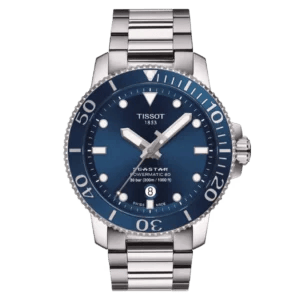
The family resemblance is there, but these watches organize the dial quite differently. The Conquest uses slender baton markers, a date window at six, and an uninterrupted polished bezel. Its sunray finish supplies the visual interest without adding another scale around the dial.
The HydroConquest places its date at three and surrounds the dial with a ceramic timing bezel. The geometric hour markers and more substantial hands give it a clearer sporting identity. On this newer generation, Longines has removed the large Arabic numerals associated with the previous HydroConquest design. It remains a diver, but a buyer who disliked the older dial should look again.
Our preference for mixed office and evening wear is the Conquest. Its simpler outline is easier to pair with a shirt or jacket, particularly when you want one watch to move between casual and dressier clothes.
The HydroConquest is the more compelling choice when you actively want the bezel and bolder markers. A timing bezel can be useful on land, too: it gives you a quick way to mark elapsed time without changing what the hands are doing. The Conquest does not offer an equivalent function.
Wrist Fit: Look Beyond the One-Millimetre Difference
The diameters suggest a close match. The more useful distinction is length: the 41mm Conquest measures 49.10mm lug to lug, while the 42mm HydroConquest reaches 51.20mm. Those extra 2.10mm deserve attention if the Conquest already approaches the edges of your wrist.
The thickness gap is more modest. At 11.70mm, the HydroConquest is only 0.80mm taller than the Conquest. Calling it a bulky alternative on thickness alone would overstate the difference. Its longer case and rotating bezel do more to distinguish the overall presentation.
There is another visual complication: a fixed-bezel watch can look expansive because more of its face is open dial. The Conquest may not appear dramatically smaller when viewed head-on, even though its case is shorter. Try both from the side as well as from above, with the bracelets properly sized.
Our hands-on review of the green Conquest 41mm covers the same generation and case size in a different dial colour, with a closer look at bracelet comfort and everyday wear.
The HydroConquest’s Clasp Is a Real Everyday Advantage
The 2026 HydroConquest redesign includes an H-link bracelet and a folding safety clasp with micro-adjustment. That is arguably the most useful reason to choose it over the Conquest, even if you never use its full water-resistance rating.
Being able to fine-tune bracelet length matters when a fit that feels right in the morning becomes tight later in the day. It also gives you more room to find a comfortable setting than removing or adding a whole link alone. Have the retailer demonstrate the adjustment before deciding how much value it holds for you.
The Conquest’s steel bracelet uses a push-button folding clasp. In our review of the green 41mm model, the bracelet was comfortable, but the absence of clasp micro-adjustment was a clear limitation. A good initial fit may make that unimportant for you; a wrist that changes size noticeably through the day makes the HydroConquest’s arrangement more attractive.
Both selected watches have 21mm lug spacing. That helps when shopping for ordinary straps, but it does not make their fitted bracelets or shaped end links interchangeable. Check compatibility with the exact case, not just the stated width.
Same Movement, Different View
Both exact references use Longines’ L888.5 automatic movement, with a silicon balance spring, a 25,200-vibration-per-hour beat rate, and up to 72 hours of reserve. Paying more for the Conquest does not buy a longer reserve or an additional complication.
For someone rotating watches, the practical routine is similar: a fully wound example can cover a normal weekend off the wrist. Neither watch has an inherent reserve advantage simply because one is positioned as an everyday model and the other as a diver.
The Conquest does give you a sapphire exhibition back. The HydroConquest has a closed screw-down back, so the movement remains out of sight. For a first mechanical watch, being able to see the rotor may be part of the enjoyment. For someone who never turns the watch over, it is unlikely to settle the decision.
Both also fall under Longines’ five-year warranty for qualifying mechanical watches, subject to its terms. There is no longer mechanical-watch warranty to justify choosing one of these models over the other.
What the Extra Water Resistance Means Here
The HydroConquest combines a 300m rating with a unidirectional timing bezel. The Conquest is rated to 100m and has a fixed bezel. Both selected references have screw-in crowns and sapphire crystals, but only one is built around the dive-watch format.
The useful distinction is purpose, not a claim that the HydroConquest is three times as useful in daily life. Its higher rating is part of a coherent sporting package. The Conquest trades the rotating bezel and some depth capability for a simpler appearance and a slimmer case.
Water resistance alone should not decide a general-purpose purchase. Consider the activity you intend to do, the watch’s condition, and the manufacturer’s operating instructions. For many buyers, bracelet comfort and case proportions will be more noticeable every day than the difference between these ratings.
Is the Conquest Worth the Extra $200?
At the list prices above, the Conquest is the more expensive watch. That reverses the easy assumption that the HydroConquest is an upgraded Conquest with diving equipment added.
The Conquest makes sense when you prefer its design enough to choose it on equal terms. The shorter case, restrained dial layout, polished bezel, and view of the movement form a distinct package. They are legitimate reasons to pay more, even though they do not produce a longer feature list.
The HydroConquest is our stronger specification-for-price choice. It offers the same movement family and reserve, a ceramic timing bezel, greater water resistance, and the more adaptable clasp for less money. A buyer who likes both designs equally has a persuasive reason to start there.
Discounts can alter the gap, but they should not obscure which generation is on offer. An older HydroConquest at a lower price does not automatically include the new bracelet. Our HydroConquest vs. Mido Ocean Star 200 comparison covers the older 43mm Longines if that is the model you are considering.
Smaller Sizes and Older HydroConquest Models
If either main reference looks too long on your wrist, compare the blue Conquest 38mm L3.720.4.92.6 with the new blue HydroConquest 39mm L3.779.4.96.6. Their lug-to-lug lengths are 46.80mm and 48.10mm respectively. That is a more useful reduction in footprint than hoping a looser bracelet will make a long case fit.
The smaller Conquest remains 10.90mm thick, while the smaller HydroConquest remains 11.70mm thick. They retain the same broad distinction: everyday styling and an exhibition back on the Conquest, ceramic timing bezel and micro-adjustment on the HydroConquest. Their lug widths differ, however: 19mm for this Conquest and 20mm for this HydroConquest.
The older blue HydroConquest 41mm L3.781.4.96.6 is a separate option, recognizable by its large 12, 6, and 9 numerals. Do not apply the new 39mm and 42mm bracelet specifications to that watch. Nor should this three-hand automatic comparison be treated as a specification guide to quartz or GMT models carrying similar names.
Final Verdict
We would choose the Conquest for one-watch ownership centred on office wear and dressier occasions. Its proportions and simpler face are the reason to buy it. Choose it because you want that watch, not because the higher price implies a better movement.
We would choose the HydroConquest for a sportier daily watch, particularly when bracelet adjustment matters. The new generation makes a strong value case without asking you to accept a much thicker watch. If both designs appeal equally, its clasp and lower price give it the edge.
Frequently Asked Questions
Do the Conquest and HydroConquest use the same movement?
The two exact references compared here both use the L888.5 automatic, with a silicon balance spring and up to 72 hours of power reserve. Check the reference before applying that answer to older, quartz, or GMT models.
Which is better for a smaller wrist?
Of the main pair, the Conquest has the shorter case. For a more substantial reduction, try the 38mm Conquest and new 39mm HydroConquest: their lug-to-lug lengths are 46.80mm and 48.10mm. Wrist shape and bracelet fit still matter alongside the measurements.
Does every HydroConquest have a micro-adjustable clasp?
No. The new 42mm L3.788.4.96.6 and 39mm L3.779.4.96.6 bracelet references discussed here do. Do not assume the same clasp is fitted to older generations or other strap configurations.
Why is the Conquest more expensive than the HydroConquest?
The prices reflect different product designs, not a simple ladder of capability. In this pair, the Conquest offers a slimmer, shorter case and an exhibition back; the HydroConquest offers more sporting features for less. The Conquest’s premium is worth considering when you prefer its appearance and fit, not for a movement upgrade.