Vaer Watches Review: Quality, Collections, and Best Models
The thing I like about Vaer is that you can start with a fairly ordinary question: what would I actually wear most days? A small field watch, perhaps. A diver that works with a shirt as easily as a swimsuit. Or a GMT that keeps running when you leave it on the dresser for a few days.
Vaer has an answer to each of those, and that everyday usefulness is a better starting point than the American-brand story alone. We have published dedicated reviews of the D5 Meridian Navy, R1 Racing Chronograph, S3 Tradition, and G2 Pacific Polar GMT. Together, they show both the variety in the range and the details that make individual models worth a look.
My short answer: Vaer is worth considering if you want restrained, practical watches with useful size and movement choices. I would start with the C3 Korean Field Solar for a compact everyday watch, the D4 Meridian for a solar diver, or the G2 Pacific Polar if you want a second time zone. The inexpensive S-series and more elaborate automatics deserve their own consideration, rather than one verdict applied to the whole catalog.
By clicking on the product links in this article, we may receive a commission fee at no cost to you. Thank you for your support.
Vaer Watches At A Glance
| Category | TWR Take |
|---|---|
| Founded | 2016 in Venice, California, by Ryan Torres and Reagan Cook |
| Production | American company with US assembly on many models; other series are assembled overseas |
| Collections covered | Field and tactical, dive, chronograph, GMT, and design/dress watches |
| Movements | Battery quartz, solar quartz, meca-quartz chronographs, and automatics |
| Current starting prices | $179 for the S3/S5 Tradition; representative solar models from $319; G2 GMT from $429; G5 GMT from $989 |
| Warranty | Two years for the original owner, including water-related failure under the stated terms |
| Main strengths | Everyday versatility, smaller case options, sapphire crystals, and a choice of practical movements |
| Main tradeoffs | Familiar styling, overlapping model names, price differences between series, and changing stock |
| Reviewed models | D5 Meridian Navy, R1 Racing Chronograph 38mm, S3 Tradition, and G2 Pacific Polar 39mm |
Prices are starting US-dollar prices before optional strap or bracelet upgrades. Collection coverage, prices, and availability were checked on September 23, 2026. Older reviews describe the versions and prices available when they were published.
Quick Verdict: Are Vaer Watches Good?
Yes, provided you choose the model for the way you will use it. Vaer’s appeal is a combination of readable designs, practical specifications, and a fairly wide choice of sizes. You do not have to buy an automatic to get an interesting watch, and you do not have to buy the largest version to get a useful one.
Our R1 review is a good example. The cream dial, colorful subdials, and cushion case give it plenty of personality, while its 38mm diameter keeps the overall package approachable. The G2 Pacific Polar makes a different argument through a clear dial, a second time zone, and quartz convenience.
I would be less enthusiastic about choosing a Vaer simply because a listing says “USA.” Assembly is one part of the purchase. The watch still needs to suit your wrist, look good to you, and justify its price against the alternatives. A $179 S3 and a $989 G5 answer quite different questions.
Vaer Brand History And Where The Watches Are Made
Vaer was founded in Venice, California, in 2016 by Ryan Torres and Reagan Cook. Their account of the brand’s beginnings centers on making an affordable everyday watch that could handle time in the ocean as well as ordinary working life. That helps explain the emphasis on screw-down crowns and water resistance across watches that do not necessarily look like divers.
American assembly has become an important part of the business. Vaer’s current assembly page describes Los Angeles as a production and quality-control hub, alongside other US assembly partners, including FTS in Arizona. These watches use an international supply chain; US assembly should not be read as a claim that every component is American-made.
It is also not a description of every Vaer watch. The product pages identify different origins: the S3 Tradition is assembled in China, the DS2 Meridian and RS1 Rally in Hong Kong, and the C1 Ceremony in Japan. The A12 Dirty Dozen is listed as Swiss Made.
I appreciate having that choice. Someone shopping for an inexpensive field watch may care more about price and proportions; someone specifically supporting US assembly can choose a model that offers it. The important thing is to check the actual watch, rather than assume the brand name settles the question.
Vaer Quality, Movements, And Ownership
Choose The Movement Around Your Habits
Battery quartz is a sensible starting point if you want a watch you can set and largely leave alone. Solar adds rechargeable convenience, provided the watch gets enough light. An automatic needs more attention when it spends time unworn, but the mechanics can be part of the enjoyment.
Vaer offers all three approaches, plus meca-quartz chronographs. The R1 Racing uses a VK63: quartz timekeeping paired with a mechanical chronograph mechanism. You get the immediate reset and a smoothly advancing chronograph seconds hand without the cost or upkeep of an automatic chronograph.
Within the automatics, the movement also changes what the watch can do. The A5 Atlas uses a Miyota 9015 with a date, while the G5 uses the Miyota 9075 GMT. The latter lets you adjust the local hour hand separately, a useful feature when traveling across time zones. Miyota’s own specifications confirm that operation and an approximately 42-hour reserve.
Size And Strap Choice Deserve Attention
One of Vaer’s strengths is the availability of smaller watches. The 36mm field models are a good place to begin if you dislike a watch spreading across your wrist. The reviewed R1 and G2 both have a 46mm lug-to-lug span despite their different case shapes.
Diameter alone will not tell you how a watch wears. A broad cushion case, a tall crystal, or the first links of a bracelet can change the impression considerably. The 41.5mm C4 and A4 tactical watches are also a different proposition from a simple 36mm field watch.
Watch the strap selector when comparing prices. Vaer commonly includes two straps, but leather and bracelet choices can raise the total. The starting prices here make the range easier to compare; they are not a promise that every pictured configuration costs the same amount.
What Does The Warranty Cover?
Vaer’s two-year warranty covers defects in materials and workmanship for the original owner purchasing from Vaer or an authorized dealer. It also addresses water-related failure during that period, provided the crown was properly sealed.
The warranty is non-transferable and excludes normal wear, impact damage, loss, and theft. That is useful support for an everyday watch, but it is not accidental-damage insurance. We are describing the published terms here, rather than reporting a warranty claim we have personally tested.
Vaer Collections And Watches To Consider
The current catalog contains considerable overlap: a military-inspired watch may also sit in the field collection, and a minimalist design can appear among the dress watches. The five groups below cover the core range without treating every size and color as a separate collection.
| Group | Main Families | Where I Would Start |
|---|---|---|
| Field and tactical | S3/S5, C3/C5 solar, A5 automatic, C4/A4 tactical, A12 Swiss automatic | S3 Tradition for price; C3 Korean Solar for convenience; A5 Atlas for an automatic |
| Dive | DS2 quartz, D4 solar, D5 automatic | D4 Meridian for everyday use; DS2 for a lower budget |
| Chronograph | RS1 Rally, R1 Racing and Oceanracer | R1 Racing 38mm for its design and proportions |
| GMT | G2 quartz and G5 automatic, including Pacific and Meridian designs | G2 Pacific Polar for a slim quartz GMT |
| Design and dress | C3/C5 Design solar and C1 Ceremony quartz | C1 Ceremony for a dressier watch; Design Navy for solar simplicity |
These are representative choices across all five groups. Our comments on models without a dedicated TWR review are based on their design and published specifications, rather than claimed hands-on testing.
Field And Tactical Watches: Vaer’s Natural Starting Point
S3 And S5: The Affordable Entry
The S-series is where I would start if keeping the price down matters most. The current S3 Tradition is a 36mm quartz watch starting at $179, with a sapphire crystal, screw-down crown, and 100m water resistance. S5 Tradition offers the same basic idea in a 40mm size.
We have a dedicated Vaer S3 Tradition review discussing its vintage-inspired appearance, warm dial accents, and compact proportions. It remains part of our coverage of the brand, though current purchases should be checked against the present S3 listing, rather than the older article’s price and component details.
The Calendar variants add a date, while Tactical and Dirty Dozen designs bring different military-style dial layouts. I would choose among these by readability and appearance before worrying about the name. If you want US assembly, however, move on to the specifically labeled models below; the S-series does not offer that feature.
C3 And C5 Solar: Practical Everyday Choices
The C3 Korean Field Solar is one of my strongest starting recommendations on paper. It combines a 36mm case, 43mm lug-to-lug length, 100m water resistance, and a Japanese Epson VS22 solar movement, with US assembly. Its starting price is $319.
That is a useful combination for someone who wants a modestly sized watch without regular winding. The 40mm C5 Korean is the larger alternative. C5 Recon and Tactical designs offer other dial treatments, so the decision need not begin and end with one vintage look.
Solar would be my preference for a watch worn frequently through an ordinary week. If you tend to put watches away in a dark drawer for months, it is still worth thinking about charging habits. Solar reduces attention; it does not remove the need for light.
A5, C4/A4, And A12: Different Reasons To Spend More
The A5 Atlas Black, starting at $699, is the automatic I would investigate first for everyday versatility. Its 38mm case, date display, Miyota 9015, and US assembly give it a different appeal from the simpler quartz field watches. A5 Field and Tactical models provide alternatives if you prefer a more utilitarian dial.
The larger C4 Tactical Field Solar starts at $519. Its 41.5mm case, 200m rating, four-o’clock crown, and rotating 12-hour bezel make it a more substantial outdoor option. The A4 automatic, from $849, takes that layout in a mechanical direction. I would compare their bulk carefully before choosing either over a smaller field watch.
At the other end of the military-inspired range, the 36mm A12 Dirty Dozen offers Swiss manufacture and a Sellita automatic movement. It was listed at $1,099 and sold out when checked. It is a distinct enthusiast option, rather than the obvious place to begin with Vaer.
Dive Watches: DS2, D4, And D5
The dive range is easiest to understand by movement. The DS2 Meridian Black 39mm starts at $239 and uses battery quartz, with sapphire and a 150m water-resistance rating. It is the lower-cost route into Vaer’s dive-watch styling.
My starting pick is the D4 Meridian Navy Matte Solar 39mm, from $429. It adds solar power, US assembly, a ceramic bezel, and 200m water resistance. Its listed 46mm lug-to-lug span is approachable, although the total height of 13.18mm including the crystal is worth considering if you prefer thin watches.
D5 is the automatic route. Meridian Black and Tropic were available at our check, starting at $729 and $749 respectively. The reviewed Navy deserves a closer look, with one important distinction about versions.
Previously Reviewed: D5 Meridian Navy
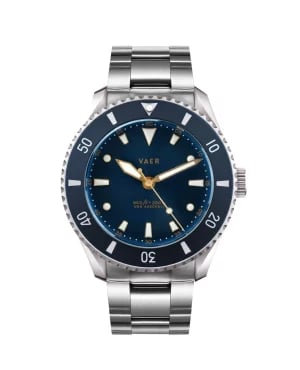
- Version: Watch covered in our 2023 review
- Movement: Miyota 9039 automatic
- Power Reserve: 40 hours, as quoted in that review
- Case Width: 39 mm
- Water Resistance: 200 m
- Historical Price: Around $600 when reviewed
Our D5 Meridian Navy review liked the balance between sporty dive-watch details and the warmth of the navy-and-gold dial. The sword hour hand, pencil minute hand, and lollipop seconds hand give the face more character than a quick glance might suggest.
The current Navy listing was $729 and sold out at our check. Vaer describes a revised V2 there and lists a Miyota 9015 with a date, so our older no-date review should not be treated as a test of that newer version. If the Navy appeals to you, check which generation you are buying, especially second-hand.
Chronographs: R1 Racing, Oceanracer, And RS1 Rally
R1 Racing Chronograph Cream 38mm
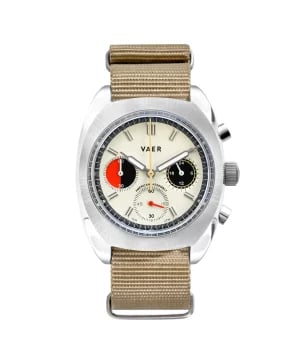
- Movement: Seiko/TMI VK63 meca-quartz
- Case Width: 38 mm
- Lug-to-Lug Distance: 46 mm
- Case Thickness: 12.6 mm
- Water Resistance: 100 m
- Assembly: United States
- Current Starting Price: $539
The R1 is the Vaer I would show someone who finds the field watches a little too restrained. The cream dial, bright accents, and cushion-shaped case give it an enjoyable retro racing character. Our R1 Racing Chronograph review covers this 38mm version, whose broad case still has presence despite its modest diameter.
The main buying qualification is price: it is now listed from $539, so the older review’s “under $400” assessment is historical. I still like the design, but I would buy it because I wanted this particular look and size. There is no date, and the busy dial is naturally sportier than Vaer’s simpler models.
R1 Racing also comes in a larger 42mm version, while the Oceanracer adds a different chronograph design within the R1 family. At a lower starting price of $279, the RS1 Rally offers a 40mm case and VK63 meca-quartz movement with Hong Kong assembly. The RS1 is worth comparing if price matters more to you than the R1’s case design or US assembly.
GMT Watches: G2 Convenience Or G5 Mechanics
G2 Pacific Polar 39mm
- Movement: Swiss Ronda quartz GMT
- Case Width: 39 mm
- Lug-to-Lug Distance: 46 mm
- Case Thickness: 10.8 mm including crystal
- Water Resistance: 150 m
- Assembly: United States
- Current Starting Price: $429
The G2 Pacific Polar is one of the most appealing Vaers to me. A white dial, dark markers, and an orange GMT hand make the display easy to separate visually, while the relatively slim case helps it work as an everyday watch. Quartz is particularly sensible if this will share wrist time with other watches.
Our G2 Pacific Polar 39mm review explores the dial, bezel, case, and strap choices in more detail. The current starting price is $429. If you prefer a different color treatment, the G2 range also includes Pacific Steel, Meridian, and Apocalypse designs; availability varies by version and size.
The G5 Pacific Polar 39mm starts at $989 and uses the Miyota 9075 automatic GMT. Its independently adjustable local hour hand is useful for frequent travel, and the 200m rating adds another specification difference. It is also thicker, at 13.06mm including the crystal. I would choose it for the movement and its operation, while keeping the G2 on the shortlist if convenience, thickness, and price matter more.
Design And Dress Watches: A Quieter Side Of Vaer
The Design collection takes the field-watch idea toward a cleaner dial. C3 Design Navy Solar at 36mm starts at $319, while the 40mm C5 version starts at $349. These make sense if you want solar convenience but prefer a less overtly military appearance.
The C1 Ceremony Cream 36mm is the dressier starting point. At $349, it uses a Japanese 1L45 quartz movement and is assembled in Japan. Its listed total thickness is 9.9mm including the crystal, with sapphire and 100m water resistance. Silver and gold-tone versions offer different looks; the Salmon and 34mm listings were sold out when checked.
I like the idea of a dressier watch that does not demand special treatment every time the day changes plans. The C1 still needs to appeal to you visually, though. We have not reviewed it in depth, and its more restrained design is a different reason to buy than the R1’s colorful dial or a diver’s rotating bezel.
Vaer Vs Other Watch Brands
Vaer Vs Hamilton
Hamilton is a natural comparison if you like traditional field watches. Our Hamilton brand review and Khaki Field guide give that side of the decision more context.
I would compare the actual wearing experience you want: dial layout, case size, winding routine, and water resistance. Vaer’s solar field models are particularly worth a look if you want the field-watch appearance with less attention to winding. If a hand-wound mechanical watch is part of the attraction, explore the corresponding Hamilton options before deciding.
Vaer Vs VERO
Vaer is the place I would begin for a relatively restrained everyday watch. VERO’s collaborations and more playful designs make a different impression, as we discuss in our VERO brand review.
There is room to like both. The choice may come down to whether you want the watch to blend into your daily wardrobe or bring a more obvious story and color palette to it. Neither brand’s country of origin tells you everything about its movements, assembly, or warranty terms.
Vaer Pros And Cons
What I Like
- Practical movement choices: Quartz and solar are treated as meaningful options, alongside automatics.
- Smaller sizes: Several field watches and the reviewed R1 offer a useful starting point for smaller wrists.
- Everyday specifications: Sapphire crystals, screw-down crowns, and useful water resistance appear even in the less expensive ranges.
- Variety without a complete change of character: Field watches, divers, GMTs, and chronographs still feel connected by their intended everyday use.
What To Consider
- Similar names can conceal real differences: Check movement, assembly, size, and generation on the exact listing.
- Prices need current comparisons: Some models cost considerably more than when we first reviewed them.
- Many designs are deliberately familiar: Buyers seeking something visually unconventional may prefer another brand.
- Availability is uneven: A listed model or color is not necessarily in stock, and sold-out does not guarantee a restock.
Who Should Buy A Vaer Watch?
Vaer suits someone who wants an analog watch that can become an ordinary part of the day. Perhaps it is a first decent watch, a smaller alternative to a bulky sports watch, or a quartz companion to a collection of automatics.
It also suits buyers who want a choice about US assembly, as long as they check which series offers it. I would be more cautious if the purchase is mainly about prestige, an unusual movement, or a design that nobody could mistake for anything else. Those are different priorities from the ones that make most Vaers appealing.
Are Vaer Watches Worth The Money?
The value case is easiest to see when you work upward from what you need. An S3 offers the basics at $179. A C3 Korean Solar adds a different movement and US assembly at $319. An R1 or G5 asks you to care enough about the design or functionality to spend more.
I would not assume that moving up the price ladder automatically buys a better watch for your life. If you want something for weekends that is always ready when you reach for it, the quartz or solar option may be the more satisfying purchase. If setting and winding are part of the enjoyment, the automatic premium has a clearer purpose.
Final Verdict
My starting shortlist would be C3 Korean Field Solar, D4 Meridian Solar, and G2 Pacific Polar. They answer three common needs—compact field watch, everyday diver, and GMT—with practical movements and fairly restrained designs.
The S3 Tradition remains the lower-budget option, while the R1 Racing is the one I would pick for a more expressive dial. The A5 and G5 deserve attention if you specifically want an automatic. Choose by size, movement, and the design you will enjoy wearing; that is where Vaer’s range makes the most sense.
Vaer Watches FAQ
Are all Vaer watches assembled in the USA?
No. Many models are US-assembled, but the S-series is assembled in China, DS2 and RS1 models in Hong Kong, and the C1 Ceremony in Japan. The A12 Dirty Dozen is listed as Swiss Made. Check the exact product page; assembly location does not mean all components come from that country.
Does Vaer make solar watches?
Yes. Current examples include C3 and C5 solar field and Design models, the C4 Tactical Field Solar, and D4 solar divers. Check the full model name because Vaer also sells battery-powered quartz watches and automatics.
Which Vaer watches should I consider for a smaller wrist?
Start with the 36mm S3 or C3 field watches, the 36mm C1 Ceremony, or the 38mm R1 Racing Chronograph. Case shape, thickness, lug-to-lug length, and strap choice still matter; a small diameter does not guarantee the right fit.
What is the difference between the Vaer G2 and G5?
The G2 uses a Swiss Ronda quartz GMT movement. The G5 uses a Miyota 9075 automatic GMT with an independently adjustable local hour hand. In the current 39mm Pacific Polar versions, the G2 is thinner and less expensive, while the G5 has a higher water-resistance rating.
What warranty comes with a Vaer watch?
Vaer offers a non-transferable two-year warranty for the original owner buying from Vaer or an authorized dealer. It covers defects and addresses water-related failure when the crown was properly sealed. Normal wear, impact damage, loss, and theft are excluded.