UNIMATIC Watches Review: Classic, Toolwatch, And My Picks
UNIMATIC makes the kind of watch I recognize before I read the name on the dial. Broad bezels, generous crowns, and a lot of open dial space give these Italian watches a strong identity. The appeal is easy to understand in photographs. The question I care about more is which version I would actually choose to wear.
My personal starting point is the Modello Quattro UC4, the watch behind my U4 Classic hands-on review. I loved its broad brushed bezel, but its substantial case and NATO strap also taught me to take wrist fit seriously. For a lower-priced, convenient everyday option, I would look at the UT4. For a mechanical watch with a smaller diameter, the UC2 is my first comparison.
This guide concentrates on the complete Classic and Toolwatch ranges, with a shorter look at limited editions and collaborations. My U4 comments draw on that hands-on review; my other recommendations are based on the current designs and published specifications.
Jump to my verdict, Classic, Toolwatch, limited editions, collaborations, or my recommendations.
UNIMATIC At A Glance
| What I Would Want To Know | The Short Answer |
|---|---|
| Brand background | Founded in 2015 by industrial designers Giovanni Moro and Simone Nunziato |
| Production | Designed and assembled in Italy, using Japanese and Swiss movements depending on the reference |
| Classic | Four permanent designs: UC1, UC2, UC3, and UC4 |
| Toolwatch | UT1, UT4, and their GMT versions; nylon and Bracelet Premium Set options |
| Core-range prices | Classic €550–€640; Toolwatch €430–€640 on nylon, €600–€800 as bracelet sets |
| Shared core features | Steel cases, sapphire crystals, and a stated 300m water-resistance rating |
| My hands-on reference | U4 Classic / UC4 |
| Main buying consideration | Case shape, overall size, and strap choice matter as much as the headline diameter |
Prices are the official EUR amounts checked on November 10, 2026, for the configurations described here. I would confirm the destination-specific total and availability before ordering.
My Verdict: Is UNIMATIC Worth Considering?
Yes, if the design speaks to you. I find UNIMATIC most convincing when I judge it as a distinctive watch with useful specifications, rather than a way to buy the most elaborate movement for the money. The Classic line pairs a very recognizable appearance with straightforward movements. Toolwatch adds a different dial treatment, quartz convenience, and a dedicated shock-protection system.
My reservation is fit. A stripped-back dial does not make the case small, and my UC4 felt substantial on the wrist. I also would not pay more simply because a watch is numbered or limited. A particular dial, material, or complication needs to justify the difference for me.
If I were choosing today, I would keep UC4, UC2, and UT4 on my initial shortlist. The first is my personal favorite from direct experience, the second is the smaller Classic, and the third is the lowest-priced entry into the core range.
A Short History, And What “Made In Italy” Means Here
Giovanni Moro and Simone Nunziato founded UNIMATIC in 2015, bringing an industrial-design background to a watch brand built around simple, recognizable forms. Modello Uno came first, followed by Due, Tre, and Quattro. The permanent Classic line arrived in 2021; the smaller, 36mm Modello Cinque followed in 2023.
UNIMATIC says its watches are designed and assembled in Italy, and its company history describes bringing assembly and testing in-house near Milan in 2021. That does not mean every component or movement is Italian. The core range uses Japanese NH35A, VK64, and VH31A movements, plus Swiss Ronda movements in the quartz GMTs. Selected editions use Swiss Sellita automatics.
I would choose between those movements on their operation, specifications, and price. A Swiss origin is not, by itself, a reason to dismiss a Japanese caliber or a quartz watch.
Understanding The Names
Modello Uno through Cinque describe the watch families. Classic and Toolwatch describe product lines. Limited editions and collaborations can use those same families, which is why similar-looking watches can have different movements, materials, prices, and availability.
Classic and Toolwatch watches are individually numbered in yearly batches. That is different from an edition capped at a stated number of pieces. I would not treat a numbered UC4 as a scarce collaboration.
Each card below identifies its featured reference. Galleries show another view, the matching bracelet set, or related colors; clicking the large image opens that specific watch or my linked U4 review. The specifications stay with the named reference. Most images are supplied by UNIMATIC, including the lume views; the two U4 detail photographs come from my hands-on review.
Classic: The UNIMATIC Designs I Would Start With
The Classic range is the clearest introduction to UNIMATIC’s visual identity: black dials, pale-green luminous markers, and relatively little decoration. UC1, UC2, and UC4 are automatic; UC3 is a battery-powered meca-quartz chronograph. All four currently carry a 300m rating, but their bezels and intended roles differ.
Modello Uno UC1: The Familiar Diver Shape
UC1 is my starting point if I want the original UNIMATIC diver look. The wide bezel and simple dial make it immediately recognizable, while the NH35A keeps the mechanical specification straightforward.
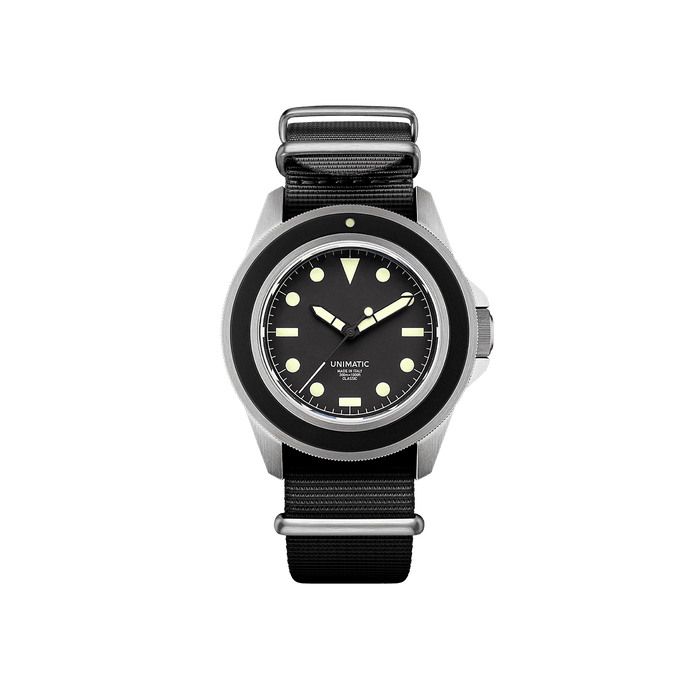
- Reference: UC1 / UWK-UC1
- Movement: Automatic NH35A; 41-hour power reserve
- Diameter: 40mm case; 41.5mm across the bezel
- Crystal / Water Resistance: Sapphire / 300m
- Material: Brushed stainless steel
- Bezel / Strap: Rotating aluminum-insert bezel / black NATO
- Price: €640
I would pay attention to the 41.5mm diameter across the bezel, rather than stop at the 40mm case figure. The insert is also deliberately sparse: its luminous dot does not provide the detailed minute scale I might want for timing. That restraint is a large part of the appeal, but it is a practical tradeoff too.
Modello Due UC2: My Smaller Classic Pick
UC2 would be my first comparison if UC1 or UC4 looked too broad. Its current official specification is 38mm, with a fixed bezel and a rounded case outline. The two-piece nylon strap also avoids the additional layer beneath the case that bothered me with my UC4’s NATO.
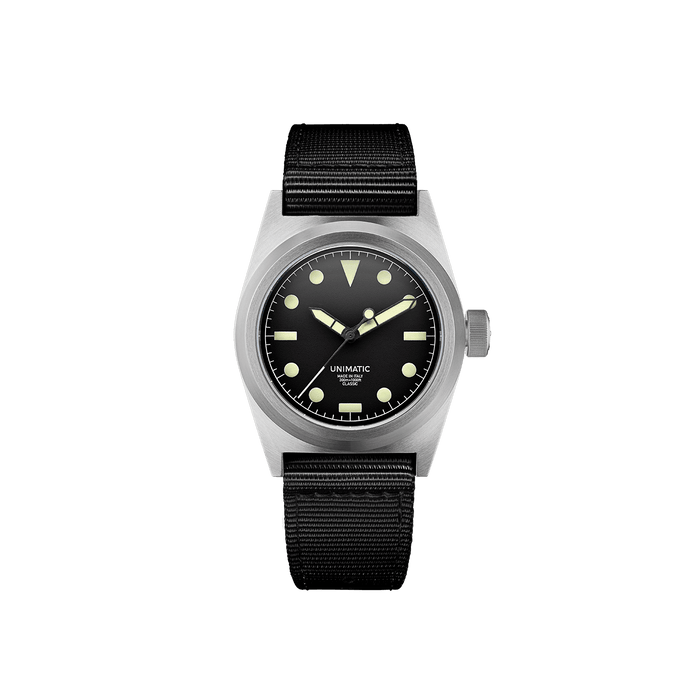
- Reference: UC2 / UWK-UC2
- Movement: Automatic NH35A; 41-hour power reserve
- Diameter: 38mm
- Crystal / Water Resistance: Sapphire / 300m
- Material: Brushed stainless steel
- Bezel / Strap: Fixed bezel / black two-piece nylon
- Price: €550
I like the calmer proportions and uncluttered dial. I would still check its shape on the wrist rather than assume that a smaller diameter guarantees a perfect fit. It shares the UC4’s €550 price, so this is primarily a choice between two very different case designs.
Modello Tre UC3: A Chronograph Without The Automatic-Chronograph Price
UC3 adds two subdials and screw-down pushers to the familiar Uno-style outline. It is the Classic I would consider if I wanted a stopwatch function and liked the fuller dial.
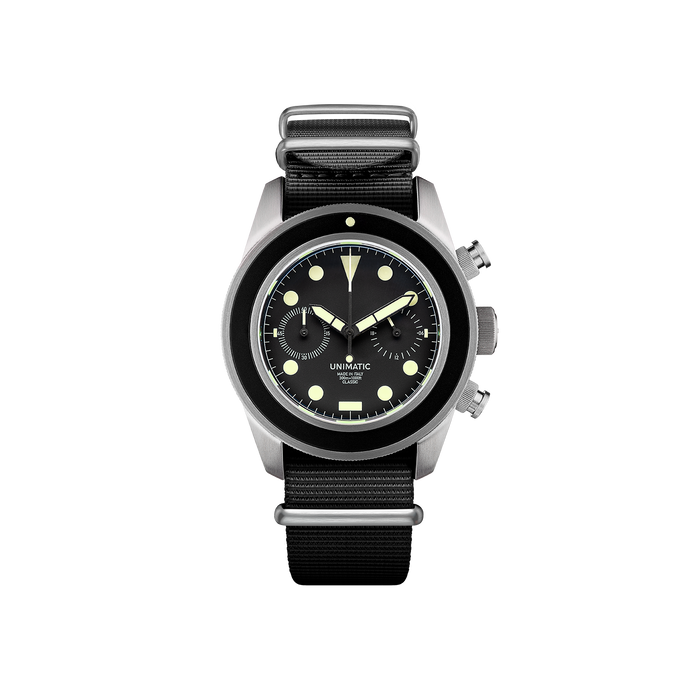
- Reference: UC3 / UWK-UC3
- Movement: VK64 meca-quartz chronograph
- Battery Life: Approximately 3 years
- Diameter: 40mm case; 41.5mm across the bezel
- Crystal / Water Resistance: Sapphire / 300m
- Material: Brushed stainless steel
- Strap: Black NATO
- Price: €640
The VK64 is meca-quartz, not an automatic movement. UNIMATIC gives an approximate three-year battery life; the old mechanical-style power-reserve figure does not apply. At €640, I find it a more approachable route to this chronograph design than the brand’s specialist mechanical collaborations. The 41.5mm bezel and projecting pushers still deserve a careful fit check.
Modello Quattro UC4: My Hands-On Favorite
UC4 is the one I know from wearing it. Its plain, broad steel bezel looked almost too simple in photographs, but I loved its brushed surface and solid feel in person. It gives the watch a rugged character without filling the dial with details.
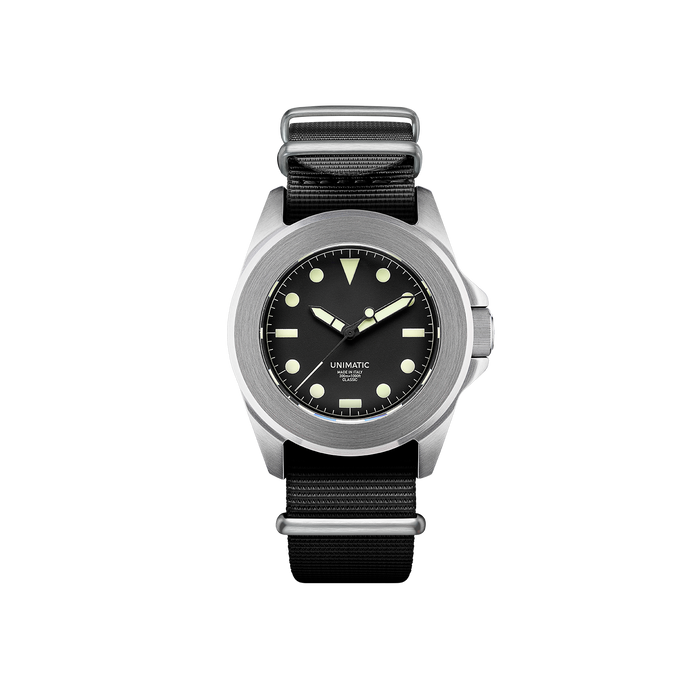
- Reference: UC4 / UWK-UC4
- Movement: Automatic NH35A; 41-hour power reserve
- Diameter: 40mm
- Crystal / Water Resistance: Sapphire / 300m
- Material: Brushed stainless steel
- Bezel / Strap: Fixed steel bezel / black NATO
- Price: €550
In my U4 Classic review, I recorded 49mm lug-to-lug and 13.7mm thickness. It looked substantial on my 6.5-inch wrist, and the NATO added another layer beneath the case. I bought a black tropic-style strap and recommended considering that option if the original setup felt bulky.
That is why UC4 is my personal pick with a qualification: I would choose it for the bezel and overall presence, then take the strap seriously. Its fixed bezel also makes it a different proposition from a rotating-bezel diver, despite the shared 300m rating.
Toolwatch: Quartz Convenience And A More Detailed Dial
The Toolwatch line uses Arabic numerals, orange details, sandblasted steel, and UNIMATIC’s 360° protection system. The brand describes a TPU construction that protects the movement and hands, and reports MIL-STD-810H testing. I have not independently tested those shock-resistance claims.
There are four core models. UT1 and UT4 use VH31A quartz movements; their GMT counterparts use Ronda 515.24D quartz movements. I would consider them on their own merits: I like being able to pick up a quartz watch without resetting it after a few days off the wrist.
Each is offered on nylon and as a Bracelet Premium Set, which includes both the sandblasted quick-release bracelet and a black two-piece nylon strap. The galleries show both configurations, and the price difference is listed in each card.
Modello Uno UT1: My Pick For A Rotating Bezel
UT1 combines a rotating countdown bezel with the more detailed Toolwatch dial. I would choose it over UT4 when I wanted that timing function and liked the larger bezel surrounding the watch.
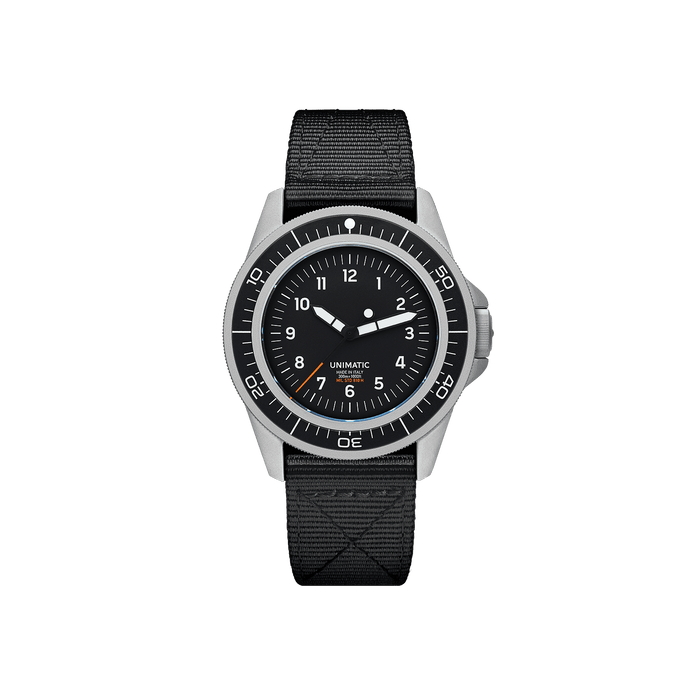
- Featured Reference: UT1 / UWK-UT1 on nylon
- Movement: VH31A quartz; approximately 2-year battery life
- Diameter: 40mm case; 41.5mm across the bezel
- Crystal / Water Resistance: Sapphire / 300m
- Case: Sandblasted steel; rotating countdown bezel
- Protection: UNIMATIC 360° system
- Prices: Nylon €520; Bracelet Premium Set €680
The VH31A’s moving seconds hand gives it a different visual character from a typical once-per-second quartz display. I would still buy it for the design and convenience, not expect the ownership routine of an automatic. Its 41.5mm outside diameter is the key fit figure.
Modello Quattro UT4: My Practical Entry Point
At €430 on nylon, UT4 is the least expensive model in the two core lines. The fixed steel bezel keeps the layout simple, while the numerals and orange accents make it feel more functional than the quieter UC4.
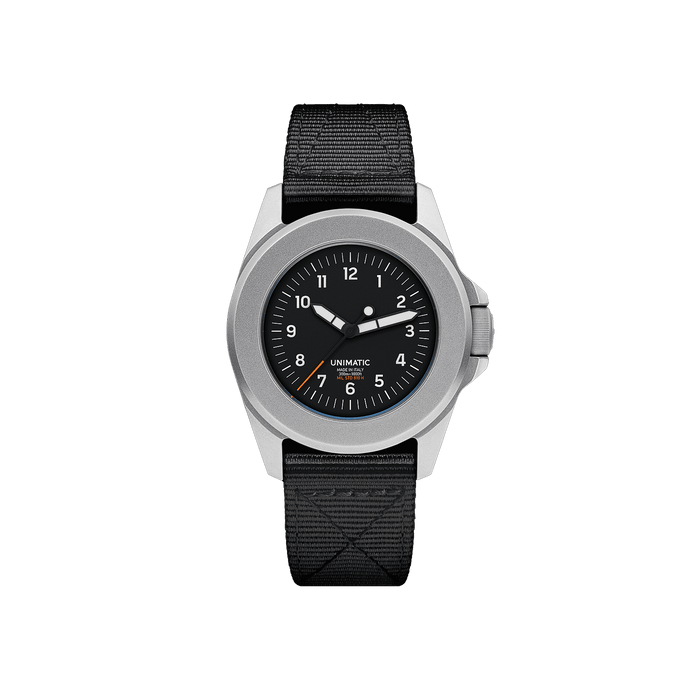
- Featured Reference: UT4 / UWK-UT4 on nylon
- Movement: VH31A quartz; approximately 2-year battery life
- Diameter: 40mm
- Crystal / Water Resistance: Sapphire / 300m
- Case: Sandblasted steel; fixed bezel
- Protection: UNIMATIC 360° system
- Prices: Nylon €430; Bracelet Premium Set €600
This would be my first recommendation for someone who likes the Quattro shape but prefers quartz. The two-piece strap is worth considering alongside the price: it avoids the under-case layer of a NATO. I would choose the bracelet set for its appearance and versatility, rather than assume it automatically improves comfort.
Modello Uno UT1-GMT: An Extra Time Zone With A Rotating Bezel
UT1-GMT adds a second-time-zone display and a date, retaining the Uno case and rotating bezel. It is the version I would compare if a travel function mattered more to me than the simplest possible dial.
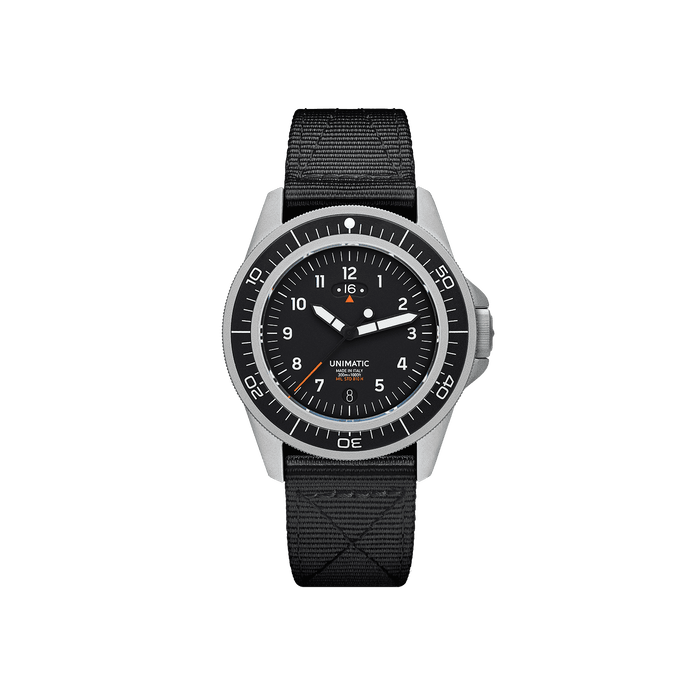
- Featured Reference: UT1-GMT / UWK-UT1-GMT on nylon
- Movement: Ronda 515.24D quartz GMT with date
- Battery Life: Approximately 45 months
- Diameter: 40mm case; 41.5mm across the bezel
- Crystal / Water Resistance: Sapphire / 300m
- Case: Sandblasted steel; rotating bezel; 360° protection
- Prices: Nylon €640; Bracelet Premium Set €800
The GMT indication appears in a window at 12 o’clock, with the date at 6. That is an unusual layout and something I would study before buying: I need to enjoy reading it, not just like the idea of owning a GMT. The Ronda movement’s stated battery life is about 45 months.
Modello Quattro UT4-GMT: My Quartz Travel Pick
UT4-GMT puts the same Ronda movement and window arrangement into the 40mm Quattro case. I would lean toward this version if I wanted the extra time zone without the broader rotating bezel of UT1-GMT.
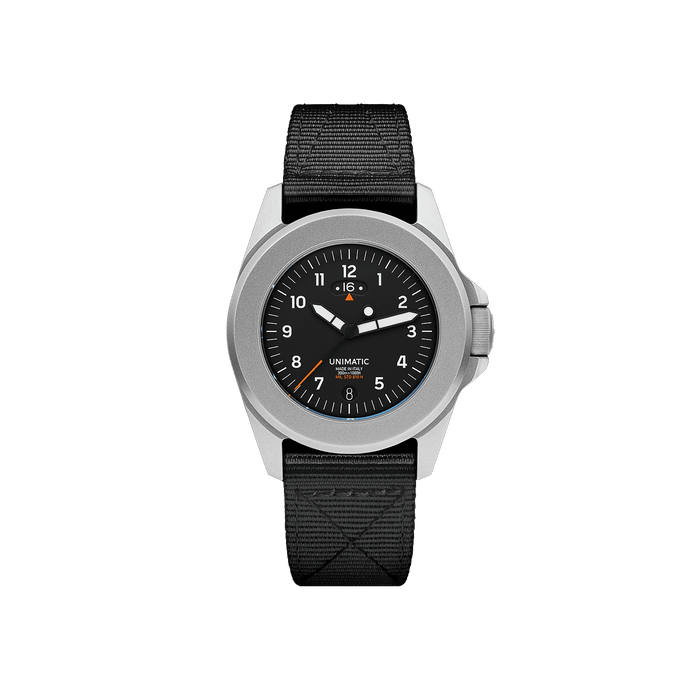
- Featured Reference: UT4-GMT / UWK-UT4-GMT on nylon
- Movement: Ronda 515.24D quartz GMT with date
- Battery Life: Approximately 45 months
- Diameter: 40mm
- Crystal / Water Resistance: Sapphire / 300m
- Case: Sandblasted steel; fixed bezel; 360° protection
- Prices: Nylon €550; Bracelet Premium Set €710
At €550 on nylon, it costs the same as UC4. That makes a useful comparison: I can choose the Classic’s automatic movement and spare dial, or the Toolwatch’s quartz operation, GMT, and date. My preference would depend on how I planned to use it.
Limited Editions: A Shorter Look Beyond The Core Range
I would explore limited editions after deciding which UNIMATIC case shape I enjoy. This is where the brand changes colors, materials, movements, and complications. A fixed production number would be secondary to those differences for me.
My representative pick is Modello Cinque U5S-NPT from the Langhe collection. Its 36mm diameter offers something the Classic and core Toolwatch lines do not. The gallery shows Truffle, Moss, and Fog, each paired with a tonal deer-leather strap.

- Featured Reference: U5S-NPT, Truffle
- Movement: Automatic Sellita SW200-1b
- Power Reserve: Minimum 38 hours; typical 41 hours
- Diameter / Material: 36mm / stainless steel
- Crystal / Water Resistance: Sapphire / 300m
- Strap: Tonal deer leather; quick release
- Edition / Price: 200 per featured reference / €1,160 each
Langhe also includes Uno, Due, and Quattro designs. Elsewhere, ICON explores titanium Uno and Cinque cases, while ProDiver includes higher-depth-rated options such as the 600m U1S-PD6-RB. I would compare the exact reference: a 600m Uno specification does not transfer automatically to a Cinque or every limited edition.
For a first UNIMATIC, I would still start with the core range unless the smaller Cinque case or a particular edition solved a clear preference.
Collaborations: Buy The Design You Like
The collaboration program brings in partners such as Todd Snyder, Norwegian Rain, Automobili Amos, and Tullio Abbate. These watches can differ substantially from the core models, and some are sold through the partner rather than UNIMATIC’s store.
The U1-TAB × Tullio Abbate is a good example of how far a color treatment can change the familiar Uno shape. Its white dial, blue bezel, and blue TPU strap make a much brighter impression than UC1.
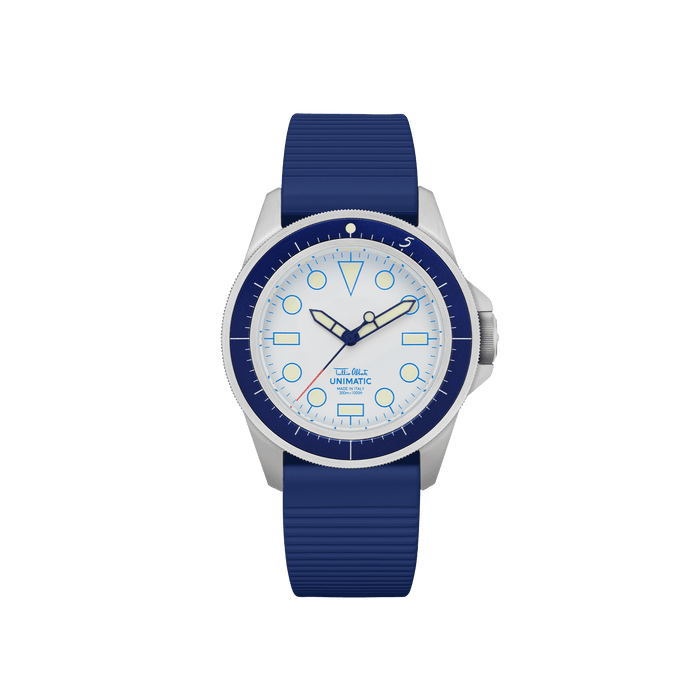
- Featured Reference: U1-TAB × Tullio Abbate
- Movement: Automatic NH35A; 41-hour power reserve
- Diameter: 40mm case; 41.5mm across the bezel
- Crystal / Water Resistance: Sapphire / 300m
- Straps: Blue TPU plus an additional gray NATO
- Edition / Price: 200 pieces / €810
- Availability: Preorder; shipping advertised for November 27
At the time of this update, U1-TAB is a preorder with shipping advertised for November 27. I would use that product-specific notice rather than the generic dispatch estimate elsewhere on the page. For other collaborations, I would check the partner’s availability and terms; an official product page can remain online after an edition sells out.
Which UNIMATIC Would I Choose?
| If I Wanted… | My Starting Pick | What I Would Weigh Up |
|---|---|---|
| The design I enjoyed hands-on | UC4 | Its substantial case and the extra bulk of a NATO |
| A smaller automatic Classic | UC2 | The rounded case shape and 38mm diameter |
| The original diver look | UC1 | The 41.5mm bezel and very sparse insert |
| A chronograph | UC3 | Meca-quartz operation and the size of the case with pushers |
| The lowest-priced core model | UT4 | Quartz convenience versus my interest in an automatic |
| A quartz watch with a timing bezel | UT1 | A broader outline than UT4 |
| A quartz GMT | UT4-GMT | Whether I like the window-based GMT display |
| A distinctly smaller case | Modello Cinque Langhe | A higher price and a limited-edition purchase |
My personal choice remains UC4, because I already know what I like about it. My practical first recommendation would often be UT4, while UC2 is the one I would put beside both before deciding on size.
Buying, Warranty, And A Few Final Checks
I would compare the exact reference and supplied strap before comparing prices. The Toolwatch bracelet sets include an additional nylon strap; they are separate configurations, not the standard strap model at an unexplained higher price. I would also distinguish an available watch, a preorder, and a partner-only listing.
UNIMATIC publishes a 24-month warranty covering qualifying material and manufacturing defects, with conditions including a valid completed warranty card. Its sales terms describe a 14-day return window, require the original packaging and included items, and currently list a €30 return charge. Personalized items are excluded from returns, and paid duties and taxes for non-EU orders are described as non-refundable. I would read those terms before ordering, especially if I were uncertain about fit.
For another approach to an enthusiast watch with a clear design identity, I would compare my Baltic brand guide or echo/neutra review. For the closest look at what a UNIMATIC is like on my wrist, my U4 Classic hands-on review is the useful next stop.
UNIMATIC Watches FAQ
Where are UNIMATIC watches made?
UNIMATIC says its watches are designed and assembled in Italy. Its movements come from Japanese and Swiss suppliers, depending on the reference; Italian assembly does not mean every component is made in Italy.
What is the difference between Classic and Toolwatch?
Classic uses simpler geometric dials and brushed cases, with NH35A automatics in UC1, UC2, and UC4 and a VK64 meca-quartz chronograph in UC3. The core Toolwatch models use quartz movements, Arabic numerals, sandblasted cases, and the dedicated 360° protection system.
Are all UNIMATIC watches limited editions?
No. Classic and Toolwatch are permanent lines with individually numbered yearly batches. Separate limited editions and collaborations can have fixed production totals, which should be checked by reference.
Which UNIMATIC would I recommend first?
My personal choice is UC4, based on my hands-on review. I would compare UC2 for a smaller Classic case and UT4 for a lower-priced quartz option. Strap choice and wrist fit would be central to my decision.
Are all UNIMATIC watches automatic?
No. UC3 uses a battery-powered VK64 meca-quartz movement. UT1 and UT4 use VH31A quartz movements, while UT1-GMT and UT4-GMT use Ronda 515.24D quartz movements. UC1, UC2, and UC4 are automatic.
Which UNIMATIC is the smallest option in this guide?
The featured Modello Cinque Langhe models are 36mm. Within Classic, UC2 is 38mm; the core Toolwatch models are 40mm at the case, with Uno versions measuring 41.5mm across the bezel. Diameter alone does not establish wrist fit.
What warranty and returns does UNIMATIC offer?
UNIMATIC lists a 24-month warranty, subject to its conditions, and a 14-day return window. Its current terms include a €30 return charge, original-packaging requirements, and exclusions for personalized items. I would check the current terms and the selling retailer before ordering.