Mühle-Glashütte Watches Review: Collections, Quality, and My Picks
Mühle-Glashütte makes more sense to me when I start with the watches themselves. The S.A.R. Rescue-Timer looks ready for a working boat, the Panova brings a little color to an ordinary day, and the Teutonia Sport II puts a small piece of a sports-car dashboard on the wrist. They have very different personalities, but clear dials and practical details run through the range.
My starting points would be the S.A.R. Rescue-Timer for a distinctive tool watch, the 29er Casual for everyday versatility, and Panova for a more affordable introduction. If you enjoy the dressier side of German watches, Teutonia deserves just as much attention.
My hands-on experience comes from the Teutonia Sport II “Racing Green” review. The other recommendations below draw on the designs and current official specifications. I cover all seven main collections, group related versions to keep the guide manageable, and include 13 representative watch cards, including the separate Marinefliegeruhr-I anniversary release.
Jump to Sportivo, Tool Watches, 29er, Teutonia, Lunova, Panova, Terrasport, special editions, or my recommendations.
A Brief Introduction To Mühle-Glashütte
The family’s connection to Glashütte began with Robert Mühle’s precision measuring instruments in 1869. Speedometers and other instruments followed. The modern company was re-established by Hans-Jürgen Mühle in 1994, initially making nautical timekeeping equipment, with wristwatches arriving in 1996. Those dates matter: the long family history is real, but it is not a claim that Mühle has been making wristwatches since 1869. The official history follows that development.
The company remains family owned. Thilo Mühle’s children, Fanny and Dustin, joined the management team in 2024, bringing the sixth generation into its leadership. I find the practical instrument background more helpful for understanding the watches than simply putting them beside more expensive Glashütte neighbors.
What Am I Paying For?
Much of the current range uses Swiss Sellita movements in Mühle’s own versions. The work includes finishing, regulation, and components such as the Mühle rotor and woodpecker neck regulator. Introduced in 2003, that regulator uses a shaped spring to help hold the regulating arm in position under shocks. Mühle explains the construction on its technology page.
There is also more involved work: three-quarter plates in relevant chronograph calibers, modules for particular complications, and the hand-wound Robert Mühle manufacture line. I would not call every movement entirely in-house, and an MU designation alone is not enough to make that assumption. The movement overview distinguishes supplied movements from the brand’s own designs.
For me, the appeal is the combination of useful case construction, legible layouts, and those movement details. The tradeoffs are equally clear. Many models are fairly large, and a 41-hour reserve is common, so a watch left off for a weekend may need resetting. I would choose the case and dial I actually enjoy wearing before paying extra for a complication.
The Range At A Glance
| Collection | Current branches covered | Why I would consider it |
|---|---|---|
| Sportivo | Compass Date, Travel GMT, Big Date, Active Chronograph, Power Chronograph, Power Dive | Modern sports designs and useful complications |
| Tool Watches | S.A.R. Rescue-Timer, LUMEN, Nautical Blue, Mission-Timer TITAN, Flieger-Chronograph, Sea-Timer BlackMotion, Seebataillon GMT | The clearest expression of Mühle’s instrument character |
| 29er | 29er, Big, Casual, Big GMT, Big Small Second, Day/Date, Pointer Date, Chronograph | Everyday watches, including a compact 36.6mm option |
| Teutonia | Teutonia II, IV, and Sport variants | Dressier dials, calendar displays, and motorsport details |
| Lunova | Date, Day/Date, Chronograph, Lady | Polished cases and restrained gradient dials |
| Panova | Blue, Gray, Green, Turquoise Blue, Lime, Violet | A straightforward automatic with plenty of color |
| Terrasport | II and I Chronograph | Traditional pilot-watch readability |
| Special editions | Marinefliegeruhr-I Edition 2026; Robert Mühle context | An anniversary watch, plus the sold-out manufacture line |
Prices and delivery estimates were checked on October 18, 2026. Cards show the official German shop’s euro prices for the exact configuration, displayed with taxes included. Local pricing, taxes, and delivery conditions can differ. Most listings quote several weeks rather than immediate dispatch; I would confirm the current estimate before ordering. Product links go directly to Mühle-Glashütte.
Sportivo: Modern Sports Watches
The Sportivo family is where I would look for a more contemporary sports watch with a ceramic bezel. Its branches offer meaningfully different functions: Compass Date has a compass-marked bezel, Travel GMT adds a second time zone, Big Date emphasizes a larger calendar display, and Active Chronograph adds stopwatch timing. The newer Power Chronograph and Power Dive add power-reserve displays.
The distinction between their bezels matters. The Power Dive has a unidirectional elapsed-time bezel; a compass, GMT, or chronograph bezel serves a different purpose. I would choose the function first, then the dial and strap.
Sportivo Power Dive: My Pick For Time Around Water
The Power Dive catches my eye with its turquoise-to-black dial and reserve indicator at six. Its 30-bar rating, rubber strap, and timing bezel make it the Sportivo I would consider first for swimming and an active holiday. The 42.5mm diameter and 50.2mm length are substantial, though; I would try it on rather than assume the rubber strap makes it a compact watch.
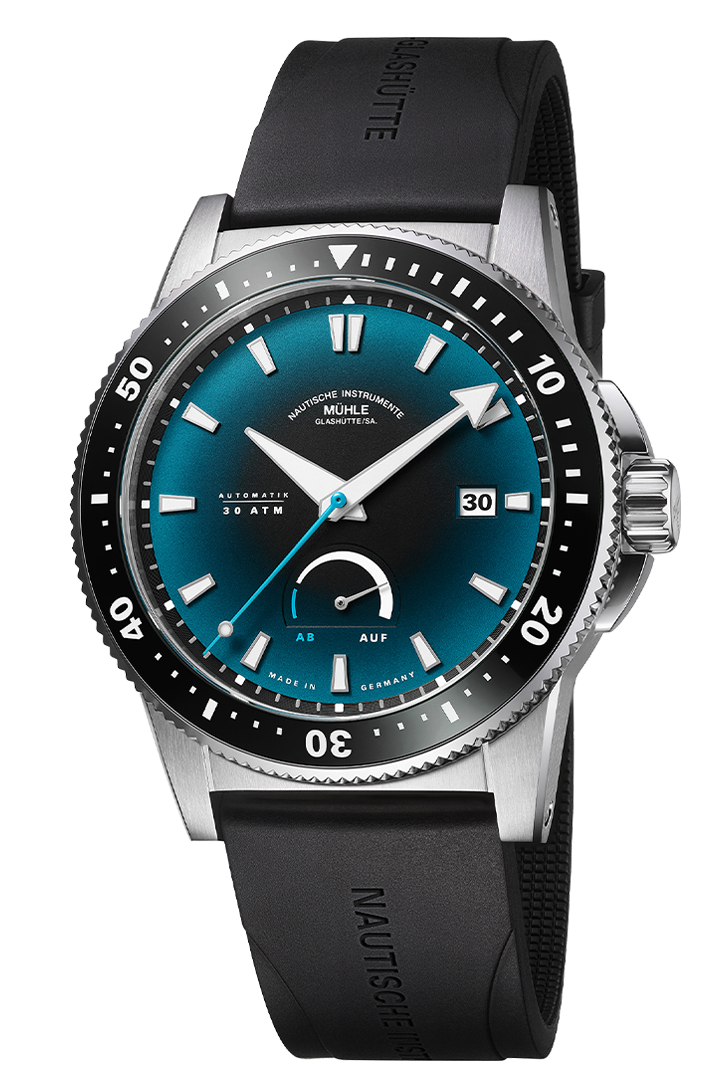
- Reference: M1-52-53-200-KB
- Movement: SW270-1 automatic, Mühle version
- Case: 42.5 mm steel; 12.5 mm thick
- Lug-to-Lug: 50.2 mm
- Water Resistance: 30 bar
- Power Reserve: Up to 41 hours
- Details: Turquoise/black dial; black rubber strap
- Listed Price: €2,850
- Availability: Listed delivery: 6–8 weeks
Sportivo Power Chronograph: More Function, More Bulk
The black-and-red Power Chronograph First Edition puts a reserve display alongside the chronograph. Mühle describes the MU9424-GR as a modular development with its own reserve-display module, and lists up to 62 hours of running time. I like the clear visual distinction from the blue Active Chronograph, but 15.5mm thickness makes this a deliberate choice for someone who enjoys a substantial watch.
It is limited to 200 pieces and the page currently invites an enquiry. I would confirm an allocation before treating it as available stock. The regular Active Chronograph remains the alternative within this group; the Big Date, including the newer Deep Blue version, offers a less crowded dial if stopwatch timing is unnecessary.
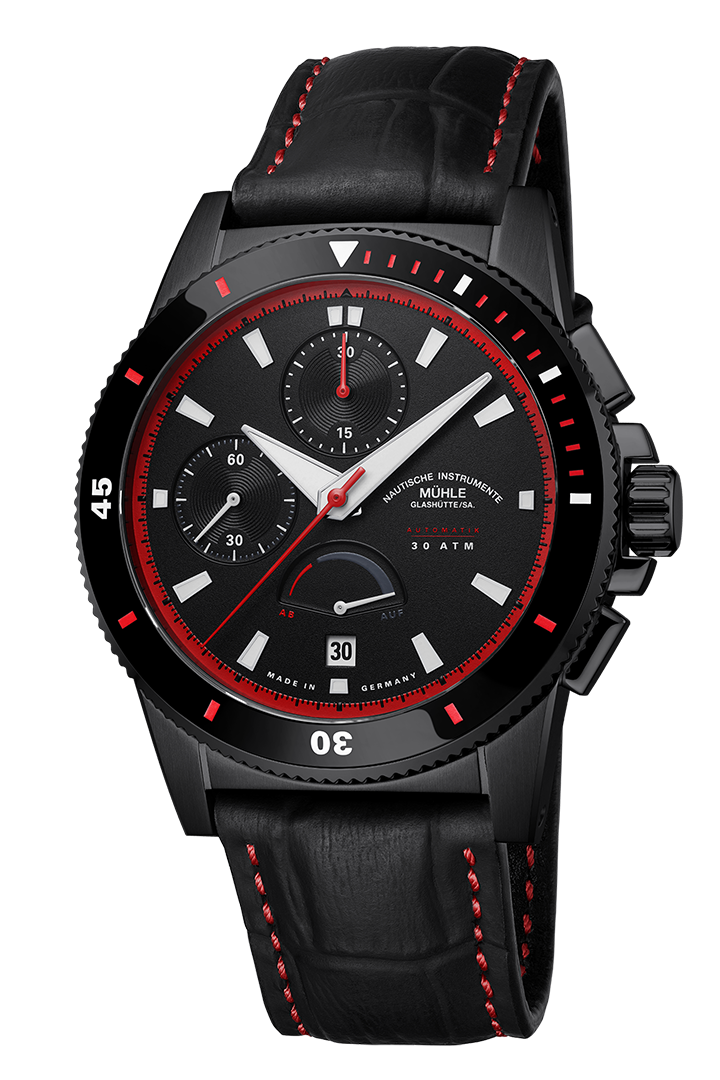
- Reference: M1-52-33-2025-LB
- Movement: MU9424-GR automatic
- Case: 42.5 mm steel with black IP coating; 15.5 mm thick
- Lug-to-Lug: 50.3 mm
- Water Resistance: 30 bar
- Power Reserve: Up to 62 hours
- Details: Black/red dial; treated black leather strap
- Listed Price: €4,300
- Availability: Enquire with Mühle; limited to 200 pieces
Tool Watches: Where I Would Start With Mühle
The Tool Watches collection has the strongest connection to the brand’s nautical work. The Rescue-Timer was developed with German maritime rescue crews and entered service in 2002. That is a more interesting reason to consider it than a long specification list alone.
S.A.R. Rescue-Timer: The Distinctive One
The rounded case, rubber bezel, and recessed date magnifier give the S.A.R. Rescue-Timer a look of its own. The official specification includes a 4mm sapphire crystal and 100-bar water resistance. It is 42mm across but only 47.6mm long, which is why I would compare its actual fit with the larger-looking alternatives rather than judge it by diameter alone.
The black-dial version is my starting point. LUMEN and Nautical Blue remain current alternatives, with different dial treatments and strap choices. This is a rescue watch with a fixed protective bezel, so I would not confuse its pressure rating with having the elapsed-time bezel of the Sportivo diver.
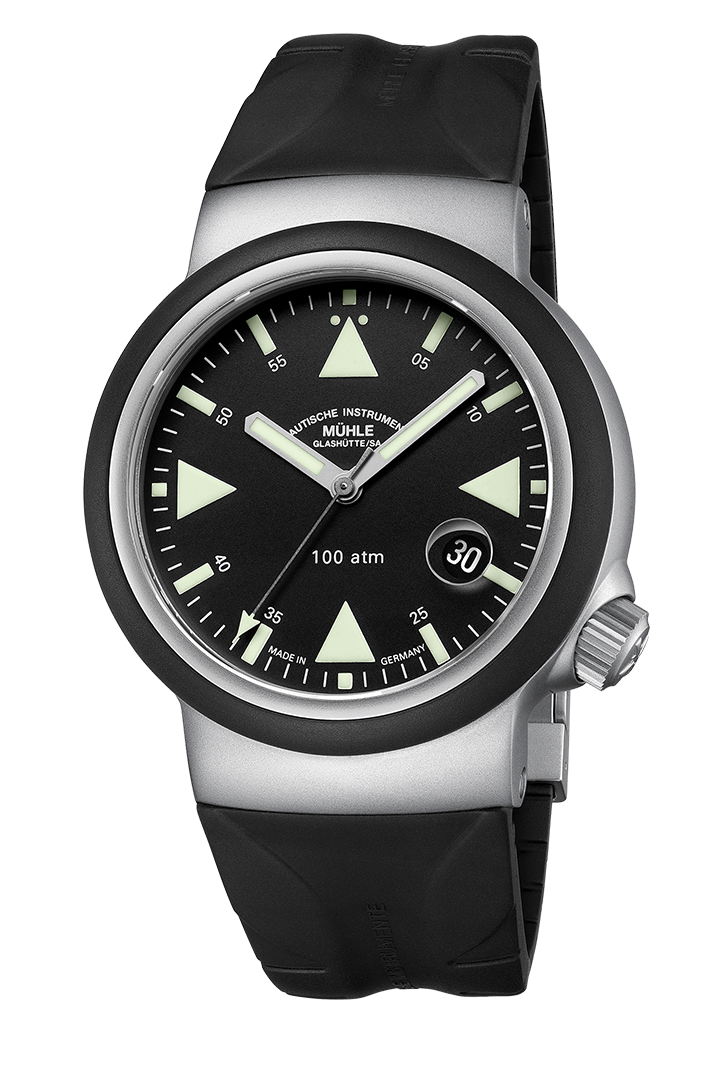
- Reference: M1-41-03-200-KB
- Movement: SW200-1 automatic, Mühle version
- Case: 42 mm steel; 13.5 mm thick
- Lug-to-Lug: 47.6 mm
- Water Resistance: 100 bar
- Power Reserve: Up to 41 hours
- Details: Black dial; rubber bezel; black rubber strap
- Listed Price: €2,200
- Availability: Listed delivery: 5–7 weeks
Mission-Timer TITAN And The Wider Tool Range
The Mission-Timer TITAN takes the idea in a more angular direction, with a titanium case, ceramic bezel, and large date window. It is a useful comparison if the Rescue-Timer’s rounded shape does not appeal. Its 52.1mm length is the number I would pay attention to; titanium does not make a large case physically smaller.
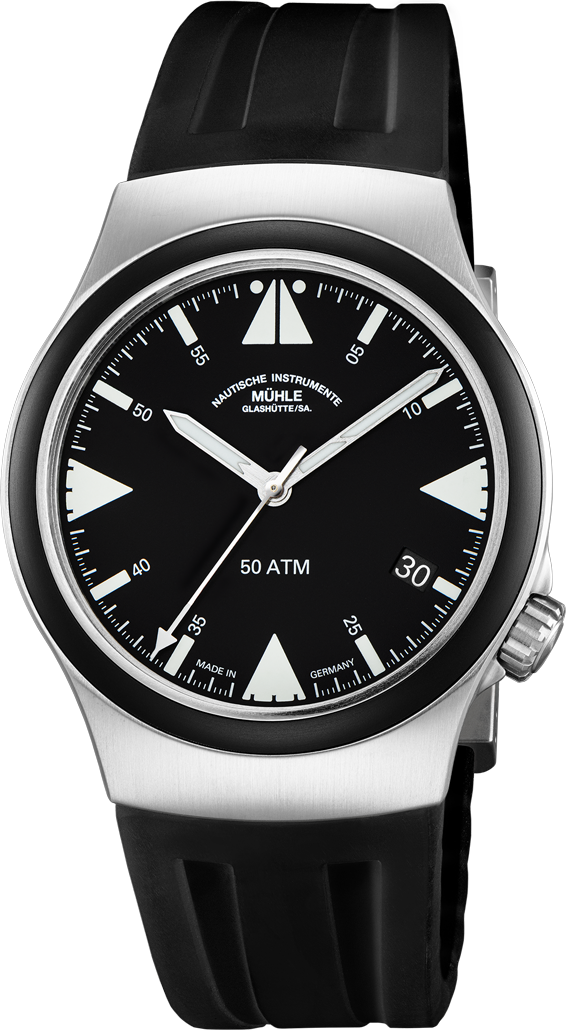
- Reference: M1-51-03-400-KB
- Movement: SW400-1 automatic, Mühle version
- Case: 43 mm titanium; 13 mm thick
- Lug-to-Lug: 52.1 mm
- Water Resistance: 50 bar
- Power Reserve: Up to 41 hours
- Details: Black dial; ceramic bezel; rubber strap with titanium clasp
- Listed Price: €2,990
- Availability: Listed delivery: 1–2 weeks
There are three other distinct routes in this collection. The Sea-Timer BlackMotion uses a black titanium-carbide-coated steel case. The Seebataillon GMT combines titanium with a second time zone in a larger 45mm format. The S.A.R. Flieger-Chronograph is the aviation timing option, with its unusual start pusher at eight o’clock.
The collection also lists five named, one-off Mission-Timer TITAN editions: Hans Ingwersen, Emil Zimmermann, Paul Neisse, Kurt Hoffmann, and Henrich Wuppesahl. I treat those as special versions of the same family and would check the individual piece’s availability directly.
29er: My Everyday Shortlist
Named after the sailing dinghy, the 29er family is the range I would browse for a watch that can move between casual clothes and a workday. It has more variety than the similar-looking names suggest. The standard 29er is 36.6mm, while the Big moves to 42.4mm. That is a significant choice, not a minor dial variation.
29er Casual: A Slimmer Everyday Option
My representative pick is the Casual in Coastal Blue. It keeps the larger 42.4mm diameter but brings the thickness down to 9.5mm, and the selected package includes both leather and suede straps. The SW300-1 has a listed reserve of up to 56 hours. I would put it ahead of the more complicated 29ers if I wanted an uncomplicated everyday watch with a little color. Velvety Brown is the other current Casual dial choice.
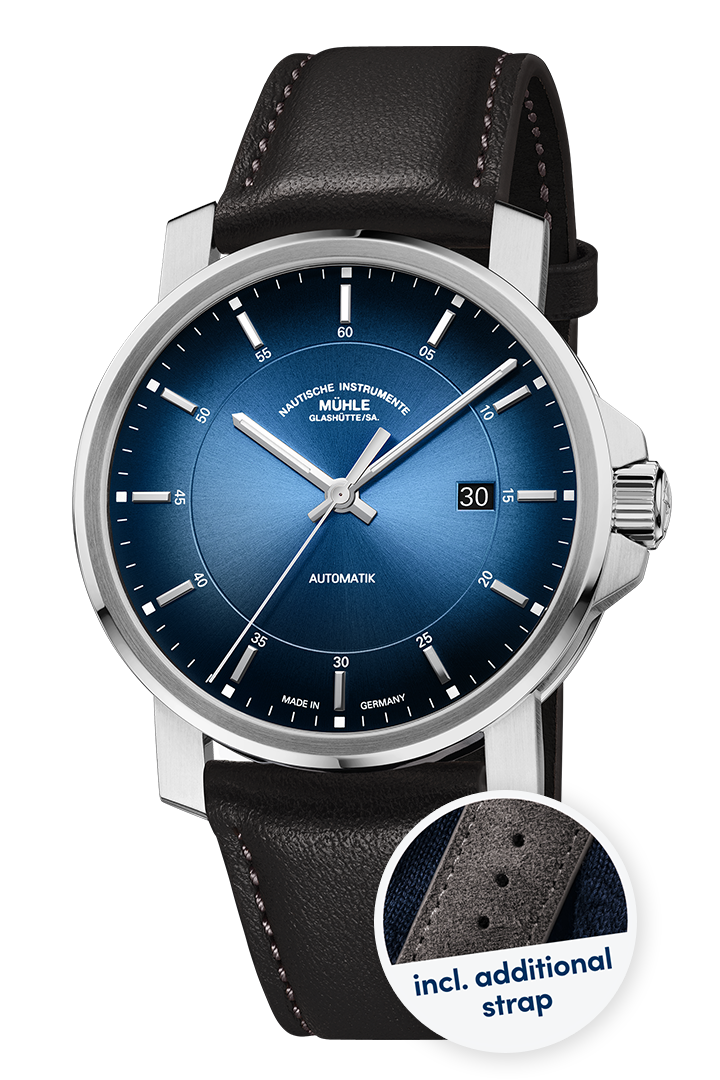
- Reference: M1-25-72-2-200-VLB
- Movement: SW300-1 automatic, Mühle version
- Case: 42.4 mm steel; 9.5 mm thick
- Lug-to-Lug: 49 mm
- Water Resistance: 10 bar
- Power Reserve: Up to 56 hours
- Details: Coastal Blue dial; leather and suede straps included
- Listed Price: €1,950
- Availability: Listed delivery: 4–5 weeks
29er Big GMT And The Calendar Alternatives
The Big GMT adds a second time zone without turning the 29er into a much thicker watch: the current listing gives 10.3mm. I have chosen the bracelet version because its fine adjustment is a useful everyday detail. The SW330-2 is the movement to check here; I would not assume that every GMT operates with an independently jumping local-hour hand.
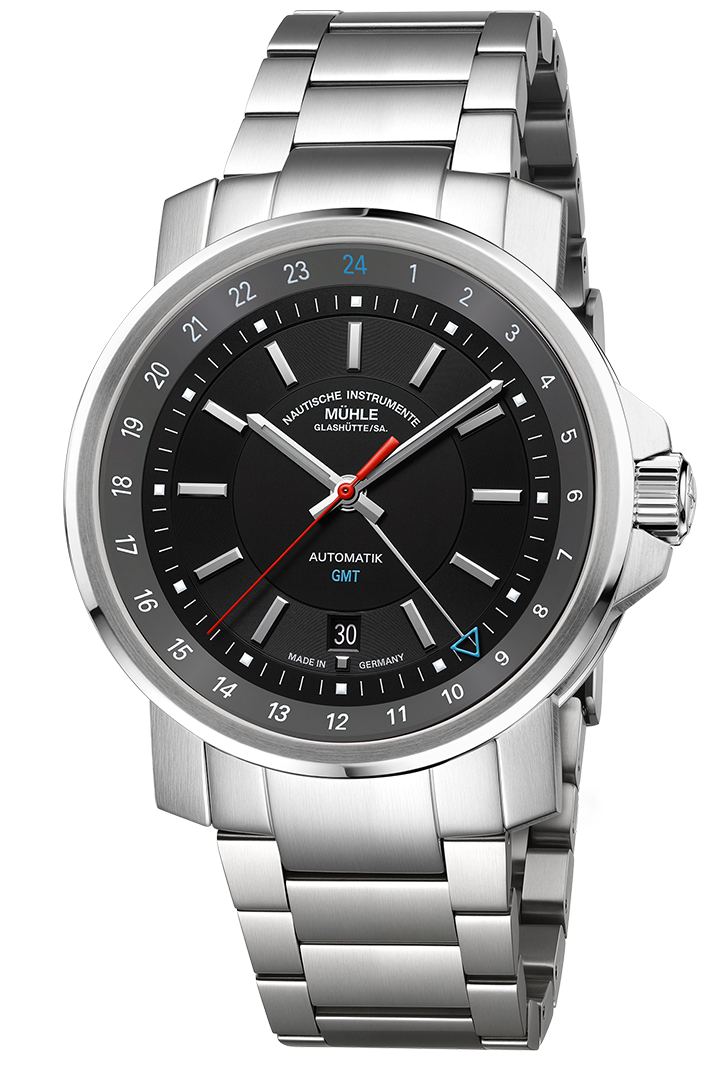
- Reference: M1-25-93-200-MB
- Movement: SW330-2 automatic, Mühle version
- Case: 42.4 mm steel; 10.3 mm thick
- Lug-to-Lug: 49 mm
- Water Resistance: 10 bar
- Power Reserve: Up to 56 hours
- Details: Black dial; steel bracelet with fine adjustment
- Listed Price: €2,650
- Availability: Listed delivery: 5–7 weeks
For the other branches, I would choose by the information I want to see: Big Small Second moves the running seconds into a subdial, Day/Date adds the weekday, Pointer Date uses a hand to indicate the date, and Chronograph adds stopwatch timing. The regular 29er and 29er Big remain the simpler date options, with several dial and strap combinations. For a smaller wrist, the standard 29er’s 42.6mm lug-to-lug length makes it particularly worth trying.
Teutonia: Dressier Watches With Character
The Teutonia collection is the broadest stylistic spread here. I would divide it into Teutonia II, Teutonia IV, and the motorsport-inspired Sport models. Decorated dials, applied markers, and distinctive lugs give the family a more formal character than the tool watches.
Teutonia II: Ring Date And Traditional Complications
The newer Ring Date is my pick for someone who wants a familiar dress-watch layout with one unusual detail. A white marker appears through the openings around the date scale, moving around the dial as the month progresses. It is a clever visual change without filling the center with extra hands.
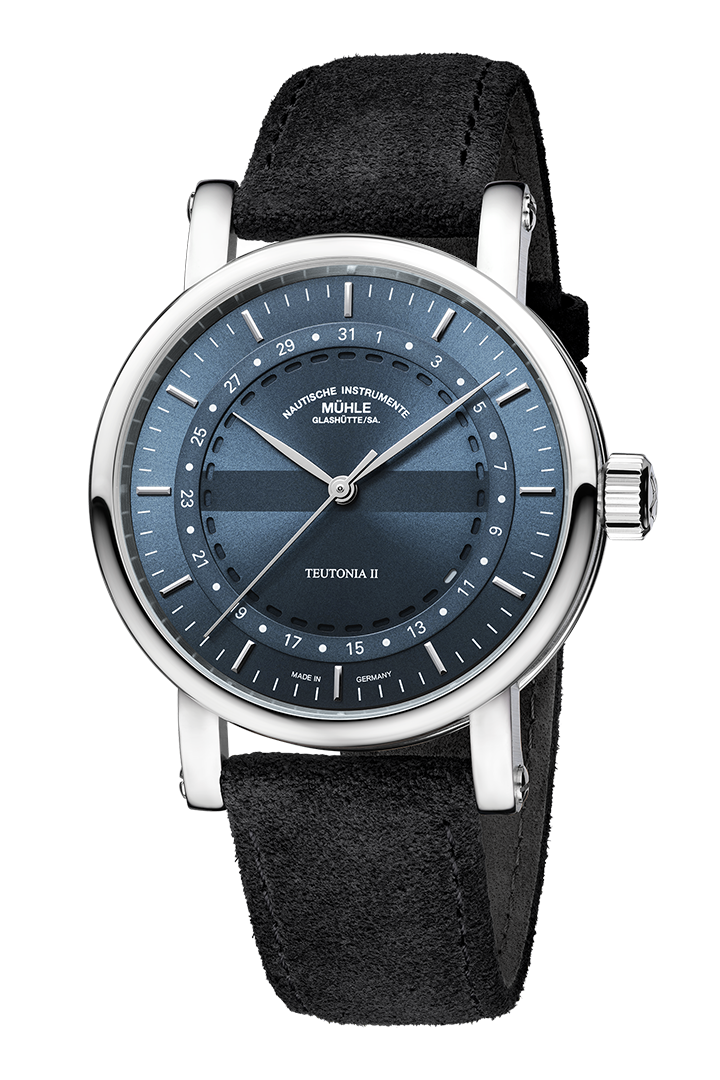
- Reference: M1-33-52-200-AB-I
- Movement: SW200-1 automatic, Mühle version
- Case: 41 mm steel; 10.7 mm thick
- Lug-to-Lug: 51.2 mm
- Water Resistance: 10 bar
- Power Reserve: Up to 41 hours
- Details: Gray-blue dial; slate gray Alcantara strap
- Listed Price: €2,200
- Availability: Listed delivery: 3–4 weeks
The rest of Teutonia II covers Small Second, GMT, Chronograph, Day/Date, Chronometer, and Medium. I would look at the 34mm Medium for a smaller case, or the 39mm Chronometer if independent accuracy certification matters. Mühle identifies the latter’s testing at the Glashütte observatory; that certification should not be assumed for every Teutonia.
Teutonia IV: Moonphase, BlueMoon, And Smaller Cases
My pick from Teutonia IV is the anthracite Moonphase, with gold-colored hands and markers against the darker dial. It is the version I would consider for a dressier watch that still has a little visual warmth. The current gray Alcantara configuration is shown below, with a longer quoted delivery window than most of the other selections.
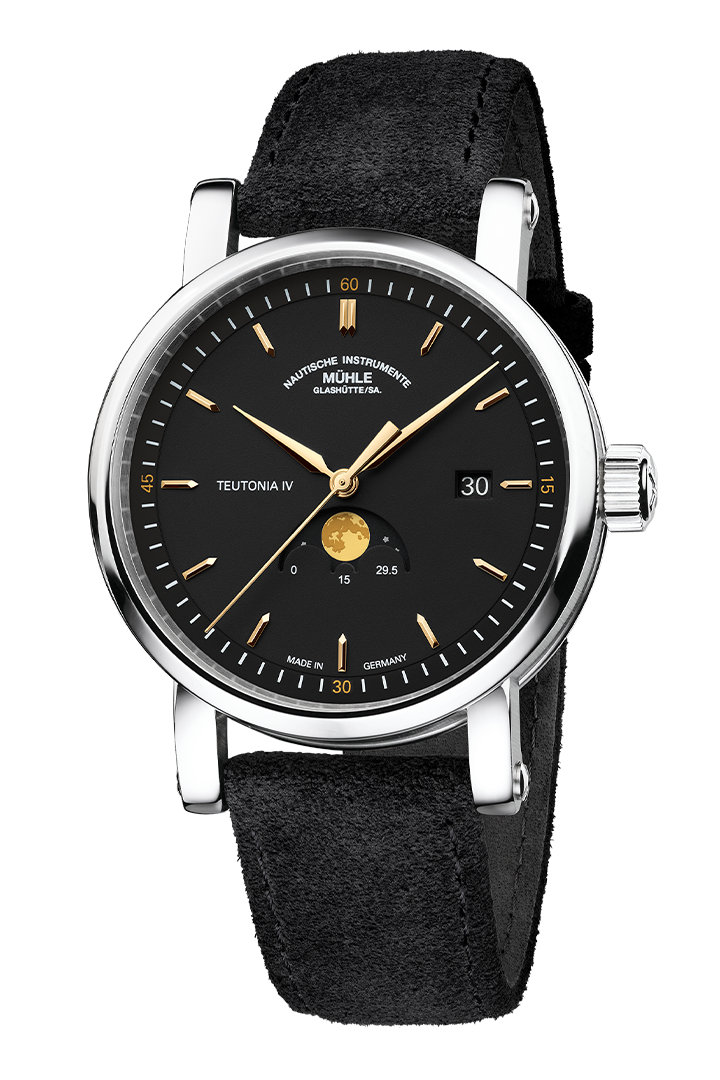
- Reference: M1-44-03-200-AB-I
- Movement: SW280-1 automatic, Mühle version
- Case: 41 mm steel; 12.6 mm thick
- Lug-to-Lug: 51.4 mm
- Water Resistance: 10 bar
- Power Reserve: Up to 41 hours
- Details: Anthracite dial; gold-colored hands; slate gray Alcantara strap
- Listed Price: €2,700
- Availability: Listed delivery: 8–10 weeks
The BlueMoon is a separate 39mm moonphase design, with a different dial layout and SW288-1 movement; it is more than a blue version of this 41mm Moonphase. Small Second and Chronograph cover the other main complications. The 33.5mm IV Lady adds a smaller format, with pastel blue, raspberry, and bicolor versions. I would compare those by size and design preference rather than let the collection’s gender labels decide.
Teutonia Sport: My Racing Green Review
The Sport I and Sport I Clous de Paris bring chronograph timing and motorsport styling to the family. The Sport II takes a different approach, using small seconds and a widened date aperture. Both the regular Sport II and Racing Green are still listed.
The Racing Green is the watch I have spent time with. In my dedicated Teutonia Sport II review, I particularly enjoyed the changing green accents, the asymmetrical dial, and the brown perforated strap. I also found that the broad dial opening and thick strap gave it more presence than the 41.6mm diameter suggested. Its 51.4mm length is worth taking seriously.
My original review identifies the watch as M1-29-74-LB-B. The current brown-strap listing uses M1-29-74-200-LB-B, shown below. I have kept the review’s original reference and price context; this card supplies the current official listing and euro price.
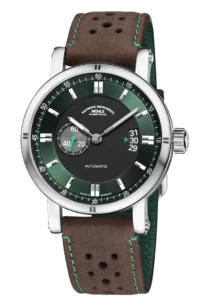
- Reference: M1-29-74-200-LB-B
- Movement: SW290-1 automatic, Mühle version
- Case: 41.6 mm steel; 12.8 mm thick
- Lug-to-Lug: 51.4 mm
- Water Resistance: 10 bar
- Power Reserve: Up to 41 hours
- Details: Black/green dial; brown perforated leather strap
- Listed Price: €2,650
- Availability: Listed delivery: 2–3 weeks
Lunova: Polished Cases And Quiet Dials
The Lunova range is the one I would consider if Teutonia feels too decorative and the tool watches too purposeful. Its polished cases and dark gradient dials give it a quieter look. The four branches are Date, Day/Date, Chronograph, and Lady.
My pick is the Day/Date, partly because the polished titanium case makes an interesting alternative to the steel Date and Chronograph. It is still a 42.3mm watch, so I would not describe it as compact. The 35mm Lunova Lady is the smaller option, while the Chronograph adds timing functions and a thicker case. I would choose the simpler Date if I liked the design but had no use for the weekday.
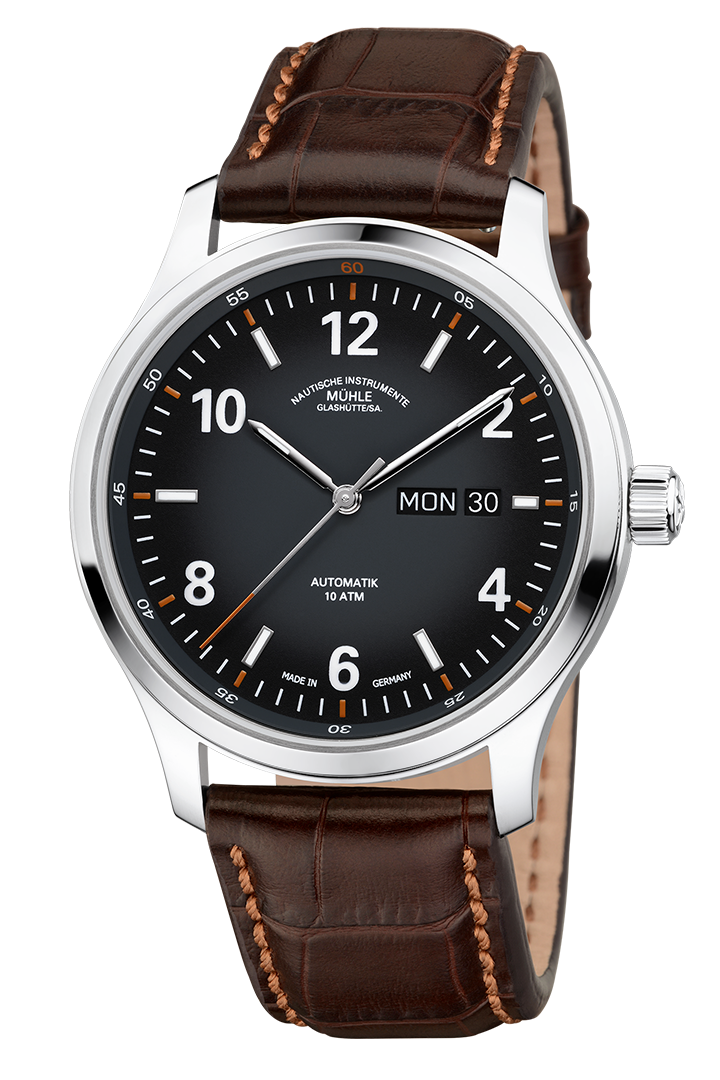
- Reference: M1-43-26-500-LB-I
- Movement: SW220-1 automatic, Mühle version
- Case: 42.3 mm titanium; 11 mm thick
- Lug-to-Lug: 50 mm
- Water Resistance: 10 bar
- Power Reserve: Up to 41 hours
- Details: Black-gray dial; brown crocodile leather strap
- Listed Price: €2,300
- Availability: Listed delivery: 2–4 weeks
Panova: My More Affordable Starting Point
Panova offers the most straightforward introduction to the brand in this guide. The date-free dial leaves room for color, luminous dots, and a clear minute track. Current choices are Blue, Gray, Green, Turquoise Blue, Lime, and Violet, with several leather, textile, and Milanese bracelet combinations across the range.
I would choose Blue on the striped textile strap for its easygoing character. At €1,250, it is the least expensive representative here, while retaining the Mühle-version automatic movement and a 10-bar case. The 40mm diameter is approachable, but its 48.2mm length is still worth comparing with the smaller 29er.
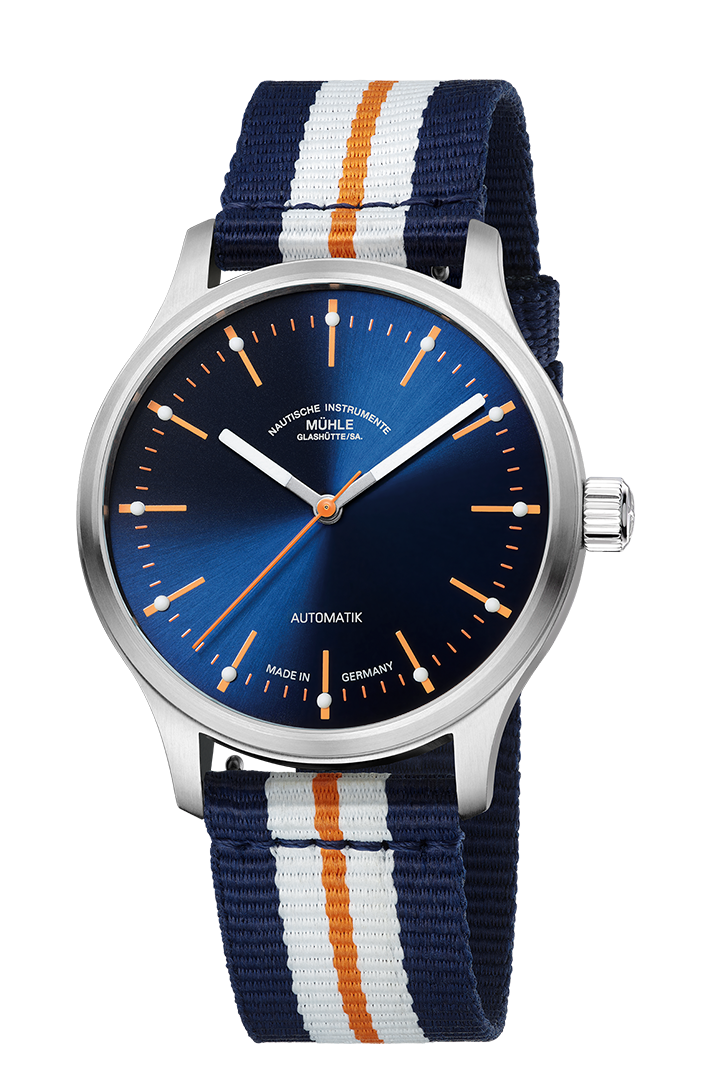
- Reference: M1-40-72-200-NB-I
- Movement: SW200-1 automatic, Mühle version
- Case: 40 mm steel; 10.4 mm thick
- Lug-to-Lug: 48.2 mm
- Water Resistance: 10 bar
- Power Reserve: Up to 41 hours
- Details: Blue dial; blue, orange, and white textile strap
- Listed Price: €1,250
- Availability: Listed delivery: 2–4 weeks
Terrasport: The Traditional Pilot-Watch Choice
The current Terrasport collection centers on the Terrasport II and Terrasport I Chronograph. The II would be my first stop: large numerals, a triangle at twelve, a red seconds hand, and a 40mm case make the design easy to understand.
The 44mm I Chronograph is the alternative if timing functions matter, using the MU9413 with a listed 62-hour reserve. I would try that larger case before ordering. The simpler II is available with black or cream dials, and the black leather configuration below is my representative choice.
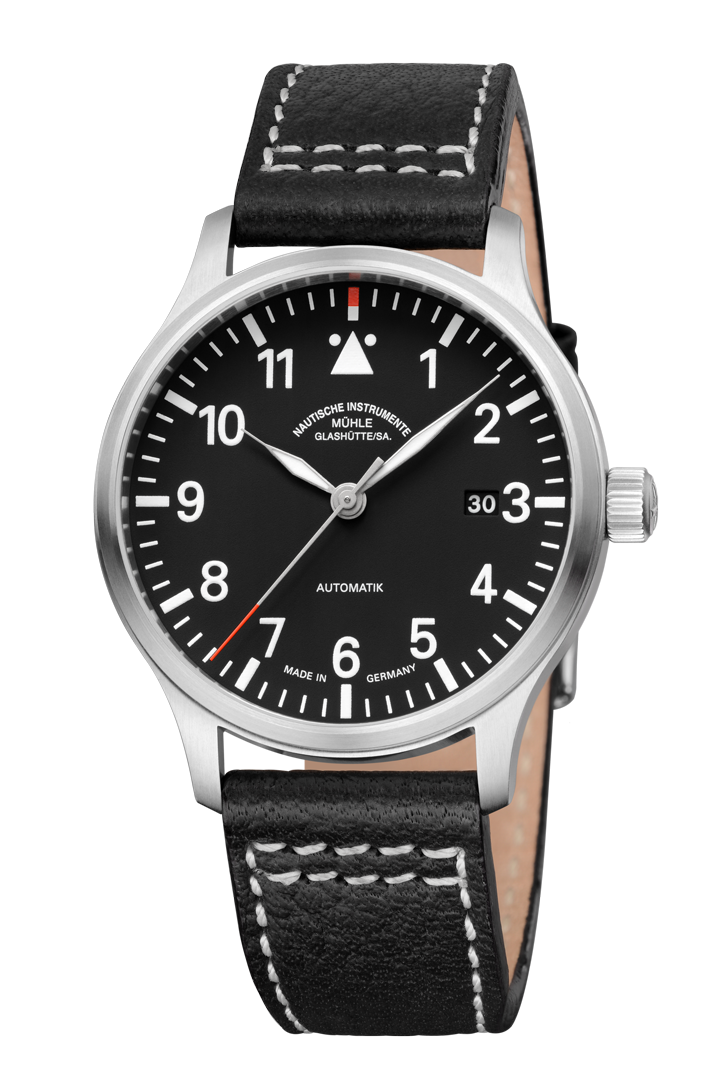
- Reference: M1-37-44-100-LB
- Movement: SW200-1 automatic, Mühle version
- Case: 40 mm steel; 10 mm thick
- Lug-to-Lug: 48.2 mm
- Water Resistance: 10 bar
- Power Reserve: Up to 41 hours
- Details: Black dial; black buffalo leather strap
- Listed Price: €1,500
- Availability: Listed delivery: 2–4 weeks
Special Editions And The Robert Mühle Line
Marinefliegeruhr-I Edition 2026
This watch sits in the official 2026 novelties rather than one of the seven main families. I would still include it on a current shortlist. It revisits the first wristwatch collection from 1996, with a dark blue dial, a special anniversary rotor, and a 300-piece limit.
The combination that interests me is 40mm across, 10mm thick, and 45.5mm long, with a 30-bar rating. Those proportions make it worth comparing with the Terrasport II if a shorter case matters. Its tachymeter-marked bezel does not make it a chronograph; this is a three-hand automatic with a date.
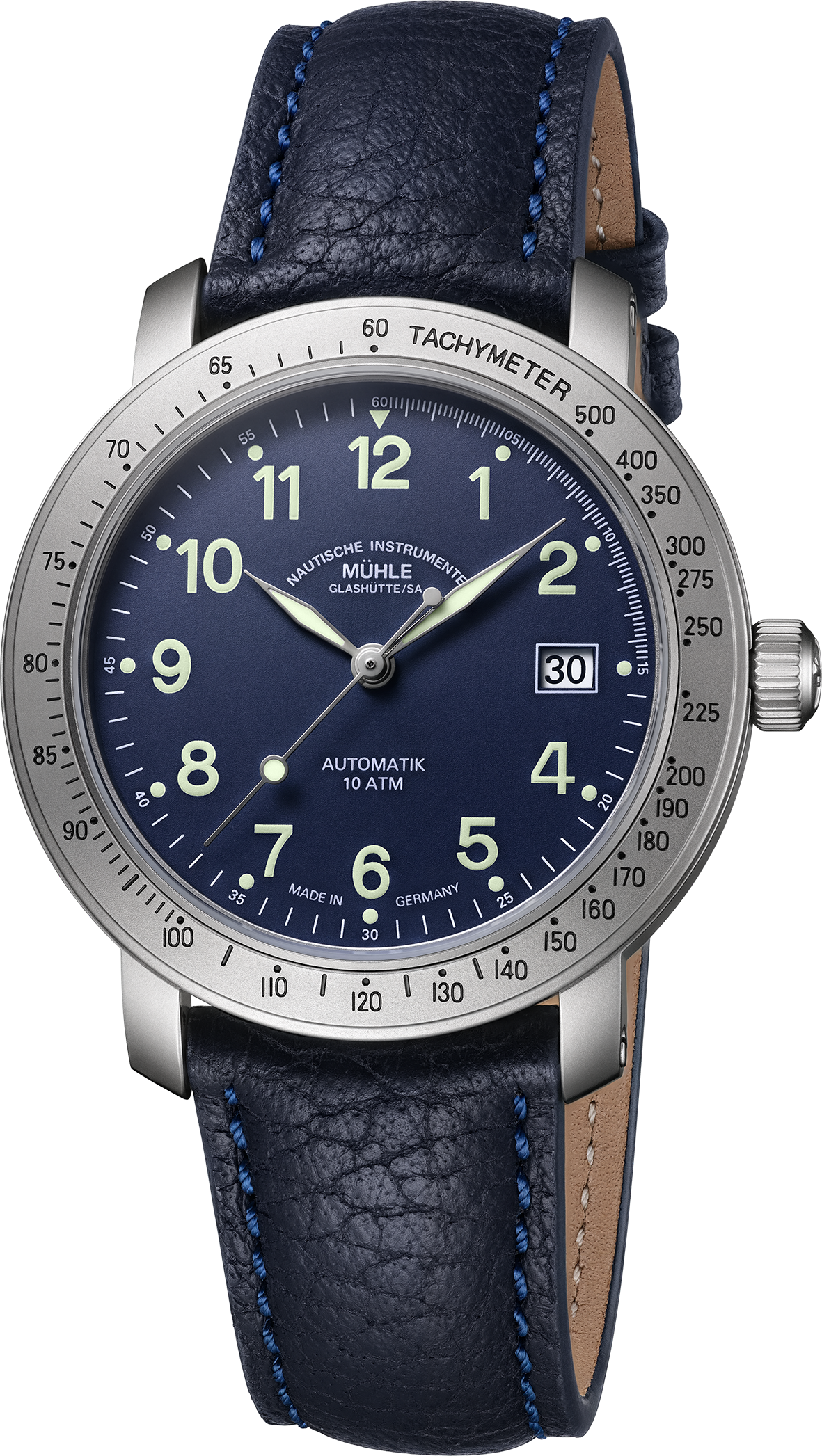
- Reference: M1-30-01-1996-LB
- Movement: SW200-1 automatic, Mühle version
- Case: 40 mm steel; 10 mm thick
- Lug-to-Lug: 45.5 mm
- Water Resistance: 30 bar
- Power Reserve: Up to 41 hours
- Details: Dark blue dial; blue leather strap with folding clasp
- Listed Price: €1,996
- Availability: Listed delivery: 4–5 weeks; limited to 300 pieces
Robert Mühle: Manufacture Watchmaking, With An Availability Caveat
The Robert Mühle manufacture line shows another side of the company: hand-wound calibers, traditional finishing, and complications such as an up/down reserve display, pointer date, and moonphase. The official page covers Kleine Sekunde, Auf/Ab, Auf/Ab Gold, Zeigerdatum, and Mondphase in steel and precious-metal versions.
All seven references on that page were marked sold out at the factory when I checked. I include them to explain Mühle’s watchmaking range, but I would approach a purchase through an availability enquiry or the secondary market rather than present them as current factory stock.
What I Would Check Before Buying
Start with length and thickness. The 42mm Rescue-Timer is shorter than the 41.6mm Teutonia Sport II, while the Sportivo chronographs are considerably thicker than the 29er Casual. Diameter alone can send a buyer toward the wrong watch.
Match the configuration to the price. A bracelet, folding clasp, or different strap can change the total. The 29er Casual package here includes two straps; the Racing Green card is specifically the brown leather version. I would also confirm whether a listed delivery window is realistic for the exact configuration.
Treat accuracy and service claims as the manufacturer’s guidance. Mühle’s FAQ states regulation between zero and +8 seconds per day, recommends a full service every four to five years, and suggests checking water resistance every two years. Those are not measurements from my testing. The same FAQ states a 24-month manufacturer warranty; I would keep the purchase documents and check the applicable terms.
Choose a suitable strap for water. Mühle says its watches rated to at least 10 bar are suitable for swimming, but a leather strap changes the practical equation. I would follow the model’s instructions, make sure the crown is properly secured, and check the condition of the seals rather than rely only on the number printed on a product page.
Which Mühle-Glashütte Would I Choose?
- For the clearest sense of the brand: S.A.R. Rescue-Timer. Its shape and rescue-service background give it a distinctive identity.
- For everyday versatility: 29er Casual. I like the slim case and the option to change between the supplied straps.
- For a lower entry price: Panova Blue. It keeps the design simple and makes color the attraction.
- For a dressier watch: Teutonia II Ring Date or IV Moonphase, depending on which display I would enjoy looking at every day.
- For a smaller wrist: the standard 36.6mm 29er, with the 34mm Teutonia II Medium and 35mm Lunova Lady also worth comparing.
- For my firsthand impressions: Teutonia Sport II Racing Green. That review goes into the dial, strap, and fit in more detail than a brand guide can.
Mühle-Glashütte is most appealing to me when a practical idea gives the watch its character. That might be the Rescue-Timer’s protective case, the 29er’s uncluttered layout, or the Teutonia Sport II’s instrument-like dial. I would start with the design I connect with, check how the case fits, and then choose the complication that earns its place on my wrist.
Frequently Asked Questions
Where are Mühle-Glashütte watches made?
Mühle-Glashütte makes its watches in Glashütte, Germany. Its family history in precision instruments began in 1869; Hans-Jürgen Mühle re-established the modern company in 1994, and wristwatch production followed in 1996.
Does Mühle-Glashütte make its own movements?
The current range includes Swiss base movements modified and finished by Mühle, as well as calibers incorporating its own components and modules. The Robert Mühle manufacture line uses its own hand-wound calibers. I would check the exact movement rather than assume every Mühle watch is entirely in-house.
Which Mühle-Glashütte watch would I recommend first?
I would start with the S.A.R. Rescue-Timer for the brand’s distinctive tool-watch character, Panova for a simpler and less expensive introduction, or 29er Casual for everyday versatility. My dedicated Teutonia Sport II Racing Green review is the best next stop for my hands-on impressions.
Which Mühle watches suit a smaller wrist?
I would compare the 36.6mm 29er, 34mm Teutonia II Medium, 33.5mm Teutonia IV Lady, and 35mm Lunova Lady. For a 40mm option, the Marinefliegeruhr-I Edition 2026 has a relatively short 45.5mm lug-to-lug length. Fit still depends on case shape and strap.
Are all Mühle watches suitable for swimming?
Mühle says its watches rated to at least 10 bar are suitable for swimming, but the strap and condition of the seals matter too. I would use a suitable rubber, textile, or metal strap and follow the exact model’s instructions; leather straps should be kept out of the water.
How long is the Mühle-Glashütte warranty?
Mühle states a 24-month manufacturer warranty from purchase covering production defects under its terms. Normal wear and damage from improper use are excluded. I would keep the purchase documents and confirm the current terms with the seller.