Best First Dive Watches
*By clicking on the product links in this article, we may receive a commission fee at no cost to you. Thank you for your support.
The best first dive watch is not always the cheapest watch with a rotating bezel. A good first diver should be easy to wear, easy to trust, and easy to understand. It should have real water resistance, strong legibility, a reliable movement, and enough design personality to help you learn what you actually like.
That is the angle of this guide. I am not trying to list every affordable dive watch or every famous diver. Instead, this is a practical shortlist for someone buying a first serious dive watch: pieces that can handle swimming and travel, work as everyday watches, and still feel interesting after the first few weeks of ownership.
I also leaned away from watches that are dive-style more than dive-ready. The Seiko 5 Sports SKX-style models are fun entry-level watches, for example, but with 100 meters of water resistance and no screw-down crown, they are not the cleanest fit for a guide built around first real divers.
Best First Dive Watches at a Glance
| Watch | Best For | Movement | Water Resistance | Case Size | Price | My Take |
|---|---|---|---|---|---|---|
| Vaer D4 Meridian Navy Matte Solar | Grab-and-go practicality | Solar quartz | 200 m | 39 mm | $399 | The easiest first diver to live with every day. |
| Vaer D5 Meridian Black Auto | First automatic microbrand diver | Automatic | 200 m | 39 mm | $679 | Compact, clean, and mechanically satisfying without getting fussy. |
| Nautage Diver II Black/Black | Affordable independent diver | Automatic | 200 m | 41 mm | $599 | A strong value pick with a modern, tool-forward personality. |
| Baltic Aquascaphe MK2 Blue | Vintage-inspired sizing | Automatic | 200 m | 37 or 39.5 mm | $630 | One of the best choices if wearability matters as much as specs. |
| Traska Freediver Carbon Black | Enthusiast microbrand quality | Automatic | 200 m | 40.5 mm | $735 | Refined enough to feel like a step up, still approachable enough for a first diver. |
| Certina DS Action Diver 38mm | Compact Swiss diver | Automatic | 300 m | 38 mm | $790 | A true dive watch in a genuinely wearable size. |
| Tissot Seastar 1000 40mm Automatic | Mainstream Swiss automatic | Automatic | 300 m | 40 mm | $875 | The safe Swiss choice if you want strong specs and broad brand recognition. |
| Seiko Prospex Sea SPB317 | First serious Seiko diver | Automatic | 200 m | 41 mm | $900 | Slimmer and more mature than many entry Seiko divers. |
| Mido Ocean Star 39 Black | Refined step-up diver | Automatic | 200 m | 39 mm | $1,000 | A polished daily diver for someone who wants a more elevated feel. |
| Christopher Ward C60 Trident Pro 300 | One-and-done first diver | Automatic | 300 m | 40 mm | $1,095 | The most complete modern all-rounder here. |
| Doxa SUB 200 Sharkhunter | Heritage and color | Automatic | 200 m | 42 mm | $1,290 | A vintage-leaning Swiss diver with real brand history. |
| Hamilton Khaki Navy Frogman Auto 41mm | Hamilton fans | Automatic | 300 m | 41 mm | $1,395 | The Hamilton to choose if you want a real dive spec, not just a nautical look. |
| Victorinox Dive Pro Automatic | Rugged Swiss tool watch | Automatic | 300 m | 43 mm | $1,200-$1,500 | Big, tough, and worth including if durability is high on your list. |
How I Chose These First Dive Watches
For a first dive watch, I care about balance more than extremes. A 1,000-meter professional instrument might be impressive, but it can also be too thick, too heavy, and too expensive for someone still figuring out what they like. A cheaper dive-style watch can be charming, but if it lacks the core durability and water resistance, it may not satisfy the buyer who actually wants a capable diver.
The baseline here is practical: 200 meters of water resistance or better, a legible dial, a timing bezel, reliable movement architecture, and case dimensions that make sense for regular wear. I also gave extra credit to watches with shorter lug-to-lug measurements, thinner cases, solar movements, strong bracelets, and brands with straightforward service or warranty support.
That does not mean every watch here is small or inexpensive. It does mean every pick has a clear reason to exist as a first diver. Some are ideal for smaller wrists, some are stronger value plays, some have better heritage, and a few are worth stretching for if you want to buy one watch and keep it for years.
Quick Buying Advice
If this is your first dive watch, start with fit. Case width gets most of the attention, but lug-to-lug length and thickness usually decide whether a diver feels natural on the wrist. A 39 or 40mm diver with a reasonable lug-to-lug can be dramatically easier to wear than a 43mm watch that looks fine on paper.
Next, decide whether you want quartz, solar quartz, or automatic. Solar quartz is the lowest-maintenance route and makes a lot of sense for a first true tool watch. Automatic movements add charm, but they also need occasional wearing, winding, setting, and eventually servicing. Neither choice is wrong.
Finally, do not buy only for the spec sheet. Water resistance, sapphire crystals, ceramic bezels, and movement names matter, but a first diver should also make you want to wear it. The best one is the watch that teaches you what your second dive watch should be.
Vaer D4 Meridian Navy Matte Solar 39mm
Grab-and-go practicality

- Movement: Solar Quartz
- Caliber: Epson VS42
- Case Width: 39 mm
- Lug-to-Lug Distance: 46 mm
- Water Resistance: 200 m
- Price: $399
The Vaer D4 Meridian Navy Matte Solar is the first watch I would show someone who wants a true dive watch but does not want to babysit a mechanical movement. The 39mm case is approachable, the 46mm lug-to-lug is easy to wear, and the 200 meters of water resistance puts it firmly in real diver territory.
Solar quartz is the key advantage. You get grab-and-go accuracy, long-term convenience, and no need to wind or reset the watch every time it sits for a few days. For a first diver, that matters more than a display caseback or movement decoration.
The D4 also has the right kind of restraint. It looks like a clean tool watch, not a novelty piece. If you want one affordable diver for swimming, travel, weekends, and daily wear, this is one of the easiest recommendations on the list.
Vaer D5 Meridian Black Auto 39mm
First automatic microbrand diver

- Movement: Automatic
- Caliber: Miyota 9015
- Power Reserve: 42 hours
- Case Width: 39 mm
- Lug-to-Lug Distance: 46 mm
- Thickness: 11.9 mm
- Water Resistance: 200 m
- Price: $679
If you want your first dive watch to be automatic, the Vaer D5 Meridian Black is the more enthusiast-minded sibling to the D4. It keeps the same compact-wearing 39mm case profile and 200-meter water resistance, but swaps in a Miyota 9015 automatic movement.
That movement choice makes sense at this level. The 9015 is slim, reliable, widely used, and a clear upgrade over many lower-cost automatic calibers. More importantly, the watch stays thin enough to work as an everyday piece rather than becoming a thick weekend-only diver.
The D5 is the better Vaer if you want mechanical character. The D4 is easier to own; the D5 is more emotionally satisfying. For many first-time mechanical diver buyers, that tradeoff is exactly the point.
Nautage Diver II Black/Black
Affordable independent diver

- Movement: Automatic
- Caliber: Miyota 9039
- Power Reserve: 42 hours
- Case Width: 41 mm
- Lug-to-Lug Distance: 49 mm
- Thickness: 12 mm
- Water Resistance: 200 m
- Price: $599
The Nautage Diver II Black/Black is a strong addition for buyers who want something less obvious than the usual Seiko, Citizen, or Tissot path. It gives you the core first-diver checklist: 200 meters of water resistance, a modern automatic movement, a clean timing bezel, and a price that stays firmly approachable.
The Miyota 9039 is a good fit here because it gives the watch a no-date, enthusiast-friendly character while keeping the total package affordable. At 41mm wide and 49mm lug-to-lug, it is not the smallest watch in this guide, but the 12mm thickness helps keep it from feeling overbuilt.
This is the kind of first diver to buy if you already know you like independent brands. It feels modern, straightforward, and tool-oriented without trying too hard to imitate the classics.
Baltic Aquascaphe MK2 Blue
Vintage-inspired sizing

- Movement: Automatic
- Caliber: Miyota 9039
- Power Reserve: 42 hours
- Case Width: 39.5 mm
- Lug-to-Lug Distance: 47 mm
- Thickness: 12.9 mm
- Water Resistance: 200 m
- Price: $630
The Baltic Aquascaphe MK2 Blue is one of the most tasteful first dive watches because it understands proportion. You can choose a 39.5mm version or a smaller 37mm version, which makes the Aquascaphe unusually friendly to buyers who have struggled with oversized divers.
The design leans vintage without feeling costume-like. The dial is clean, the bezel is handsome, and the overall profile has enough softness to work outside of beach and pool settings. That matters if this is going to be your only sports watch for a while.
The Aquascaphe is not the most aggressively specced watch here, but that is not the point. It is a first diver for someone who wants charm, daily wearability, and a little collector credibility without jumping straight into four-figure pricing.
Traska Freediver Carbon Black
Enthusiast microbrand quality

- Movement: Automatic
- Caliber: Miyota 9039
- Power Reserve: 42 hours
- Case Width: 40.5 mm
- Lug-to-Lug Distance: 48 mm
- Thickness: 11.9 mm
- Water Resistance: 200 m
- Price: $735
The Traska Freediver is an easy watch to recommend because it feels more refined than its price suggests. It has the specs you want in a first serious diver, but the draw is the overall execution: clean proportions, a practical case size, a slim profile, and Traska’s knack for making watches that feel polished without becoming precious.
The 40.5mm case and 48mm lug-to-lug put it in a broad sweet spot. It has enough presence to feel like a dive watch, but it avoids the hockey-puck feeling that can turn people away from the category. The Miyota 9039 also keeps the dial clean and the ownership experience simple.
This is the pick for someone who has already spent too much time on watch forums and wants their first diver to feel a little more enthusiast-approved. It is still practical, but it has more nuance than a basic department-store diver.
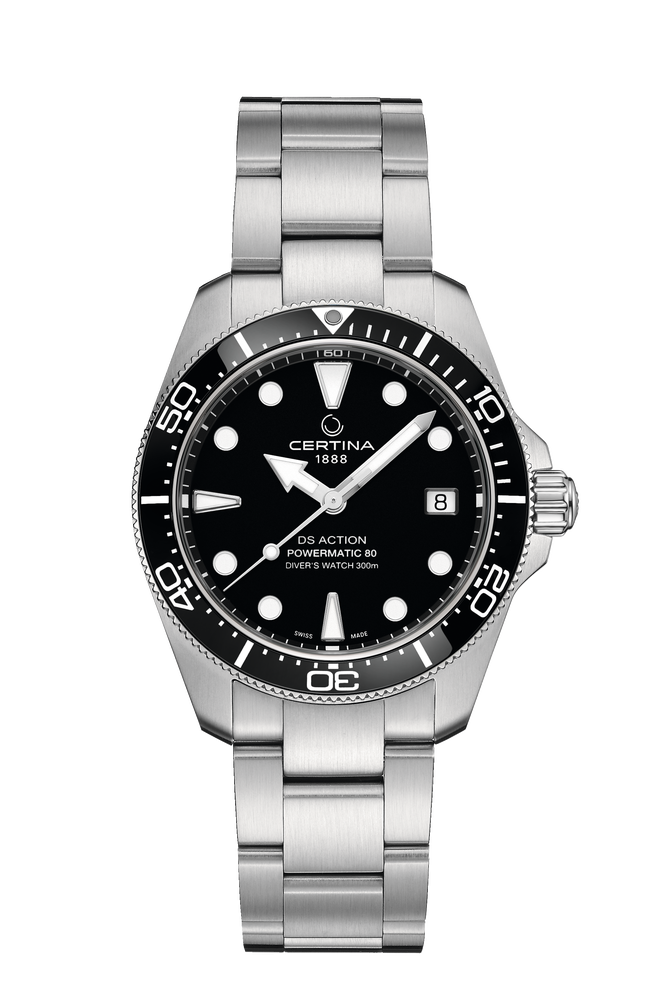
Certina DS Action Diver 38mm Powermatic 80
Compact Swiss diver
- Movement: Automatic
- Caliber: Powermatic 80.611
- Power Reserve: 80 hours
- Case Width: 38 mm
- Thickness: 13.22 mm
- Water Resistance: 300 m
- Price: $790
The Certina DS Action Diver 38mm is one of the cleanest answers to the first-diver problem: it is a real Swiss automatic dive watch, it has 300 meters of water resistance, and it comes in a case size that does not assume every buyer wants a 43mm watch.
The Powermatic 80 movement is another major strength. An 80-hour power reserve is genuinely useful if you rotate watches, travel, or take the watch off for the weekend. It makes the automatic ownership experience more forgiving than many older 38- to 42-hour movements.
This is the best compact Swiss pick in the guide. If you want a dive watch that feels serious but still controlled on the wrist, the 38mm DS Action Diver deserves a very close look.
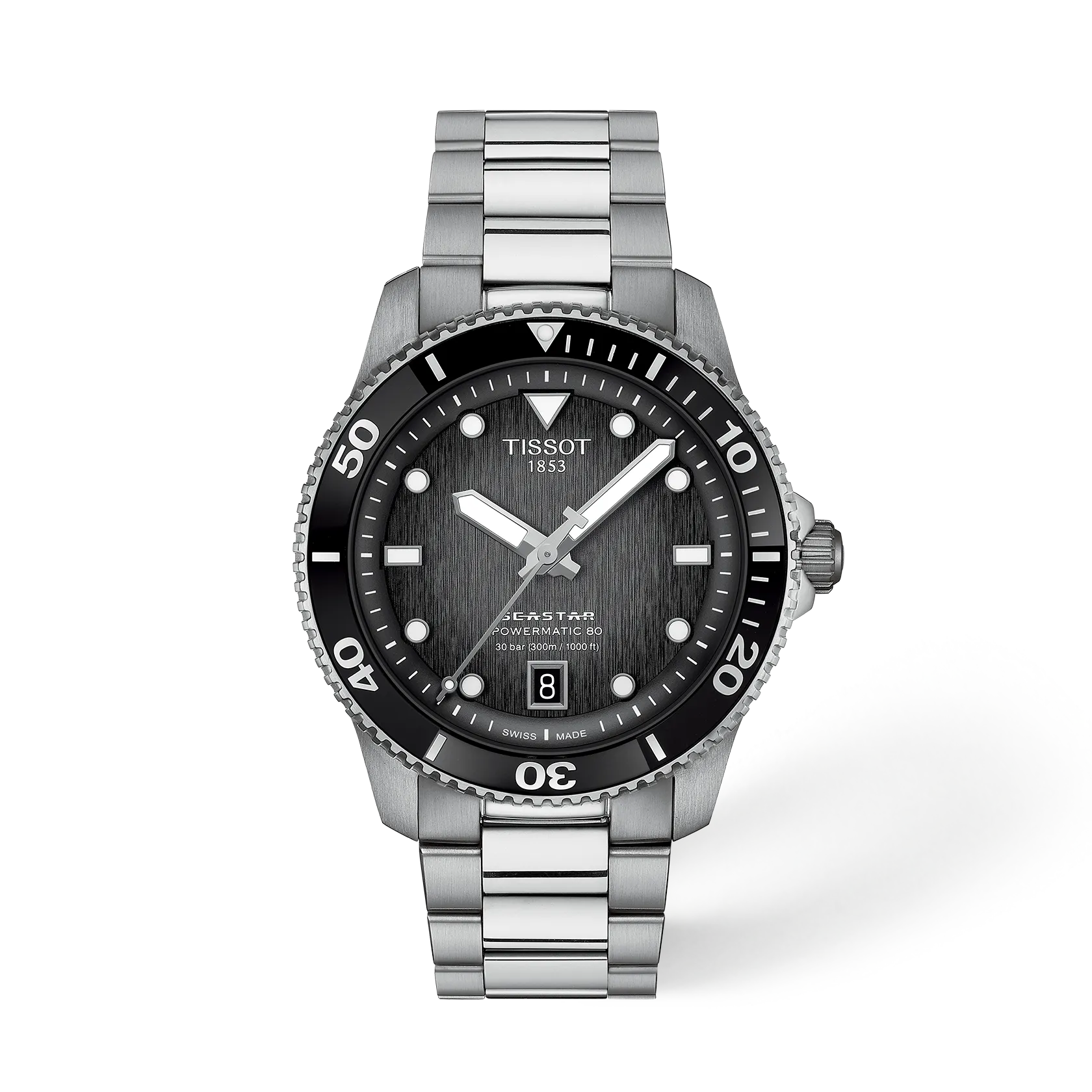
Tissot Seastar 1000 40mm Automatic
Mainstream Swiss automatic
- Movement: Automatic
- Caliber: Powermatic 80
- Power Reserve: 80 hours
- Case Width: 40 mm
- Thickness: 12.48 mm
- Water Resistance: 300 m
- Price: $875
The Tissot Seastar 1000 40mm Automatic is the mainstream Swiss recommendation for a first diver. It gives you a recognizable brand, 300 meters of water resistance, a Powermatic 80 automatic movement, and a case size that is much easier to wear than the older 43mm Seastar models.
For a first-time buyer, Tissot’s strength is reassurance. You are not taking a flyer on an obscure brand, the specifications are strong, and the watch looks modern without being overly aggressive. It is the kind of diver that makes sense as a first nice watch as much as a first dive watch.
It is not the quirkiest or most collector-coded pick here. That is part of the appeal. If you want a straightforward Swiss automatic diver with broad appeal, this is one of the safest choices.
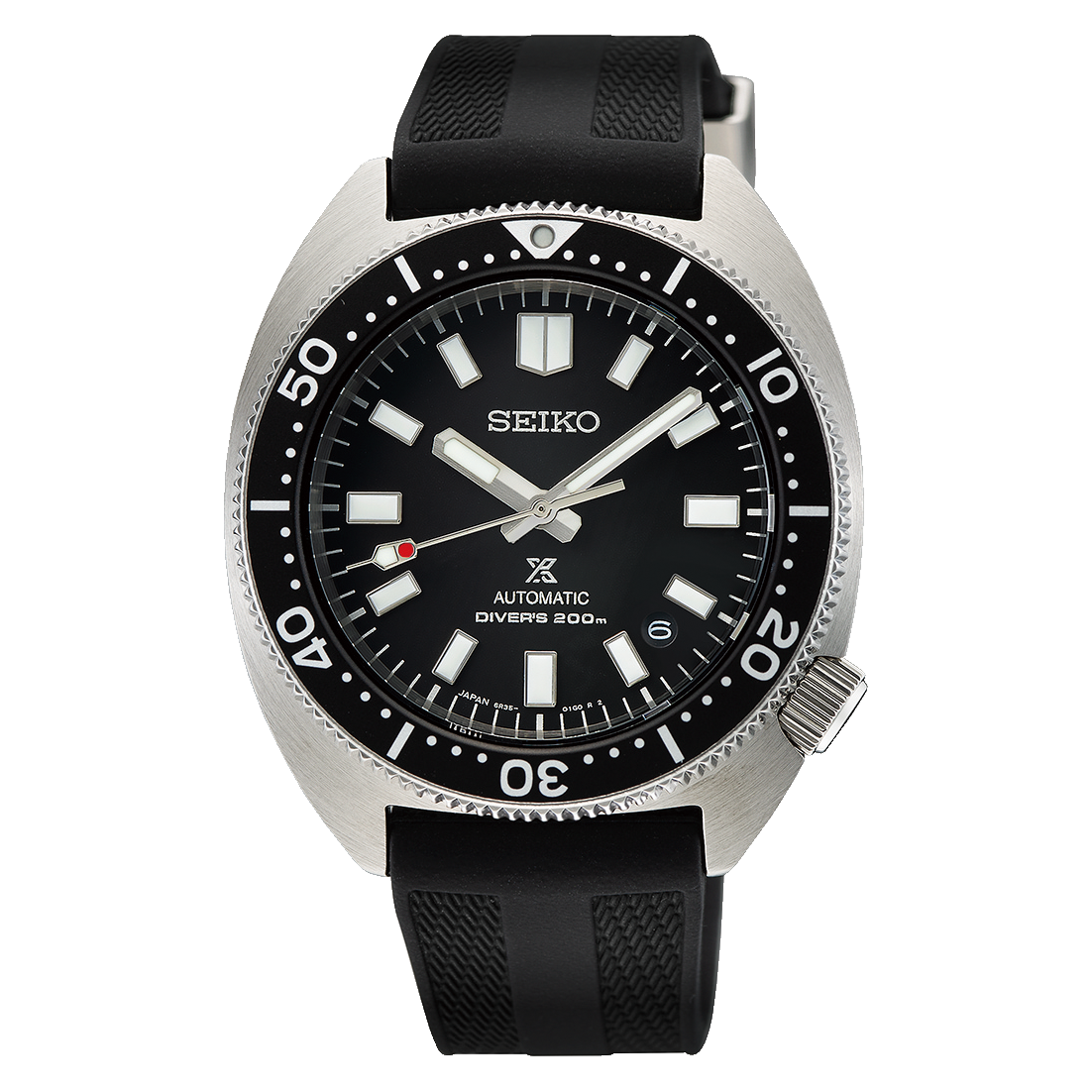
Seiko Prospex Sea SPB317
First serious Seiko diver
- Movement: Automatic
- Caliber: 6R35
- Power Reserve: 70 hours
- Case Width: 41 mm
- Lug-to-Lug Distance: 46.9 mm
- Thickness: 12.3 mm
- Water Resistance: 200 m
- Price: $900
The Seiko Prospex SPB317 is a better first serious Seiko diver than many of the brand’s chunkier options. The case is 41mm wide, but the 46.9mm lug-to-lug and 12.3mm thickness make it wear flatter and more gracefully than the diameter suggests.
This is still recognizably Seiko: practical, legible, slightly toolish, and connected to a long dive-watch lineage. The 6R35 automatic movement gives you a 70-hour power reserve, which is useful if you rotate watches or do not wear it every day.
The SPB317 is not the cheapest way into Seiko divers, but it is one of the better first serious choices if you want the brand’s history without buying something that feels oversized or too entry-level.
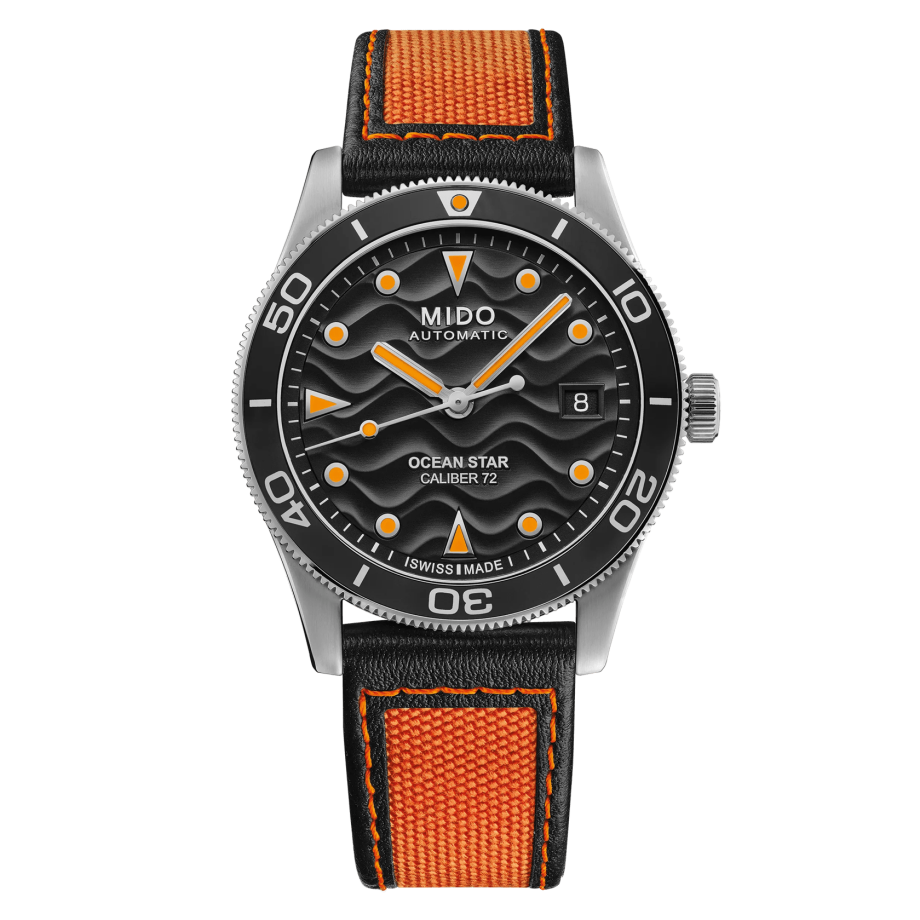
Mido Ocean Star 39 Black
Refined step-up diver
- Movement: Automatic
- Caliber: Mido Caliber 72
- Power Reserve: 72 hours
- Case Width: 39 mm
- Thickness: 10.5 mm
- Water Resistance: 200 m
- Price: $1,000
The Mido Ocean Star 39 Black is the first diver to consider when you want something more refined but still practical. The 39mm case and 10.5mm thickness are excellent numbers for a daily-wear dive watch, and the design is clean enough to work beyond casual settings.
Mido’s Caliber 72 gives you a 72-hour power reserve, which makes the watch easier to live with than many standard automatic divers. The 200 meters of water resistance keeps it credible as a real sports watch, even if the overall feel is more polished than rugged.
This is a strong first diver for someone who already knows they prefer subtlety. It will not shout from across the room, but it looks grown-up, wears well, and has enough Swiss substance to justify stepping past the sub-$1,000 picks.
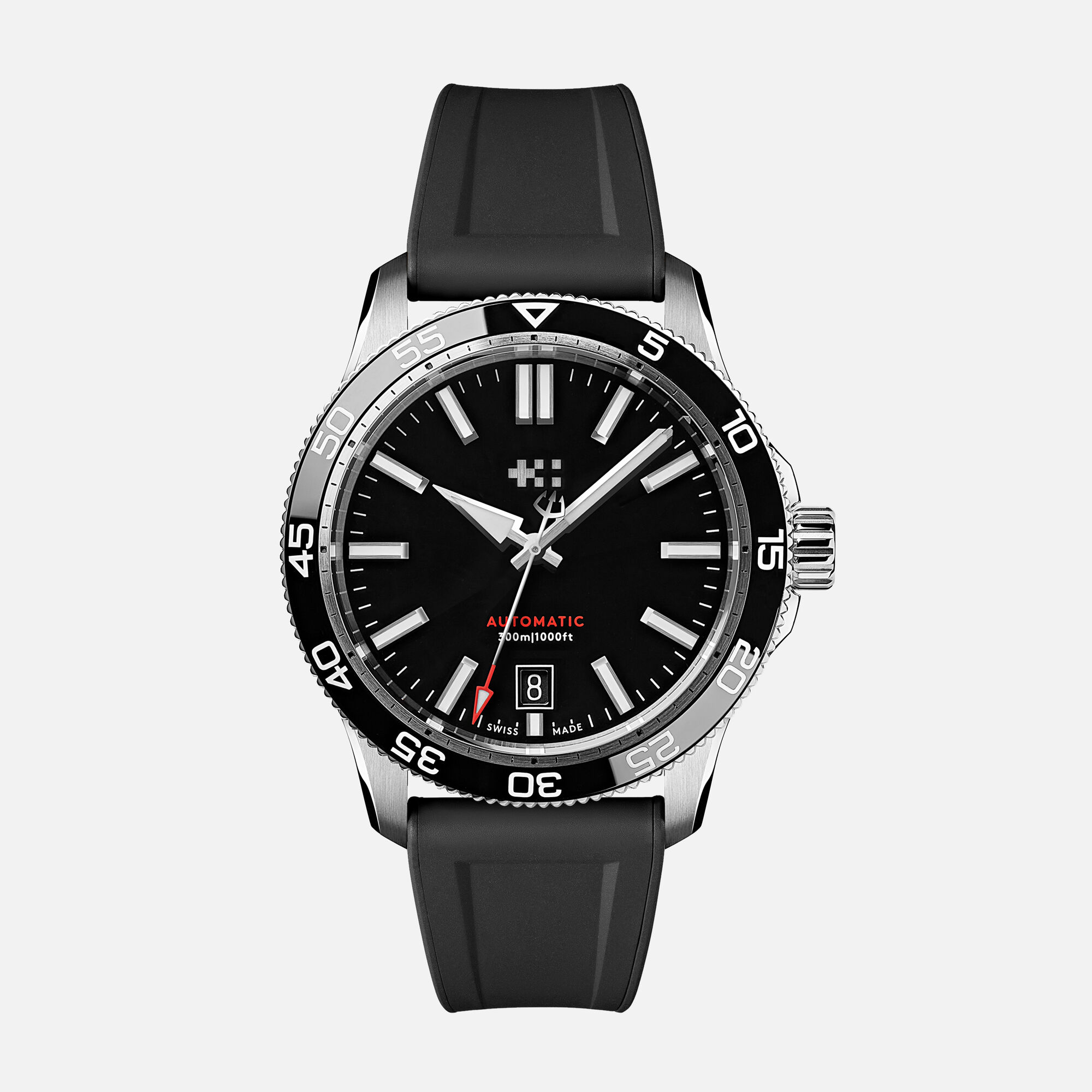
Christopher Ward C60 Trident Pro 300 40mm
One-and-done first diver
- Movement: Automatic
- Caliber: Sellita SW200-1
- Power Reserve: 38 hours
- Case Width: 40 mm
- Lug-to-Lug Distance: 47.45 mm
- Thickness: 11.3 mm
- Water Resistance: 300 m
- Price: $1,095
The Christopher Ward C60 Trident Pro 300 may be the most complete first dive watch in this guide. It has 300 meters of water resistance, a reliable Sellita automatic movement, an impressively slim 11.3mm case, and a 40mm size that lands in the modern sweet spot.
What makes it stand out is how resolved the whole package feels. The finishing, dial layout, bezel action, case profile, and strap or bracelet options all feel like they have been thought through. It is not just a pile of specifications; it is a well-developed watch.
The price is higher than many first-diver recommendations, but this is the one-and-done option. If you would rather buy one strong watch than experiment through three cheaper ones, the C60 Trident Pro 300 is hard to argue against.
Doxa SUB 200 Sharkhunter
Heritage and color

- Movement: Automatic
- Caliber: Sellita SW200-1
- Power Reserve: 38 hours
- Case Width: 42 mm
- Lug-to-Lug Distance: 46 mm
- Thickness: 13.8 mm
- Water Resistance: 200 m
- Price: $1,290
The Doxa SUB 200 Sharkhunter is for the buyer who wants their first diver to come with some history. Doxa has real dive-watch credibility, and the SUB 200 gives you a more accessible way into that world than the brand’s more specialized cushion-case models.
The 42mm case sounds larger than some of the other picks, but the 46mm lug-to-lug keeps it more wearable than the diameter implies. The domed crystal, vintage-inspired shape, and stark black Sharkhunter dial give it a different character from the cleaner modern divers above.
This is not the most conservative first diver, and that is why it works. If you want something Swiss, heritage-rich, and a little more expressive, the SUB 200 is an excellent first step into dive-watch collecting.
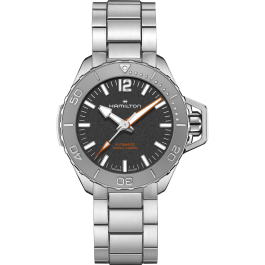
Hamilton Khaki Navy Frogman Auto 41mm
Hamilton fans
- Movement: Automatic
- Caliber: H-10
- Power Reserve: 80 hours
- Case Width: 41 mm
- Thickness: 13.09 mm
- Water Resistance: 300 m
- Price: $1,395
Hamilton has several nautical watches, but the Khaki Navy Frogman Auto 41mm is the one I would include here because it has the actual dive-watch credentials to match the category. The 300 meters of water resistance, H-10 automatic movement, and 80-hour power reserve make it a more serious choice than the smaller Khaki Navy Scuba models with lower water resistance.
The Frogman also has a stronger identity than many entry-level divers. The crown guard design is distinctive, the dial is straightforward, and the case size is large enough to feel purposeful without jumping into the oversized 43- and 46mm territory that can be rough for a first diver.
This is the Hamilton pick for someone who wants the brand name, Swiss-made execution, and real aquatic capability. It costs more than the value picks above, but it earns its place by being the cleanest Hamilton fit for this guide.
Victorinox Dive Pro Automatic
Rugged Swiss tool watch
- Movement: Automatic
- Caliber: Sellita SW220-1
- Power Reserve: 38 hours
- Case Width: 43 mm
- Thickness: 14 mm
- Water Resistance: 300 m
- Price: $1,200-$1,500
The Victorinox Dive Pro Automatic earns a spot in the main list because it is exactly the kind of watch some first-time diver buyers are actually looking for: sturdy, Swiss-made, highly legible, and built with a more rugged personality than the slimmer desk-divers above.
The case is the main caveat. At 43mm wide and 14mm thick, this is not the most universal fit in the guide, and smaller wrists may be better served by the Certina, Vaer, Baltic, or Mido. But if you like a more substantial watch, the size feels aligned with the tool-watch brief rather than accidental.
What makes the Dive Pro appealing is its clarity of purpose. The 300 meters of water resistance, automatic Sellita movement, and hard-wearing Victorinox identity make it a practical first diver for someone who wants toughness first and refinement second.
Watches I Considered But Would Keep Secondary
The Vaer DS2 Meridian is a very good budget option if you want to stay closer to $250, but its 150 meters of water resistance makes it feel more like a capable everyday sports watch than the core first-diver standard I used here.
The Tissot Seastar 1000 40mm Quartz is also worth considering. It has 300 meters of water resistance, a thin case, and a lower price than the automatic version. I focused on the automatic because it better fits the “first serious watch” brief, but the quartz model may be the smarter buy for pure practicality.
The Baltic Aquascaphe Classic Black Gilt is another strong option if you prefer warmer vintage styling. I chose the MK2 Blue because the 37mm and 39.5mm sizing options make it especially useful for first-time buyers.
FAQ
What makes a good first dive watch?
A good first dive watch should be wearable, legible, water resistant, and easy to own. For most buyers, that means 200 meters of water resistance or more, a timing bezel, a reliable quartz, solar, or automatic movement, and dimensions that work for daily wear.
Should my first dive watch be automatic or quartz?
Automatic is more traditional and more emotionally satisfying if you like mechanical watches. Quartz or solar quartz is more accurate, lower-maintenance, and easier to grab when you are heading out the door. For a first diver, solar quartz is often the most practical choice, while automatic is the more enthusiast-oriented choice.
Is 100 meters of water resistance enough for a dive watch?
For swimming and casual water use, 100 meters can be enough if the watch is in good condition and the crown is secure. For this guide, though, I focused on 200 meters or more because that is a cleaner baseline for a first real dive watch.
What is the best first dive watch under $500?
The Vaer D4 Meridian Solar is my favorite under $500 because it combines 200 meters of water resistance, a wearable 39mm case, and a low-maintenance solar quartz movement. It is practical in exactly the way a first dive watch should be.
What is the best first automatic dive watch?
The Christopher Ward C60 Trident Pro 300 is the strongest one-and-done automatic pick, while the Vaer D5 Meridian and Certina DS Action Diver 38mm are better if you want to keep the price lower. The right choice depends on whether you prioritize value, compact sizing, or overall refinement.
What size dive watch should I buy first?
Most people should start around 38 to 41mm, with a lug-to-lug measurement under about 49mm if possible. That range usually gives you enough dive-watch presence without making the watch feel bulky or awkward for everyday wear.