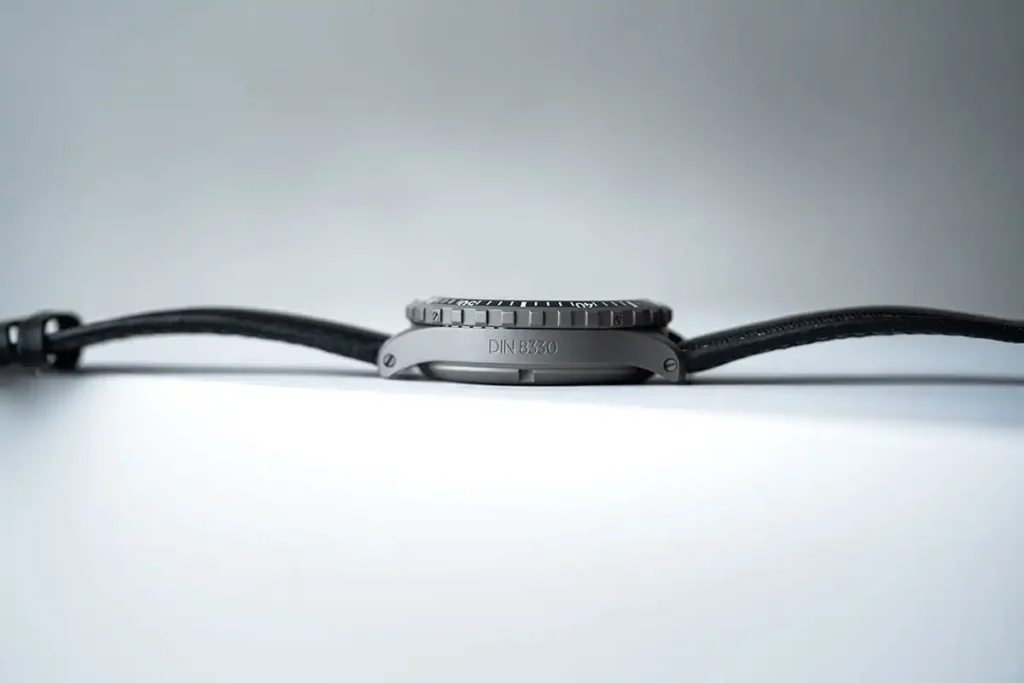
In 2024, Laco – a German brand with nearly a century of pilot watch heritage – introduced the “Hamburg” line of watches as the first to meet the rigorous DIN 8330 standard for aviator timepieces. The Laco Hamburg DIN 8330 is a modern tool watch that bridges old-school cockpit instrument design with cutting-edge engineering. It pays homage to Laco’s WWII-era pilot watches (think bold Arabic numerals and the classic flieger triangle at 12 o’clock) while packing serious professional credentials: anti-magnetic shielding, extreme shock/vibration resistance, a sapphire crystal with double anti-reflective coating, 20 ATM water resistance, and a hardened case built from 904L stainless steel. In essence, it’s a pilot’s watch that has been officially certified to handle the same abuses as an aircraft’s on-board instruments, from brutal G-forces to cockpit fuel fumes. Yet for all this fortification, Laco’s Hamburg remains surprisingly wearable day-to-day. On the wrist, it doesn’t feel like an overbuilt gimmick; it feels purpose-built but ergonomic and highly legible – an excellent “go-anywhere” tool watch even outside of a cockpit. Let’s take a deep dive into the details of the Hamburg DIN 8330 and see how it performs in the real world.

*By clicking on the product links in this article, we may receive a commission fee at no cost to you. Thank you for your support.

Specs:

  • Ref #: 862164
  • Movement: Automatic
  • Caliber: Sellita SW200-1 (Top Grade)
  • Power Reserve: 38 hours
  • Case Width: 43.5 mm
  • Lug-to-Lug Distance: 49.8 mm
  • Price: Around $2,000

Hamburg DIN 8330: Overview

The Laco Hamburg DIN 8330 makes its intentions clear at first glance. The case is utilitarian in the best way possible – 43.5 mm of dark sandblasted steel that practically absorbs light, eliminating reflections in the cockpit. This matte gray finish, along with the watch’s squat, wide stance, gives it a no-nonsense, almost stealth-fighter presence on the wrist. The dial layout reinforces the tool-watch vibe: aside from a discreet Laco logo and a small date window, everything is oriented toward immediate legibility and function. Bold white numerals at 3, 6, and 9 o’clock and the iconic twin-dotted triangle at 12 dominate the matte black dial, just as they did on Laco’s 1940s Beobachtungsuhren (“B-Uhr”) pilots’ watches. In keeping with those WWII designs, the Hamburg’s dial is refreshingly uncluttered by text or ornament – there are no flashy colors or unnecessary complications here. Instead, Laco has built a watch that looks and feels like a legitimate cockpit instrument, one that could plausibly be found strapped to a pilot’s thigh or used as a backup should the avionics fail.

Despite its certification for professional aviation use, the Hamburg DIN 8330 isn’t some unwearable hulking monster. Yes, it’s a large watch, but thanks to a reasonable lug-to-lug span of ~50 mm and downward-curving lugs, it sits securely even on my medium-size wrist. The weight (about 102 g on its strap) is enough to feel substantial without ever becoming a burden. Laco clearly put thought into ergonomics – the crown is positioned at 3 o’clock with protective guards, so it doesn’t dig into your hand, and the included strap is pliable and comfortable (more on that later). Overall, the initial impression is that of a serious, professional-grade pilot’s watch that, somewhat surprisingly, is perfectly at home in everyday scenarios. It’s not often you can say a watch tested to withstand jet cockpit conditions can also be your casual daily driver, but the Hamburg DIN 8330 pulls it off. In short, Laco has managed to deliver a wrist-worn instrument that’s tough as nails yet entirely practical for daily wear.

Dial and Legibility

laco-fliegeruhr-hamburg-din-8330-862164-dial

One of the first things you notice about the Hamburg DIN 8330 is how purpose-built the dial is for quick, error-free reading. The base dial is a matte black soft-iron plate (which doubles as a magnetic shielding element) that completely avoids glare. There’s no glossy finish or sunburst effect – just flat black, as it should be on an instrument meant to be read at a glance under bright sunlight or dim red cockpit lighting. The high-contrast markers stand out starkly against this backdrop: Laco uses crisp white Arabic numerals and indices filled with Super-LumiNova C1 lume. Notably, they didn’t print numerals all around the dial – only the critical cardinal positions (3, 6, 9) get oversized numbers, while simpler line markers denote the other hours. At 12 o’clock, the traditional pilot watch “flight triangle” with two dots is present, providing intuitive orientation of the dial in low-light conditions.

Laco’s attention to legibility goes beyond just lume and font size. They’ve deliberately minimized any dial text or bright branding that could distract the eye. In fact, both the Laco logo and the date display are printed in a muted grey hue rather than stark white. This is a thoughtful touch: at a quick glance, your eye gravitates to the white hands and numerals, not to the brand name or date. The date window itself is at the 4 o’clock position, a somewhat unusual placement chosen so as not to replace or disrupt any of the primary hour markers. The date is fairly small and non-obtrusive; with its dark background and grey numerals, you might not even notice it’s there until you need it. This subdued approach keeps the dial balance intact and maintains focus on the time-telling essentials – exactly what you want in a critical tool watch.

The handset on the Hamburg is also designed for maximum clarity. Both the hour and minute hands are broad, sword-shaped pointers with white frames and luminescent fill. Against the black dial, they are extremely easy to differentiate at a glance. The minute hand stretches almost to the edge of the minute track, while the hour hand is shorter and chunkier – there’s no confusion between the two. The seconds hand is a thin stick with a lumed tip, sweeping around the perimeter. When you consider everything as a whole, the dial and hands adhere to a form-follows-function philosophy reminiscent of aircraft gauges.

Bezel and Functionality

Unlike traditional flieger watches, the Hamburg DIN 8330 features a rotating timing bezel, underscoring its mission as a true all-purpose tool watch. This 60-minute bezel is engineered with as much care as the rest of the watch. First, it’s crafted from ceramic, which is highly scratch-resistant – an important quality if you’re frequently banging the watch against cockpit surfaces or cockpit tools. The insert has a full luminous scale: bold Arabic numerals at 10-minute intervals (with marks for the in-between minutes) are all filled with Super-LumiNova C1, just like the dial.

Crucially for a pilot’s needs, the bezel is bidirectional with a precise ratcheting action, meaning you can rotate it either clockwise or counter-clockwise as needed. This is different from a dive watch’s one-way bezel; in aviation timing situations (which aren’t about tracking oxygen reserves), being able to adjust timing forward or backward is super convenient. The bezel action is satisfyingly solid, with no play – it has a distinct click at each minute so you can count minutes by feel if you can’t look down. The edge of the bezel is deeply notched with a “gear tooth” profile that’s easy to grip. Fun fact: Laco explicitly designed the bezel and its grip for operation with pilot gloves on.

Case and Build Quality

laco-fliegeruhr-hamburg-din-8330-862164-case

The case material is a standout: Laco chose 904L stainless steel, a grade of steel known for its exceptional resistance to corrosion, heat, and saltwater. This is the same high-end alloy used by Rolex in its sports models, and it’s a step above the 316L steel used in most watches. In practical terms, that means the Hamburg’s case is less likely to corrode if exposed to jet fuel or sea water (remember, DIN 8330 testing includes exposure to typical aviation fluids), and it offers increased hardness and durability against wear and abrasion. Now, this is not necessarily a feature most of us will need on a daily basis, but it’s good to know what our watch is capable of.

 The entire case is finished in a dark gray sandblast that not only kills reflections but also gives the watch a tactical, utilitarian aesthetic. Run a finger over the surface and you’ll find it consistently smooth and non-reflective – no polished bezels or shiny case sides here.

With a 43.5 mm diameter and 13.6 mm thickness, the Hamburg is certainly a beefy watch, but it’s built in proportion. The lugs are on the shorter side and curve down nicely, keeping that ~50 mm lug-to-lug span manageable.
The crown is screw-down and flanked by chunky crown guards that flow out of the right side of the case. This is a departure from vintage pilot watches (which often had big “onion” crowns and no guards), but it makes sense here. The screw-down crown helps ensure the watch’s 200 m (20 ATM) water resistance and prevents dust or moisture from entering at high altitudes or during sudden pressure changes. The crown guards, meanwhile, protect against impacts – a necessary design choice for passing the shock and impact tests of DIN 8330. Despite the guards, the crown is easy to grasp thanks to deep fluting. Unscrewing it and winding or setting the time is a breeze; the crown action is smooth, with Laco’s threading feeling secure and precise.

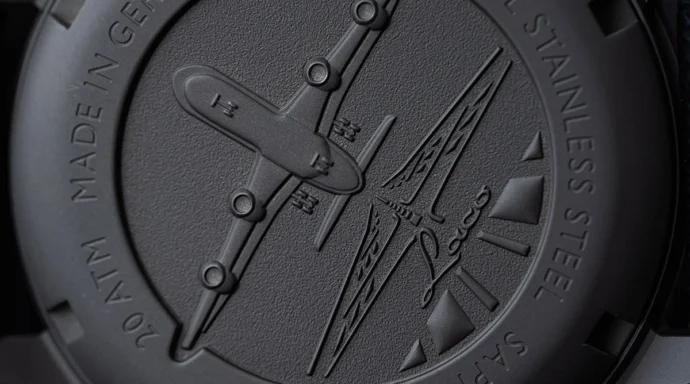
Flipping the watch over, you’ll find a solid screw-in caseback engraved with an airplane relief. The embossed aircraft design is a nice nod to the watch’s aviation purpose without being overly flashy. There’s no display window here – understandably, since a sapphire caseback could compromise magnetic shielding. Instead, the Hamburg’s innards are wrapped in a soft-iron cage for anti-magnetic protection.

laco-fliegeruhr-typ-c-hamburg-din-8330-862164-back-slide

Strap and Wearability

The Hamburg DIN 8330 comes fitted with a black “Nytech” strap, which is as suited to the watch’s mission as the rest of its components. At first glance, it looks like a classic pilot watch leather strap. However, the material is a modern high-tech synthetic rather than traditional leather. The top surface is Nytech – a textile-like, water-resistant fabric – while the underside is a supple rubber layer for comfort. You can literally take this strap through a downpour or rinse it off after a sweaty hike, and it won’t deteriorate the way an untreated leather strap might. Laco lightly pads the strap, so it has a bit of cushion on the wrist without feeling overly bulky.

One immediately noticeable feature is how securely the strap is attached. Laco uses screwed strap bars instead of spring bars, which eliminates any worry of a bar compressing or breaking under stress. This is part of meeting the DIN 8330 strap safety test, where the watch is yanked and tugged to ensure it won’t separate from the strap. In daily wear, that means you can snag the watch on something without instant panic. That said, if you do want to change straps, be prepared for some effort – those screws are likely set in tight.

On the wrist, the Nytech strap breaks in quickly. It’s softer out of the box than a thick leather pilot strap would be. The underside’s rubbery finish prevents it from absorbing sweat and also helps it grip your wrist slightly so the watch doesn’t slide around. The 20 mm width might seem narrow for a 43.5 mm watch, but the visual effect is that the case looks even more like an instrument (the slim strap almost disappears from top view). Comfort-wise, I wore the Hamburg for hours on end with zero irritation; the strap’s edges are neatly finished and the interior rubber is smooth against the skin.

Movement and Performance

The Hamburg DIN 8330 is powered by Laco’s caliber Laco 200, which is essentially a top-grade Sellita SW200-1 automatic movement. This is a well-known Swiss workhorse caliber used in many mid-to-high end watches, chosen here for its reliability and ease of service – an important consideration for a watch meant to be a long-term professional instrument. In standard form, the SW200 ticks at 28,800 beats per hour (4 Hz), has 26 jewels, and a power reserve of roughly 38 hours.

The movement features hacking seconds and hand-winding, as expected. Hacking (stop-seconds) is particularly useful in aviation, where synchronizing watches to the exact second can be crucial for timing maneuvers. The crown action for winding and setting is precise; when you unscrew and pull the crown, there’s a reassuring click into each position (winding, date, time) and the hands stop dead for exact setting. 

While the SW200 isn’t an exotic or high-horology movement, it is absolutely the right choice here. Its proven robustness under shock and vibration is essential – DIN 8330 testing put this movement through punishing vibrational forces and impacts, far more than a typical watch would ever see, and it came out unscathed and still keeping time.

Specs:

  • Ref #: 862164
  • Movement: Automatic
  • Caliber: Sellita SW200-1 (Top Grade)
  • Power Reserve: 38 hours
  • Case Width: 43.5 mm
  • Lug-to-Lug Distance: 49.8 mm
  • Price: Around $2,000

Pricing and Value

The Laco Hamburg DIN 8330 carries a retail price of around $2,170 USD for the standard three-hand model. That places it in an interesting position in the market. On one hand, ~$2.2k is a substantial sum for a time-and-date watch from a brand like Laco, which is often known for more affordable pilot watches. In fact, Laco’s own basic pilot models (with Miyota movements and without frills) can be had for a few hundred dollars, and their non-certified Swiss-powered pilot watches tend to run around $1,000–$1,400. However, comparing the Hamburg DIN 8330 to those watches isn’t apples-to-apples – this is not just a styling exercise, but a thoroughly over-engineered instrument. The premium in price directly reflects the premium in specification. You’re getting a Top Grade Swiss movement, a 904L steel case, a ceramic bezel, a sapphire crystal with dual AR, 200 m dive-level water resistance, and the extensive (and expensive) testing and certification process of DIN 8330. In that light, the price begins to look quite justified.

When looking at competitors or alternatives, it becomes clear that the Laco Hamburg is in a bit of a class of its own. Sinn, the German brand famous for tool watches, spearheaded the predecessor TESTAF standard and had models like the Sinn 857 UTC that met those pilot tests. But as of now, Sinn has no current DIN 8330-certified watch in its catalog (their earlier certified models were discontinued), which effectively leaves Laco as the only game in town for a officially DIN-certified pilot watch in 2025.

If we broaden the scope to “tool pilot watches” in general (ignoring formal certification), there are certainly other options: for example, Sinn’s 106 has a very similar look and feel, and offers excellent anti-magnetic and shock-resistant properties at somewhat lower prices.

All told, Laco has priced the Hamburg DIN 8330 fairly in my opinion. It’s expensive relative to a fashion-oriented pilot watch, but a good deal for what it delivers: truly military-grade build and a unique bragging right. In the hierarchy of tool watches, I’d say it offers a lot of bang for the buck, especially when you compare it to Swiss luxury pieces that cost more and do less.

Takeaway and Final Thoughts

laco-fliegeruhr-hamburg-din-8330-862164

I can confidently say that Laco has knocked it out of the park with this one. This watch set out to meet an extremely high bar – essentially to be as tough and reliable as a certified cockpit instrument – and it lives up to that promise in every way. What’s impressive is how wearable and down-to-earth the Hamburg remains, despite its hardcore specs. It still serves as an excellent tool watch for daily wear because it is well-made, ergonomic, and offers excellent readability. Laco managed to build a watch that geeks out on engineering and performance, yet never forgets the basics of good watch design. The dial is clean and legible, the lume is fantastic, the bezel and crown are satisfying to use, and the watch looks darn good in a utilitarian, form-follows-function sort of way.

Are there any downsides or areas for improvement? Very few, and mostly minor. The 43.5 mm size will be too large for some – there’s no getting around that. A mid-40s case is historically appropriate for a B-Uhr style pilot watch (those were often 55 mm!), but I could see Laco potentially exploring a slightly smaller DIN 8330 model in the future for those who want the same toughness in a more compact package. The other potential “wish list” item is a stainless steel bracelet option. While I appreciate the Nytech strap (especially for active use), a matching bracelet would broaden the watch’s versatility and appeal to the dive-watch crowd who might consider this as an alternative.

In the grand scheme, the Laco Hamburg DIN 8330 is a unique and commendable achievement. It brings the pilot watch on par with the diver’s watch in terms of having a defined performance standard, and it gives consumers a tangible measure of quality to point to. For the German watch industry, it’s also a statement: it shows that a brand known for its history can also innovate and lead in modern standards. As someone who (obviously) loves watches, that’s the kind of stuff I find exciting.

Specs:

  • Ref #: 862164
  • Movement: Automatic
  • Caliber: Sellita SW200-1 (Top Grade)
  • Power Reserve: 38 hours
  • Case Width: 43.5 mm
  • Lug-to-Lug Distance: 49.8 mm
  • Price: Around $2,000

Other Watch Reviews

DiveSport_Titan_Taucheruhr_1-scaled-de-tr-pt_cover

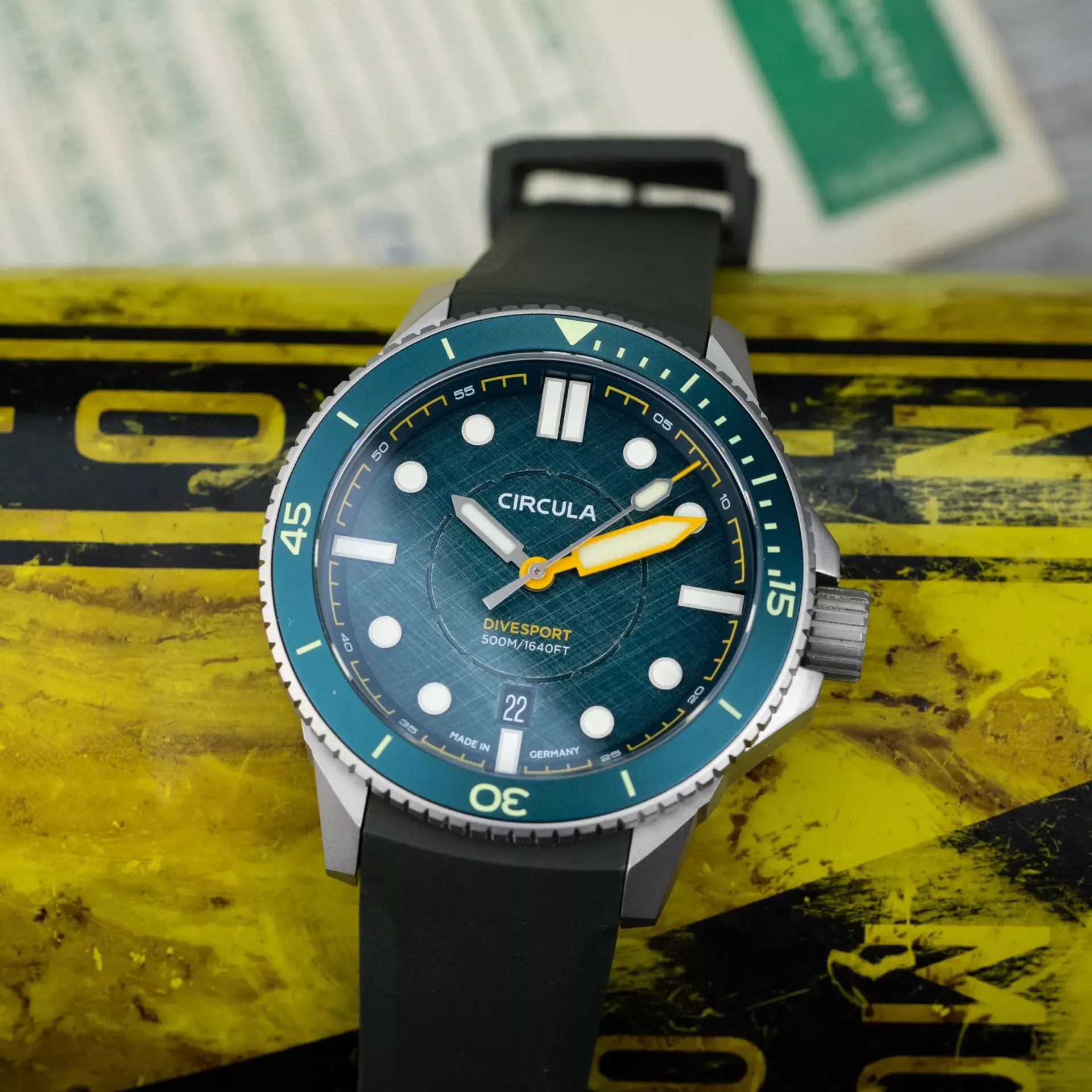
Circula DiveSport Titanium Petrol In-Depth Review

The Circula DiveSport Titanium Petrol has genuinely impressed me as an enthusiast looking for a tough, unique diver. It takes a different path than many microbrand divers by focusing on over-engineered capability and community-driven design rather than vintage homage. The result is a watch that feels purposeful and fresh. In a sea of dive watches, the DiveSport manages to carve its own identity – from that scratch-pattern dial to the two-tone lume and hardened titanium build, it doesn’t come across as a cookie-cutter design at all.
Read More »

The Watch Resource is an independent watch review site founded in 2021, where a team of watch enthusiasts works tirelessly to create educational buyer’s guides and insightful reviews.

© 2023 All rights reserved​

Newsletter